
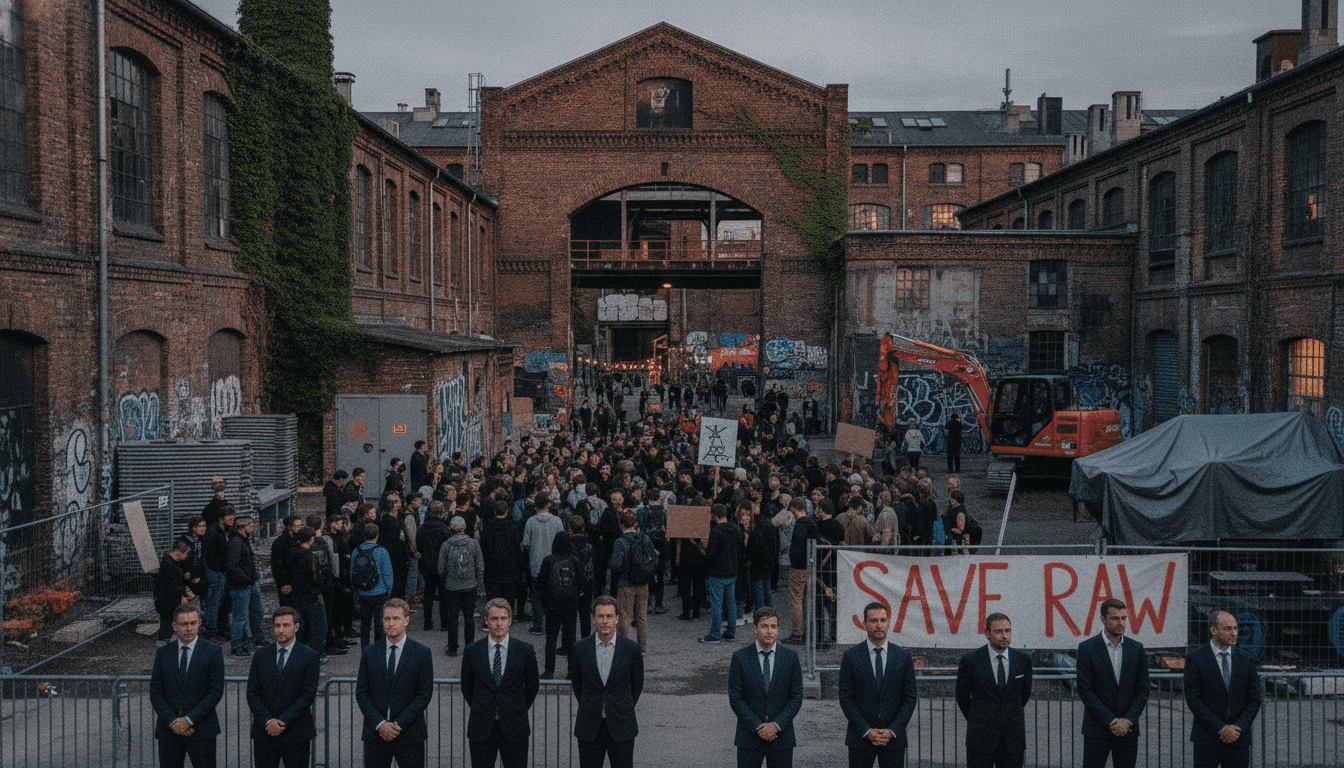
RAW Gelände eviction notices escalate in June 2026 as Berlin cultural hub fights for survival
RAW Gelände faces a showdown as developer evictions threaten Berlin’s cultural hub; tenants and activists clash with investors over demolition, leases and future use.
RAW Gelände eviction notices escalate in June 2026
A fight over the future of the RAW Gelände has intensified this month after a Göttingen-based investor issued eviction and cease-and-desist orders to several long-standing venues on the site. The notices, which surfaced in January and culminated in deadline demands in mid‑June, have put Berlin’s best-known 1990s-era cultural complex at immediate risk. Local organizers, tenants and a growing citizens’ movement have mobilized with demonstrations and a petition after Club Cassiopeia and other anchor projects were told to vacate within weeks.
The dispute centers on contested claims about safety, leasing status and the developer’s plans for large-scale redevelopment on prime land beside Warschauer Straße. Venue operators have disputed the developer’s public justification—citing adequate fire protection and temporary permits—and say the notices are part of a strategy to increase rent and clear the way for demolition. The rapid escalation has thrust a long-running negotiation into public view and sparked a wider debate about urban development, heritage and cultural space in Berlin.
City officials are now mediating talks while activists press for binding assurances that guarantee affordable long-term leases for the site’s cultural tenants. A high-profile demonstration on 19 June drew thousands of supporters and highlighted the depth of local opposition to demolition and large commercial projects. With both the investor and the district government under scrutiny, the immediate outcome remains uncertain but the dispute has already changed the tenor of planning discussions for the area.
Historic railway works and wartime scars shape the site
The RAW Gelände occupies land that was established as a royal Prussian railway repair yard in 1867 and later expanded to service a growing rail network across the city and region. Over its long life the complex has been repeatedly reshaped by industrial change, wartime destruction and political transitions, leaving a layered architectural landscape. Heavy bombing during the Second World War destroyed much of the factory, but several robust structures and an overground bunker known as “Der Kegel” survived and have been repurposed by present-day community projects.
Under East German administration the yard continued to serve the rail system and carried a different political symbolism, eventually taking the name RAW Franz Stenzer in the 1960s. After reunification the site was transferred to the national rail company and then to a succession of real-estate vehicles, which declared many of the buildings surplus. That trajectory—from industrial workshop to contested development plot—frames the present conflict, which pits the site’s deep historical layers against proposals for modern redevelopment.
Memorials and remaining wartime fabric now stand alongside graffiti-scarred façades and patched roofs, creating an unusual juxtaposition of remembrance and everyday cultural life. This layered history is central to the argument made by residents and tenants who say the value of RAW is not only economic but also historical and social. For many supporters, preserving the ensemble’s physical and intangible qualities is part of a broader effort to safeguard Berlin’s post‑reunification cultural fabric.
A grassroots cultural ecosystem anchored by dozens of projects
Since the mid-1990s the RAW Gelände has been home to a loose federation of independent cultural, creative and leisure projects, many of which evolved through interim-use agreements with successive owners. Today the compound hosts skate halls, climbing facilities converted from wartime bunkers, rehearsal rooms, art spaces for street and digital art, music venues, beer gardens and a popular weekly flea market. These projects operate largely independently and have become a fixture of local life, drawing both longtime residents and visitors to Friedrichshain.
The social and economic model on the RAW site has been precarious but resilient: many ventures run on modest margins, depend on affordable rents and rely on a cooperative ethos to survive. Associations such as RAW Kultur L and earlier initiatives organized tenants, negotiated with authorities and provided a degree of self-governance, enabling the site to function as a semi-informal cultural district. That arrangement has been repeatedly tested by changes in ownership and shifting municipal priorities, but until now it has allowed a rare concentration of low-cost cultural infrastructure to remain in central Berlin.
Beyond entertainment the site supports community-oriented programs—children’s circus groups, music schools and environmental initiatives—that local advocates argue are irreplaceable. The presence of these activities strengthens the claim that RAW is not merely a cluster of night-time venues but a mixed-use socio-cultural ecosystem. Displacing these projects, critics warn, would remove essential amenities that serve diverse age groups and socioeconomic backgrounds.
Developers’ masterplan and disputed commercial ambitions
Investor plans that have circulated in recent years depict a radically transformed RAW site, with large commercial blocks and a high-rise element that critics say echoes other bland office developments near the Ostbahnhof. Those visualizations and masterplans have fueled public concern because they appear to marginalize the existing ensemble of low-rise, repurposed buildings that give RAW its character. Developers and some planners argue that new construction is necessary to unlock investment and generate steady rental income, but opponents say the proposed scale and typology would erase the site’s social value.
Technical studies and planning documents also became focal points in the dispute over whether the investor has a financial imperative to redevelop now. Local planners and the Office for Alternative Urban Development have published assessments arguing that the owner’s returns could be secured with substantially less demolition and reduced building volume. Those alternative scenarios propose a mixed approach that renovates a larger portion of the existing fabric while concentrating new development in a reduced footprint, thereby lowering cost risk and maintaining cultural uses.
The conflict is thus both architectural and financial: it concerns what is possible within the site’s legal planning framework and what is desirable for the city’s social infrastructure. Previous municipal decisions, including a 2019 development plan that preserved the so-called sociocultural zone, suggested compromise was possible. The most recent moves by the investor, however, suggest a renewed willingness to press for a re-set of prior agreements, which opponents view as a negotiation tactic to increase pressure on tenants.
Negotiations collapse as Club Cassiopeia faces eviction
Negotiations between the investor, tenant associations and district officials recently deteriorated, culminating in eviction orders affecting crucial venues such as Club Cassiopeia. The club’s potential closure is significant because several other projects in the sociocultural cluster are economically linked to its operations and shared infrastructure. Owners of the site say compliance and safety issues motivated the move, while operators countered with documentation of fire safety measures and temporary permits, deepening mistrust between the parties.
Public reaction was swift: on 19 June a large demonstration with a rave-themed element drew thousands to the streets in support of RAW and its tenants. Protesters demanded a return to mediated talks, a halt to immediate evictions and the preservation of affordable cultural leases. Simultaneously, organized civic groups promoted alternative planning proposals and sought political intervention to secure longer-term protections for the complex.
Meanwhile, municipal actors have signalled they remain engaged but cautious. The Green Party building councillor has publicly urged the investor back to the negotiating table and proposed mechanisms to preserve cultural uses amid any development. Whether the investor will accept binding, long-term lease guarantees or pursue the more lucrative option of residential and office schemes is the central question facing the talks.
City officials, planners and residents propose alternatives
Local planners and community advocates have advanced concrete alternatives that aim to reconcile the site’s economic potential with its cultural role. Proposals include halving the planned building volume, concentrating new additions in discrete areas, and formalizing a guarantee of multi-decade leases at affordable rates for existing cultural tenants. Supporters of these measures contend that such compromises would reduce investment risk for the owner while preserving the social capital that underpins the site’s popularity.
Examples from other Berlin projects have been cited to illustrate possible outcomes: mixed-use developments that respect existing structures, negotiated ground-rent models and public-private partnerships that prioritize cultural continuity. Advocates point to these precedents as proof that large, centrally located properties can be developed without wholesale demolition if stakeholders engage in good-faith negotiation. They argue that a managed, incremental approach would deliver economic returns while sustaining the complex’s cultural functions.
At the same time, critics of the investor’s approach press for legally binding safeguards rather than informal assurances, fearing that temporary permits or voluntary commitments could be reversed by future owners. Campaigners are pushing for a formalized planning agreement that would enshrine specific protections for the sociocultural zone and set clear conditions for any redevelopment. The debate now centers on whether municipal authorities will insist on such guarantees as part of any approval process.
The broader implications of the RAW dispute extend beyond this single site and resonate with citywide debates about gentrification, cultural protection and land-use policy. Planners, activists and cultural workers see the outcome as a test case for how Berlin balances private investment with the preservation of public-oriented cultural infrastructure. For many residents, the stakes are existential: the loss of RAW would represent not only a change in streetscape but a shift in the kinds of urban life the city chooses to support.
The contest over RAW Gelände is not simply a clash between developers and nightlife venues; it is a confrontation about urban identity, historical continuity and who gets a voice in shaping the city’s future. As mediations continue and protests persist, both the physical fabric of the site and the legal framework that governs it will determine whether RAW can remain a living cultural quarter or will be replaced by a denser, commercially driven development. The decisions made in the coming weeks and months will shape not only Warschauer Straße but the wider politics of urban conservation and development across Berlin.
