
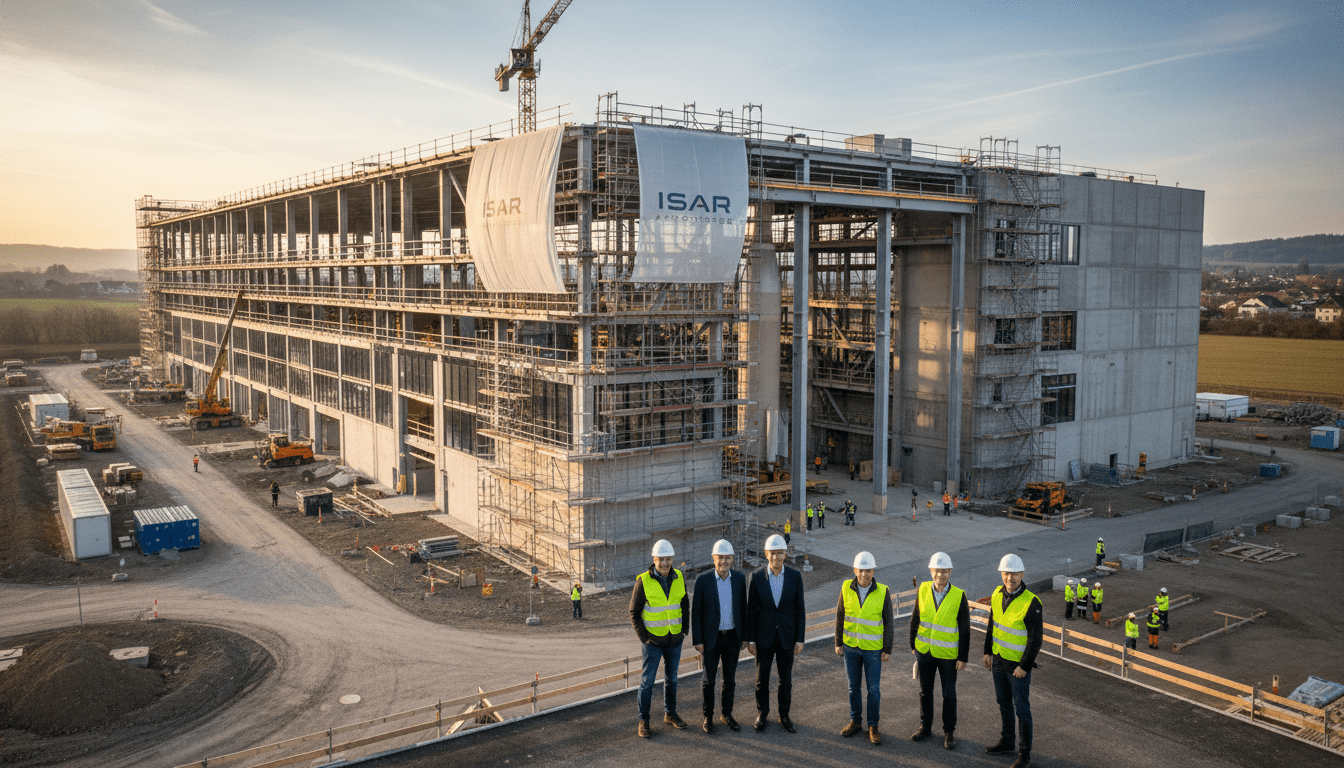
Isar Aerospace Parsdorf Factory to Produce Up to 40 Rockets a Year
Isar Aerospace Parsdorf factory set to mass-produce rockets on a 40,000 sqm campus near Munich, targeting up to 40 launch vehicles annually to serve Europe’s growing small-satellite market.
Production Campus in Parsdorf
The German start-up is constructing a 40,000 square metre manufacturing campus in Parsdorf, a northern suburb of Munich, to move from prototype builds to series production. The Isar Aerospace Parsdorf factory is being designed for high-throughput assembly, with the company planning an annual output that could reach 40 rockets. Company officials say the site will consolidate production stages previously spread across multiple facilities to shorten lead times and improve repeatability.
The layout emphasizes flow-line production and larger assembly halls to handle structural components, propulsion systems, and final integration under one roof. The factory footprint aims to combine automated processes with manual quality-control stations to balance speed and precision. Project planners expect the new capacity to accelerate deliveries for commercial launch customers and institutional programmes.
Planned Output and Industry Context
Producing up to 40 rockets per year would represent a significant cadence for a European launcher manufacturer focused on small-to-medium payloads. That rate compares with traditional European practices, where leading firms have only partially adopted continuous assembly-line techniques. The planned throughput reflects growing demand for dedicated launches from constellation operators and scientific missions.
Analysts say higher output targets respond to a market shift toward frequent, on-demand launches rather than large, infrequent missions. For a private launch firm, achieving this scale requires not only factory space but robust supply chains, steady component qualification and streamlined testing cycles. The Parsdorf factory is positioned as a test case for whether European launchers can match production models already seen in other aerospace sectors.
Manufacturing Approach and Technology
The new facility aims to adopt modular manufacturing and batch-track production methods to reduce handover times between workstations. Engineers plan to use jig-less assembly for larger stages and integrated test stands that shorten the validation loop for engines and avionics. The approach prioritizes repeatable processes that improve yield over many production runs.
Automation will be applied selectively where it delivers measurable time savings and quality gains, while final assembly and acceptance testing will remain closely supervised by experienced technicians. The combination of automated machining, composite layup areas and propulsion test infrastructure is intended to allow parallel workstreams to progress without interference. This concurrent-process strategy is central to meeting the target of dozens of vehicles per year.
Comparison with Established European Players
European incumbents have historically produced launchers at lower volumes and with more bespoke assembly practices, and some have only partially migrated to flow-line methods. The Isar Aerospace Parsdorf factory signals a new model for regional launch production by planning high-volume output from the outset. Established aerospace contractors may view this as a push toward industrialising launcher manufacture across the continent.
Competition and cooperation could both increase as supply chains adapt to higher volumes. Suppliers of engines, avionics and composite structures will face pressure to scale while meeting aerospace-quality standards. Observers say this could accelerate industry-wide adoption of standardised components and production tooling, which would benefit smaller operators seeking reliable, repeatable hardware.
Local Economic and Workforce Implications
Building a large production campus in Parsdorf is expected to have measurable local economic effects, including construction activity and long-term manufacturing employment. The factory will likely require skilled technicians, engineers and quality-control staff, drawing talent from the Munich region’s established industrial base. Local suppliers may win new contracts for parts, tooling and services tied to the production ramp.
Municipal leaders and regional development agencies typically welcome such projects for the jobs and investment they bring, though they also emphasise the need for training programmes and infrastructure improvements. The plant’s proximity to Munich provides access to a deep labour market, research institutions and transport links, which will be important as the company moves from construction into sustained production.
Regulatory, Testing and Supply-Chain Challenges
Reaching a production rate of up to 40 rockets annually depends on clearing regulatory milestones, securing test ranges and stabilising supply chains. Launch vehicles require rigorous certification and recurring acceptance tests that can create bottlenecks if not carefully scheduled. Engine testing, propellant handling, and environmental compliance are among the technical and regulatory hurdles the factory must manage.
Supply-chain resilience is another critical factor; parts suppliers must be able to deliver consistent quality at scale while meeting lead times. Any single-point failures in specialised components could disrupt production flow. The company will need to balance inventory strategies, supplier diversification and in-house fabrication to maintain throughput without excessive cost.
This shift toward industrialised production also raises questions about test capacity and range availability in Europe, since higher launch rates require reliable access to launch pads and associated logistics. Coordination with national and regional authorities will be necessary to align testing and launch windows with broader airspace and maritime safety requirements.
The Parsdorf campus represents a deliberate move to industrialise launch manufacturing in Europe, blending automated processes with hands-on expertise to reach ambitious output goals. If the Isar Aerospace Parsdorf factory achieves its stated targets, it could reshape expectations for how quickly commercial and institutional customers in the region can obtain dedicated launch services.
