
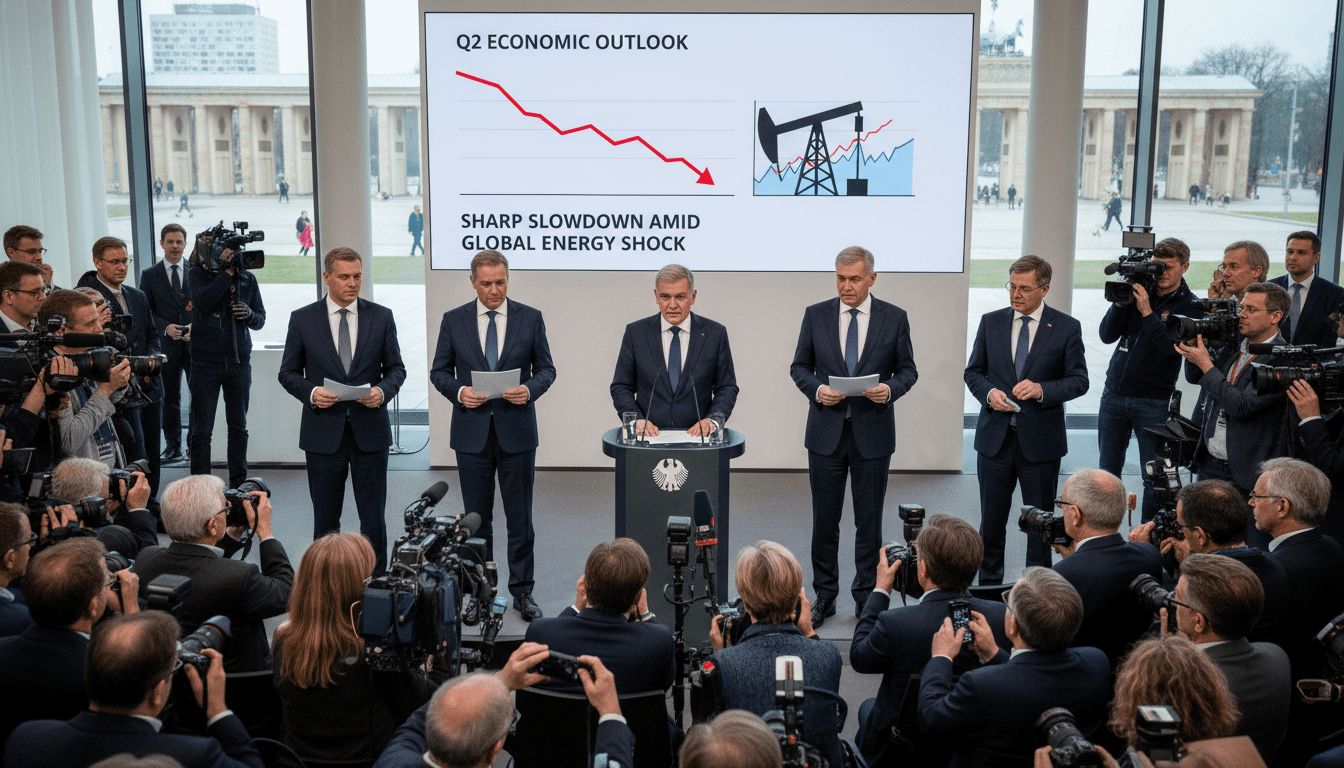
German economy faces sharp second-quarter slowdown as Iran conflict lifts energy costs
German economy set for sharp second-quarter slowdown as Iran conflict raises energy and commodity prices; government considers relief measures and reforms to shield businesses and households.
The German economy is expected to slow markedly in the second quarter after a stronger-than-expected start to the year, the federal government said in a May report on the country’s economic situation. The Ministry of Economics signalled mounting risks from the conflict in Iran and the wider Middle East, linking the escalation to rising energy and commodity costs that are already weighing on firms and consumers. Officials flagged a revised 2026 growth forecast of just 0.5 percent and warned that how long the conflict endures will determine the depth and duration of the downturn.
Government cites Iran conflict as main economic risk
The Ministry of Economics’ May assessment attributes the anticipated weakening mainly to fallout from the Iran war and associated disruptions to global trade and supply chains. Energy and raw-material price pressures are specifically singled out as immediate transmission channels through which the conflict is affecting activity. The report notes that even after a de-escalation, higher energy costs and strained supply chains could leave lingering effects on production and inflation.
Quarter-one growth masks looming slowdown
Germany’s gross domestic product rose by 0.3 percent quarter-on-quarter in the first quarter, according to the Federal Statistical Office, giving an initially positive tone to 2026. That early growth, however, is now judged insufficient to offset the renewed headwinds expected in Q2 as international trade routes and shipping through the Strait of Hormuz face constraints. The government has already lowered its annual projection for 2026 to 0.5 percent growth, underlining a shift from optimistic early-year readings to a more cautious outlook.
Energy-price spike and supply-route disruptions
Oil prices have climbed since the outbreak of hostilities in the region, a development the ministry links to restricted shipping through key passages such as the Strait of Hormuz. Those higher energy costs are filtering through to retail fuel prices and production inputs, exerting pressure on household budgets and corporate margins alike. The report highlights that consumers are feeling the strain at the pump despite an existing temporary fuel rebate that runs through the end of June.
Industry sectors most exposed to rising costs
Energy-intensive industries are bearing the brunt of the shock, with the chemicals, paper, glass and metals sectors singled out for notable declines. Since February 2022 these sectors have contracted more sharply than the broader industry, with production down 15.2 percent compared with a 9.5 percent fall across industry as a whole. Corporates in these fields face higher input costs and tighter profitability, prompting concerns about competitiveness and employment in regions reliant on heavy industry.
Policy options and relief measures under discussion
Lawmakers and government officials have said they are considering targeted relief if the conflict persists and price pressures remain elevated. Politicians from the governing coalition have pointed to potential additional measures beyond the current fuel rebate to ease burdens on households and businesses. The ministry report underscores that any policy response will need to balance short-term relief with longer-term fiscal and structural objectives.
Reform pressure ahead of parliamentary summer recess
Chancellor Friedrich Merz has signalled competitive-strengthening as a government priority, while business groups push for relief on rising social charges and costs. The coalition hopes to advance a comprehensive reform package on pensions, taxes, the labour market and bureaucracy reduction before the parliamentary summer break in mid-July. With the economic outlook deteriorating, momentum for structural reforms and quicker policy action has increased, according to officials and industry representatives.
Economic sentiment indicators have already softened since the onset of the Iran war, the ministry report notes, reflecting growing caution among firms about investment and hiring. Companies cite fears of further energy-price increases and continued supply-chain stress when assessing near-term prospects. Those shifts in business confidence are now a key channel through which international geopolitical developments are translating into domestic economic weakness.
The government stresses that the path ahead is inherently uncertain and tied to geopolitical developments beyond Germany’s control, making policy calibration difficult. Officials warn that a prolonged conflict could sustain elevated energy and commodity prices, while a rapid de-escalation would still leave residual cost and supply-chain effects. For now, authorities are preparing measures to cushion the immediate impact while pressing forward on reforms intended to bolster long-term resilience.
