
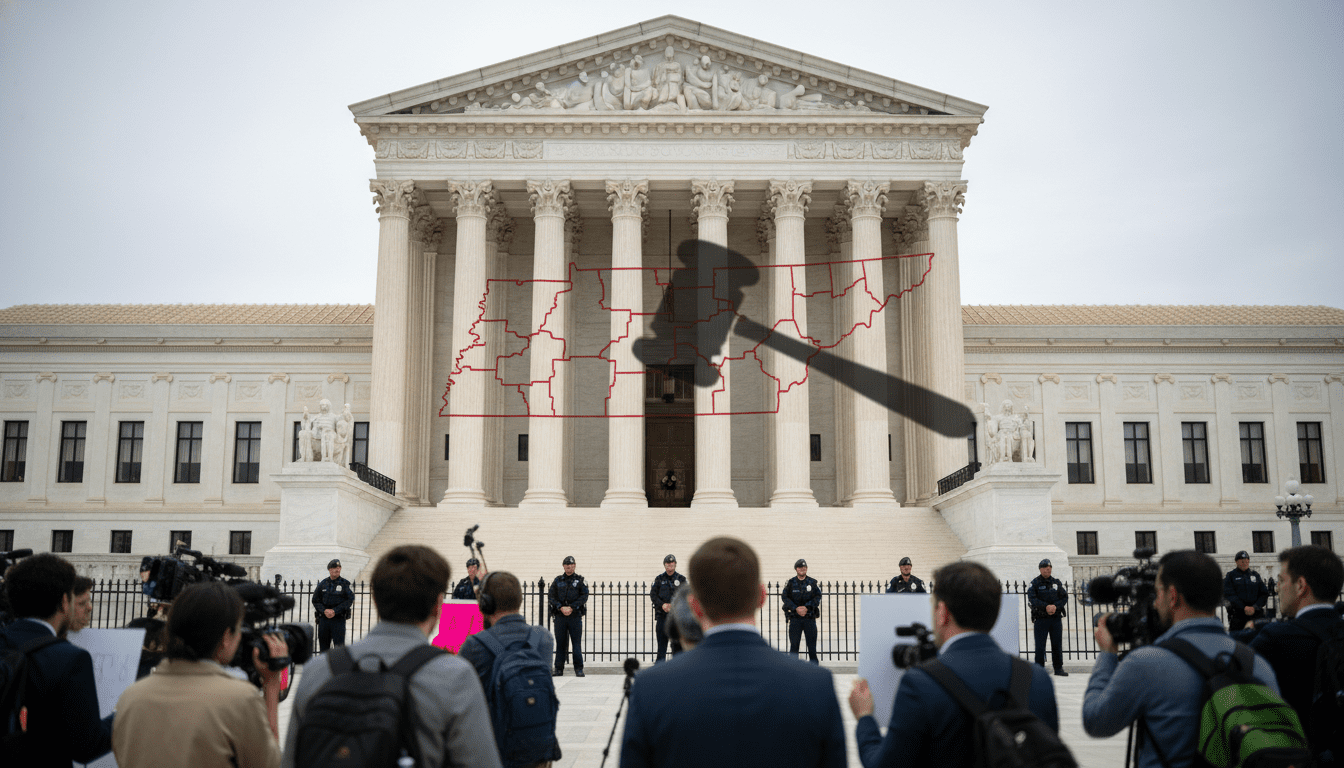
Supreme Court Decision Weakens Voting Rights Act as Tennessee Moves to Redraw Districts
Supreme Court ruling on May 11, 2026 weakens the Voting Rights Act, enabling gerrymandering in Tennessee and beyond and triggering urgent civil-rights warnings.
The Supreme Court’s decision on May 11, 2026 removed federal safeguards that had constrained state-level manipulation of electoral maps, and Tennessee Republicans moved quickly to exploit the change. The ruling directly affects the Voting Rights Act and comes as Tennessee’s legislature has already taken steps to redraw districts and challenge opposition lawmakers. Civil-rights groups and legal experts warned that the combination of the court ruling and partisan redistricting could disenfranchise Black and minority voters across the region.
Supreme Court ruling removes key Voting Rights Act protections
On May 11, 2026 the high court issued a majority opinion that curtailed federal oversight tied to the Voting Rights Act, altering the standard for when Washington can intervene in state election laws. The decision overturned decades of precedent that had previously required enhanced review of changes in jurisdictions with histories of discriminatory practices. That shift narrows the scope of federal review and raises the bar for proving intentional racial discrimination in voting disputes.
Legal scholars say the practical effect will be a heavier burden on plaintiffs and a greater latitude for states to defend contested redistricting plans. The ruling does not eliminate all federal civil-rights enforcement, but it significantly reduces the tools most often used to block aggressive mapmaking before it takes effect. State legislatures that had previously hesitated now have clearer legal room to redraw districts without immediate federal preclearance.
Tennessee lawmakers act swiftly to redraw districts and remove opponents
Within days of the ruling, Tennessee’s Republican supermajority advanced measures to reshape legislative boundaries and to strip two young Black Democratic lawmakers of their seats, citing procedural and conduct-related justifications. State officials argued their actions were lawful exercises of majority rule, while critics described them as targeted efforts to silence dissent and weaken representation. The removals and the new maps are part of a broader strategy that legal analysts say is intended to cement partisan control for years.
The Tennessee moves fit a pattern of aggressive redistricting that has shifted power in several southern states over the past decade. Advocates for the ousted lawmakers say the changes are designed to dilute Black voting strength and marginalize communities that historically supported Democrats. Local protests and national attention have followed, with demonstrators decrying what they call racially motivated voter suppression.
Civil-rights groups warn of systematic disenfranchisement
National and local civil-rights organizations responded with urgency, characterizing the decision and subsequent state actions as a threat to equal access to the ballot. Groups that once relied on the Voting Rights Act’s preclearance and relaxed evidentiary standards said they will pursue litigation and turn to public campaigns to counteract the changes. Leaders warned that without federal checks, discriminatory practices could spread unnoticed until after elections are held.
Many advocates emphasized that the impact will be felt most acutely by Black, Latino, and other minority communities in states with histories of voter suppression. Legal filings and community organizing are already underway in Tennessee and neighboring states as civil-rights attorneys evaluate new strategies for proving discriminatory intent under the tightened legal framework. The shift in enforcement, they said, means more cases will hinge on protracted court battles rather than preventive remedies.
Gerrymandering’s political consequences extend beyond Tennessee
Politicians and strategists on both sides recognize that redrawn boundaries can determine electoral outcomes for years and shape national politics. The decision empowering more aggressive gerrymandering threatens to entrench majorities in statehouses and congressional delegations even when electoral preferences shift. Observers say this could skew representation at all levels, affecting policy on voting, education, health care, and more.
Scholars point to a long history of map manipulation in the American South, where changes to district lines have been used to minimize minority influence. With the Voting Rights Act’s constraints reduced, those tactics can be deployed more openly and quickly. The broader implication is a potential reordering of political competition that would be difficult to reverse absent new legislation or a later court decision.
Legal challenges and the path forward for federal and state remedies
Attorneys for voting-rights groups signaled immediate plans to challenge Tennessee’s redistricting actions in state and federal courts, arguing that the changes violate constitutional protections and state law. Experts expect a cascade of lawsuits testing whether the post-ruling legal landscape still allows effective remedies against discriminatory maps. State supreme courts and federal judges will play a pivotal role in interpreting how far the recent decision permits partisan maneuvering.
Congressional responses are also possible but would require bipartisan support to craft new safeguards or to restore the enforcement mechanisms narrowed by the court. For now, the combination of a conservative Supreme Court and state-level majorities creates a difficult environment for federal legislative fixes. Legal observers say the most likely near-term outcomes are staggered court rulings and localized remedies rather than an immediate national reversal.
The immediate aftermath in Tennessee shows how a single high-court ruling can translate swiftly into political action at the state level, redefining who can shape elections and who can be represented in legislatures. Voters, advocates and lawyers across the country are preparing for protracted fights that will determine whether the effects of this decision are limited or long-lasting.
