
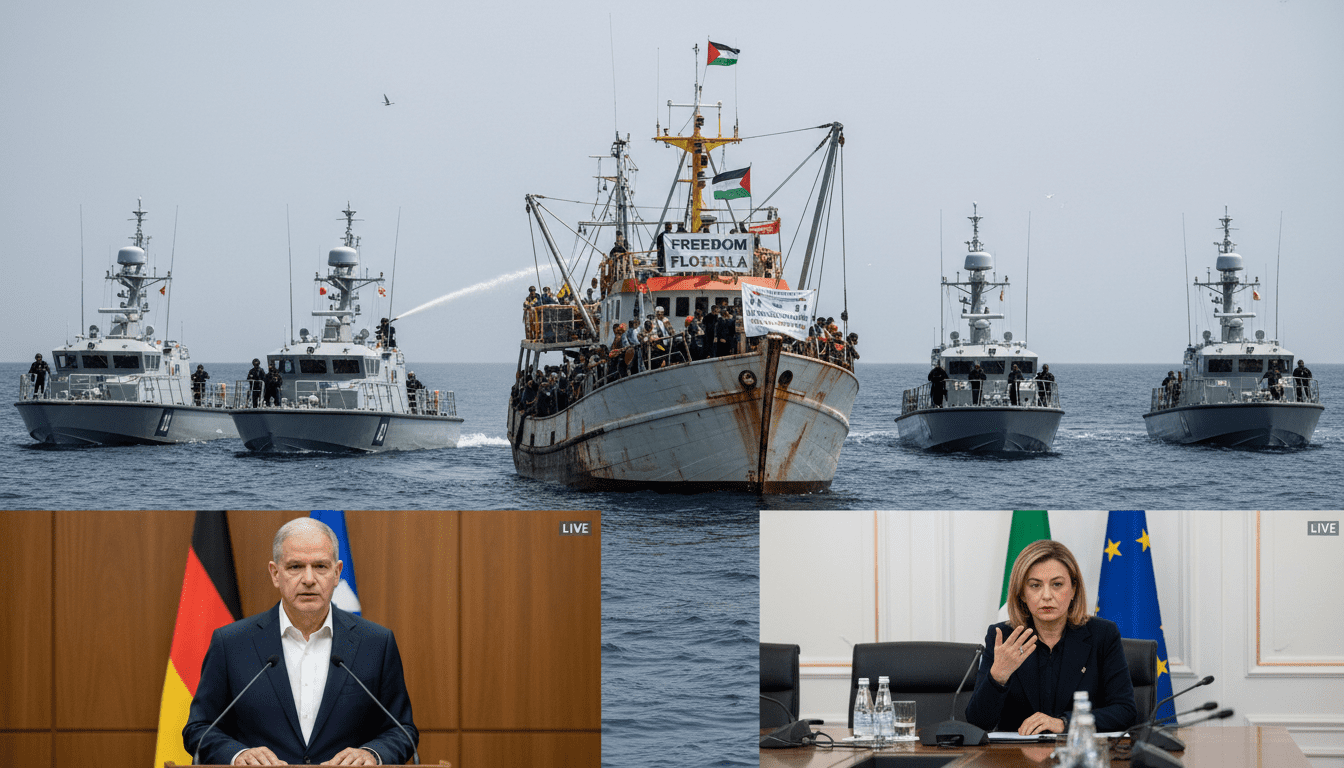
Global Sumud flotilla halted by Israeli navy off Crete, prompting German-Italian protest
Germany and Italy warn the interception of the Global Sumud flotilla may breach international law, calling for respect for humanitarian access and detainee releases.
The Israeli navy intercepted and stopped more than 20 vessels from the Global Sumud flotilla west of the Greek island of Crete, detaining dozens of activists while Germany and Italy expressed deep concern about the operation and its legality. The joint German-Italian statement said the stoppage in international waters could be inconsistent with international law and urged full respect for legal norms and the avoidance of irresponsible actions. Organizers accused Israeli forces of using violence during the nighttime operation, while Israeli authorities maintain the action complied with legal obligations and that no injuries were reported.
Israel halts flotilla in international waters, navy says operation lawful
Israeli officials reported that naval units intercepted the convoy during the night and prevented the vessels from proceeding toward the Gaza coast. Authorities said the operation was conducted in accordance with applicable law and was aimed at enforcing maritime security measures tied to the longstanding blockade. The Israeli statement emphasized that all activists removed from the vessels were uninjured and that the action was coordinated with Greek authorities where necessary. The navy’s account contrasts with organizers’ allegations of a forceful and aggressive boarding.
Berlin and Rome question legality and call for humanitarian access
A joint German-Italian declaration voiced serious concern about the interception and suggested the stop of the Global Sumud flotilla in international waters might not align with international law. Both governments reaffirmed their support for humanitarian efforts to reach Gaza, stressing that such assistance must be delivered in compliance with legal and international standards. Italy additionally demanded the immediate release of any unlawfully detained Italian nationals, reflecting the presence of Italian citizens among those aboard. German officials likewise expressed close attention to the fate of detained activists and the wider implications for humanitarian access.
Organizers describe violent scenes; Israel disputes those claims
Organizers of the flotilla said they encountered violent measures during the operation in the hours before dawn, accusing Israeli forces of heavy-handed tactics as sailors and activists clashed at sea. They described the convoy as part of a humanitarian mission intended to deliver aid to civilians in Gaza and framed the voyage as nonviolent civil action. Israeli authorities rejected those characterizations, asserting that procedures were followed to minimize risk and that no casualties occurred. The competing narratives have fueled diplomatic exchanges and raised questions about independent verification of events at sea.
Detentions, disembarkation plans and Greek involvement
Israel’s foreign minister stated that detained activists would be brought ashore in coordination with the Greek government, and Athens confirmed it was prepared to receive the individuals and facilitate their safe return home. Greek officials told diplomats that they would take custody of those removed from the boats and ensure their transfer to their countries of origin if necessary. Organizers reported that some vessels were able to resume their journey after the nighttime incident, while others remained intercepted or under Greek oversight. Both governments signaled ongoing consular engagement to ascertain the status and nationality of detainees.
Tracking data shows vessels near Greek territorial waters before interception
Open-source tracking sources cited by the flotilla’s organizers and maritime monitoring services indicated that several vessels were transiting along the coast of Crete and had entered or skirted Greek territorial waters in the evening prior to the interception. The movement of small private sailboats and motorboats along established maritime routes complicated the operational picture, with some ships later changing course following the encounter with Israeli forces. Organizers characterized the voyage as the largest flotilla attempt in recent years, launched from ports in Sicily with the declared aim of delivering humanitarian supplies to Gaza.
Historical context: Gaza sea blockade and past flotilla attempts
The flotilla’s stated objective was to challenge the Israeli maritime blockade of Gaza, a restriction in place since 2007 that Israel says is necessary for its security and that Egypt has also helped to enforce. Previous attempts by activists to break the blockade have been met with interceptions and, on occasion, forceful boardings by Israeli units; a notable prior operation involved a mixed flotilla of small boats that was intercepted last autumn and drew international attention. The recurring confrontations have repeatedly raised debates about legal authority at sea, the obligations of states to allow humanitarian assistance, and the risks faced by activists mounting such missions.
The events off Crete are likely to prompt further diplomatic exchanges between Israel, European capitals, and Greece, and may spur calls for independent investigation into the conduct of the interception and the treatment of detainees. International human rights groups and some foreign governments may press for greater transparency over the legal basis for the stop and for concrete steps to ensure safe humanitarian access to civilians in Gaza.
