
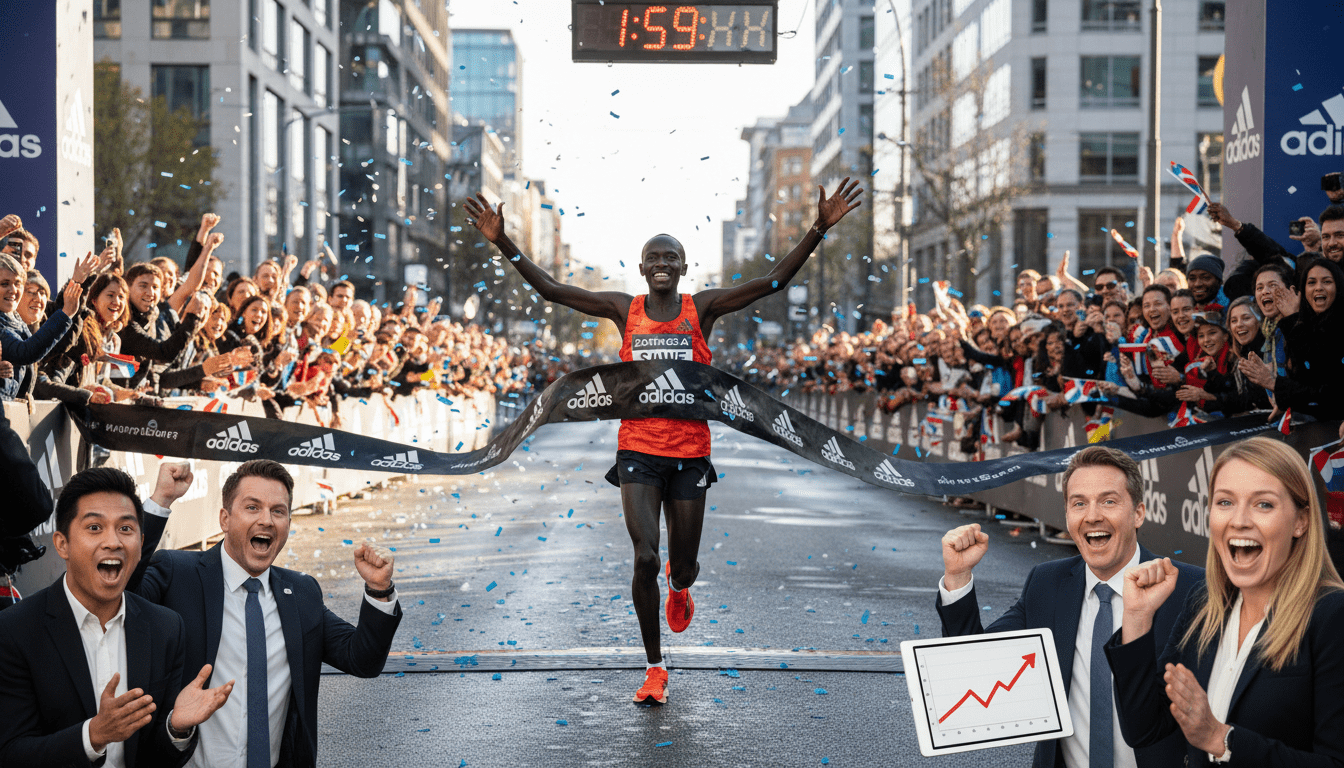
Adidas shares jump after Sawe breaks marathon two-hour barrier in London
Adidas shares rose after Sabastian Sawe ran an official sub‑2 marathon in London, with investors reacting to the win linked to the brand’s new Adizero Adios Pro Evo 3.
Sabastian Sawe’s performance at the London Marathon on April 26, 2026, produced immediate market and sporting reverberations as he completed the 42.195 km course in 1:59:30 wearing Adidas footwear. The result — the first sub‑two‑hour finish in an official race and one that left a second‑place finisher also under two hours — combined athletic milestone with commercial significance, prompting a roughly two percent uptick in Adidas shares after a year‑to‑date slide. Analysts and running industry observers noted the convergence of a headline athletic achievement and the debut of Adidas’s latest racing shoe.
Sawe sets official sub‑2 marathon mark in London
Sawe crossed the finish line in 1:59:30, beating the standing world record of 2:00:35 set by Kelvin Kiptum in October 2023. Officials recognized Sawe’s time under standard competitive conditions, marking a first in sanctioned marathon history. The race conditions in London — reported around 15 degrees Celsius with a light wind — were widely described as favorable for fast times.
Fans and media crowded the finish as Sawe held up the race shoe with “WR” and “sub‑2” written on it in marker, a symbolic confirmation of the achievement. The runner’s celebration underscored both the personal triumph and the broader narrative about technology and performance in elite distance running.
Adidas shoe used by winner and runner‑up identified
Both Sawe and the second‑place finisher wore Adidas’s new Adizero Adios Pro Evo 3 during the race. The model was designed specifically for elite competition and is being positioned by the company as a breakthrough in race shoe engineering. Observers noted that having the top two finishers wearing the same model amplified media attention on the product.
Adidas has described the Evo 3 as a “superschuh” in internal and promotional materials, a term that has become common in discussions about performance footwear that combines advanced foam, carbon plate technology, and extreme weight reductions.
Technical advances cited in Evo 3 design
Adidas engineers trimmed the mass of the Adizero Adios Pro Evo 3 to an average of 97 grams per shoe, about 30 percent lighter than its predecessor. The shoe integrates new foam formulations and a carbon plate to improve energy return and responsiveness over marathon distances. The company’s design team emphasized ultralight components paired with structural stiffness to balance propulsion and endurance.
Those technical details follow years of laboratory testing and iterative prototypes that Adidas and rival brands have pursued in the quest to help athletes run faster while complying with governing body rules. The Evo 3’s debut in a high‑profile race provided a visible validation point for the brand’s development program.
Market reaction and investor concerns before the race
Adidas shares rose roughly two percent on the day of Sawe’s victory, reversing part of a recent slide that saw the stock down about 18 percent since the start of the year. Investor worries cited earlier included potential effects from U.S. tariffs targeting certain goods and macroeconomic uncertainty tied to geopolitical tensions in the Middle East. The sub‑2 performance offered a positive headline that markets interpreted as confirmation of Adidas’s competitive positioning in elite running gear.
Traders and analysts stressed that a single event does not resolve structural questions facing the company, but they acknowledged that marquee sporting achievements can catalyze short‑term consumer interest and provide marketing momentum. Retail and wholesale orders, product sell‑through, and subsequent promotional campaigns will determine whether the on‑track success translates into sustained sales improvements.
Historical context: record attempts and Nike’s experiments
The London result rekindled comparisons to earlier high‑profile attempts to break the two‑hour barrier. Nike’s sponsored attempt in Monza in 2017 fell short in competition, while Eliud Kipchoge’s 1:59:40 run under the Ineos 1:59 Challenge was not eligible for official record status because of pacing and other non‑standard conditions. Those episodes helped shape public debate about what constitutes a valid record and the role of footwear, pacing, and event setup.
Sawe’s run, validated under official race rules, changes that narrative by producing a sanctioned sub‑two milestone. Athletic federations and equipment regulators may now face fresh scrutiny of shoe technologies and race protocols as competitors and governing bodies assess the implications.
Potential ripple effects for the running industry
The visible success of the Adizero Adios Pro Evo 3 at an official marathon is likely to intensify competition among sportswear brands for elite endorsements and consumer demand. A validated performance in a major city marathon tends to boost brand credibility among recreational runners who follow elite results, and that can translate into increased interest for high‑end racing models and adjacent apparel lines.
Industry analysts expect marketing campaigns and product restocks to follow, and several retailers have reportedly moved to adjust inventory plans in anticipation of higher demand. Longer term, the episode may accelerate research into materials and biomechanics as companies look to replicate or exceed the Evo 3’s claimed benefits.
The London marathon result fused athletic history with corporate opportunity, producing immediate stock movement and renewed attention on shoe technology and race regulation. Whether the moment turns into a sustained commercial upswing for Adidas will depend on follow‑through in sales, distribution, and how regulators and rivals respond to the performance evidence on the world’s roads.
