
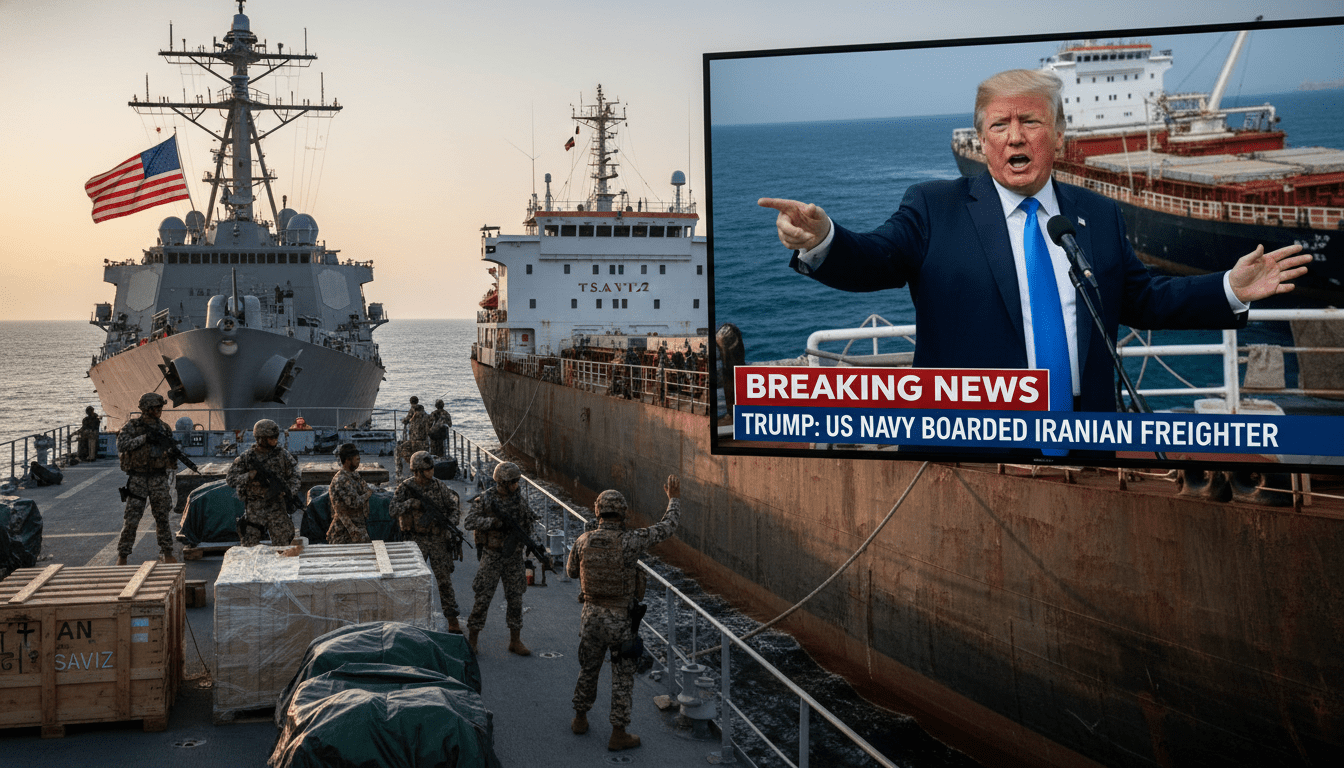
US Navy seizes Iranian freighter near Strait of Hormuz, escalating tensions
US Navy seizes Iranian freighter — USS Spruance intercepted the Touska near the Strait of Hormuz, US officials say, as Iran suspends talks and regional shipping faces renewed disruption.
Immediate account from the White House
President Donald Trump said on his platform that the US Navy seized an Iranian freighter, naming the ship Touska and saying it attempted to bypass a US maritime blockade near the Strait of Hormuz. The president described an interception by the guided-missile destroyer USS Spruance in the Gulf of Oman and said US Marines subsequently took control of the vessel. An independent verification of the boarding and the damage Trump described was not immediately available.
The White House statement framed the action as enforcement of a blockade intended to restrict Iranian maritime movement. US officials said the crew refused orders to turn back, prompting the Spruance to fire on the freighter’s engine room before a boarding party secured the deck and began a cargo search.
Boarding operation and reported damage
According to the US account, the Spruance fired a shot that made “a hole in the engine room” of the nearly 275-meter freighter, disabling the ship before Marines boarded. US naval personnel are said to be conducting an inspection of the Touska’s manifest and cargo while holding the vessel under control. The administration characterized the operation as a lawful interdiction amid an ongoing maritime standoff.
Iranian authorities have not released a parallel account confirming the sequence of events described by US officials, and no third-party confirmation was available in the immediate aftermath. International shipping monitoring services and regional ports were reported to be on heightened alert, reflecting the uncertainty that follows naval interdictions in this strategic corridor.
Iran cancels planned second round of talks with Washington
State media in Tehran reported that Iran has declined to attend a second round of talks with US representatives, citing what Iranian outlets described as “excessive demands” and “unrealistic expectations” from Washington. The state broadcaster IRIB and the official news agency IRNA said Tehran blamed shifting US positions and the continuing US blockade of Iranian ports for its decision to suspend participation.
Washington had announced that a US delegation led by Vice President JD Vance would travel to Islamabad for mediated discussions. Pakistan, together with Egypt and Turkey, has been presented by the US as part of a mediation effort aimed at brokering a more durable ceasefire and a pathway to de-escalation. Iran’s withdrawal from the scheduled session complicates those diplomatic efforts and raises the risk of further military and economic confrontation.
Strait of Hormuz closed again as shipping shifts
The Strait of Hormuz was closed to commercial traffic over the weekend after Tehran briefly reopened the waterway and then reinstated the restriction. Iranian military spokespeople cited the US maritime blockade as justification for the renewed closure, which affects a significant volume of global crude shipments transiting the narrow channel.
Global traders and energy markets watch the strait closely because any sustained disruption can quickly influence oil prices and shipping routes. Shipping firms and insurers typically react to escalations with route changes and higher premiums, and regional ports have scrambled contingency plans amid the evolving security picture.
Mediation efforts centered in Islamabad
Pakistan confirmed that its prime minister, Shehbaz Sharif, had spoken with Iran’s president, Massud Peseschkian, over the weekend. Islamabad has been presented as the location for talks and a venue where mediators from Egypt and Turkey would join Pakistani facilitators in efforts to bridge the gulf between Tehran and Washington.
US officials said the delegation led by Vice President Vance was expected in Islamabad, but Iranian withdrawal from the meeting has left the schedule uncertain. Diplomats involved in back-channel consultations have warned that repeated cancellations and public recriminations reduce the space for compromise and make diplomatic progress less likely.
Escalatory rhetoric and a looming ceasefire deadline
The two-week ceasefire between the United States and Iran is due to expire on Wednesday, and leaders in both capitals have issued stark warnings about next steps. President Trump warned that, should Iran reject US conditions, the United States might target civilian infrastructure, including power plants and bridges. Tehran has framed US actions — particularly the maritime blockade — as violations of the truce and has signaled it will respond to what it sees as continued aggression.
Analysts caution that the combination of a naval interdiction, a suspended diplomatic channel, and public threats raises the risk of miscalculation. Military and diplomatic actors now face a compact window to either revive negotiations or prepare for an escalation that would have broader regional consequences.
The situation remains fluid as naval forces, diplomats and trading firms reassess their positions in response to the latest developments.
