
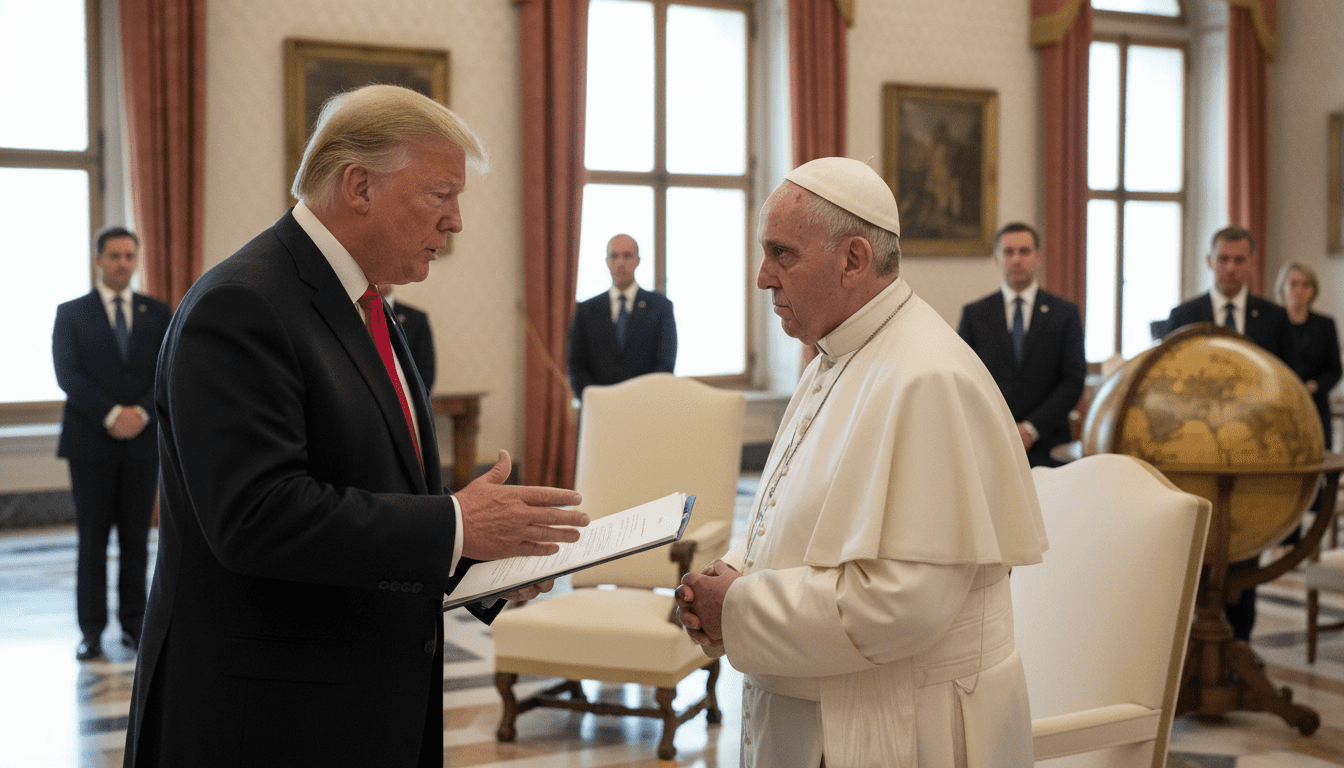
Pope Leo XIV says he will not engage further with President Trump over Iran war
Pope Leo XIV says he won’t engage further with President Trump over the Iran war, focusing on preaching peace and rejecting threats to civilians, urging calm.
Pope Leo XIV said he would not enter into another public confrontation with U.S. President Donald Trump over the conflict involving Iran, insisting his priority remains preaching a message of peace. The pontiff framed his restraint as a desire to avoid escalating a media narrative that grew out of presidential comments and subsequent commentary. He reiterated that it was not his intention to contradict the president and that he would continue to speak on moral and humanitarian principles. The statement follows a sharp exchange between the Vatican and the White House that has drawn wide attention.
Pope Leo XIV refuses further public dispute with President Trump
The pope told reporters that pursuing a personal dispute with the U.S. president was “not in my interest” and that he preferred to devote his energy to pastoral duties and calls for reconciliation. He said much of the controversy arose from interpretations of comments rather than from direct disagreement. According to the Vatican summary, subsequent articles and social commentary amplified those interpretations into a perceived confrontation. The pontiff sought to close the door on a bilateral spat while maintaining his public moral stance.
Origins of the clash: remarks on Iran and omnipotence
The dispute began after the pope criticized what he called a “delusion of omnipotence” that, he said, fuels wars such as the campaign against Iran and other conflicts around the world. He specifically condemned any rhetoric that threatened to destroy entire civilian populations, calling such threats “absolutely unacceptable” and contrary to Catholic teaching on the sanctity of life. Those remarks were framed by some commentators as a rebuke directed at the U.S. president’s language about Iran. Vatican officials later clarified that the pope’s comments were intended as a broader moral critique rather than a personal attack.
Trump’s sharp rebuttal and accusations
President Trump reacted angrily to the pope’s call to end hostilities in the Middle East and Ukraine, accusing the pontiff of leniency toward crime and alleging a tilt toward the “radical left.” In a series of posts and statements, the president described the pope’s foreign-policy position as “terrible” and argued the pontiff’s American background influenced his election in ways linked to interactions with the White House. The administration’s messaging portrayed the exchange as political rather than moral, intensifying the public dispute and drawing responses from international observers.
Papal clarification and references to “tyrants”
In follow-up remarks, Pope Leo XIV said an inaccurate narrative had circulated and stressed he did not seek to contradict any specific politician. He also spoke of a “handful of tyrants” reshaping global affairs without naming individuals, a phrase that commentators connected to the wider dispute. The pope affirmed he was not intimidated by any government and reiterated the church’s historical role in speaking out against threats to civilians. Vatican aides described the pontiff’s language as pastoral and prophetic rather than partisan.
Diplomatic stakes for Vatican–U.S. relations
Analysts say the exchange highlights a delicate balance for the Vatican, which must weigh moral advocacy against the practicalities of diplomatic engagement with a major power. The Holy See traditionally pursues quiet diplomacy on sensitive security issues while also invoking moral norms publicly when it deems them necessary. Observers note a risk that personal antagonism could complicate Vatican access to U.S. policymakers on humanitarian and conflict-resolution initiatives. Yet the pope’s decision to step back from direct confrontation may be aimed at preserving those channels while keeping moral pressure in public statements.
International and ecclesiastical responses to the dispute
Responses have varied across governments, religious leaders and policy experts, with some praising the pope’s insistence on protecting civilians and others urging restraint from both sides. Catholic bishops and diplomats emphasized the importance of keeping lines of communication open to enable mediation and relief efforts. Foreign ministries in Europe and the Middle East have been monitoring the rhetoric for signs it might affect negotiations or military calculations. NGOs working in conflict zones warned that escalatory language can exacerbate risks for civilians and hinder humanitarian access.
The episode underscores the pope’s dual role as a spiritual leader and a global moral voice, and it raises questions about how the Vatican will navigate public criticism of powerful states going forward. Pope Leo XIV’s announcement that he will avoid further public wrangling with President Trump signals a tactical retreat from personal confrontation while preserving a platform to press for peace. Observers will watch whether the reduced public rhetoric leads to quieter diplomatic engagement and whether the appeals for calm have any measurable effect on tensions surrounding the Iran conflict.
