
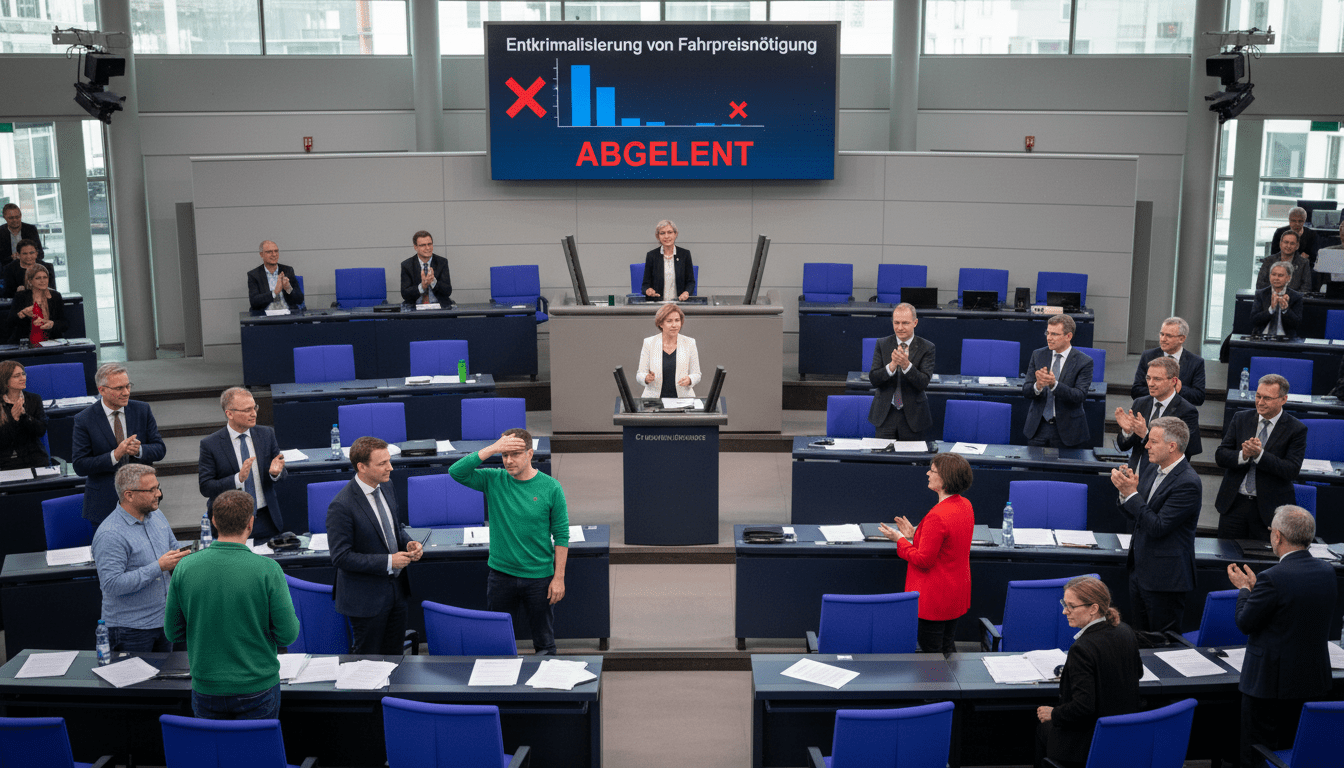
Bundestag Rejects Decriminalization of Fare Evasion in Second Reading
Meta description: Bundestag defeated proposals to decriminalize fare evasion, keeping Section 265a StGB in force as lawmakers clash over fines, prison terms, and social justice.
The Bundestag on Thursday rejected bids to decriminalize fare evasion, defeating proposals from the Greens and The Left in a second reading that would have removed criminal penalties for riding public transport without a valid ticket. The decriminalization of fare evasion was discussed at length, with opponents arguing it would reward unlawful behaviour and proponents warning that current rules funnel poor people into the criminal justice system.
Parliamentary vote and outcome
In the vote, the parliamentary groups for the CDU/CSU, SPD and AfD opposed the draft bills, while the Green and Left caucuses pressed for change. Two separate proposals failed to secure a majority, leaving the status quo under Section 265a of the Criminal Code intact. Lawmakers recorded sharply divided speeches that reflected broader political and social tensions over public services and criminal policy.
Arguments from the largest parties
During the debate, CDU lawmakers framed decriminalization as unfair to law-abiding passengers who purchase tickets, with CDU MP Alex Müller warning that responsible commuters would “feel like the dupes.” The AfD echoed the warning and spoke of a slippery slope toward further decriminalizations in other areas of law. The SPD, despite public statements of support for reform, voted against the measures in parliament, a decision critics attributed to coalition discipline and political calculation.
Voices for decriminalization
Left and Green MPs argued the criminal penalty disproportionately harms people with limited means and cited cases where unpaid fines led to substitute imprisonment. Left MP Luke Hoß said those who cannot afford tickets are “anything but criminals” and urged the SPD to prevent people from ending up behind bars for poverty-driven offences. Green MP Helge Limburg emphasized that decriminalization would not remove all sanctions, noting that administrative fines and other enforcement tools could still apply.
Justice minister’s position and legal rationale
Federal Justice Minister Stefanie Hubig (SPD) publicly supported decriminalization last week, urging a reassessment of the practice of Ersatzfreiheitsstrafen — substitute prison terms imposed when fines go unpaid. Hubig framed the reform as a measure to reduce court workloads and to prevent the criminal justice system from punishing poverty. Her intervention sharpened the debate but did not change the parliamentary arithmetic needed to advance a legal change.
Current legal framework and statistics
Riding public transport without a valid ticket is classified under German law as “Erschleichen von Leistungen” and is covered by Section 265a of the Strafgesetzbuch (StGB). Police crime statistics show that in 2024 there were more than 93,000 incidents in which officers were involved with alleged fare evasion or related enforcement actions. Those statistics do not separate all cases of fare evasion from other offences, but they underline the volume of incidents that feed into enforcement and prosecutorial processes.
Practical consequences for offenders and operators
Under the existing criminal framework, offenders can face criminal charges that, if converted into unpaid fines, may ultimately result in substitute imprisonment for those unable to pay. Transport operators and enforcement agencies warn that removing criminal penalties could complicate ticket-control regimes and burden operators with higher enforcement costs. Advocates for reform counter that administrative fines, targeted social support and improved fare-policy design could maintain deterrence without criminalizing poverty.
Political implications and next steps
The defeat of the decriminalization proposals is likely to keep the issue alive in party platforms and civic debate ahead of upcoming municipal and national elections. The SPD’s split between its public stance and its parliamentary vote may provoke internal discussions about strategy and messaging within the ruling coalition. Lawmakers who favor reform may pursue narrower measures, such as ending substitute imprisonment for unpaid ticket fines or expanding social exemptions, rather than full decriminalization.
Public transport users, civil society groups and legal scholars will watch whether the judiciary or regional legislatures take incremental steps to soften penalties or whether future federal bills return with revised compromise language. The tension between maintaining order on public transit and avoiding criminal sanctions for economically vulnerable people ensures the debate will continue.
