
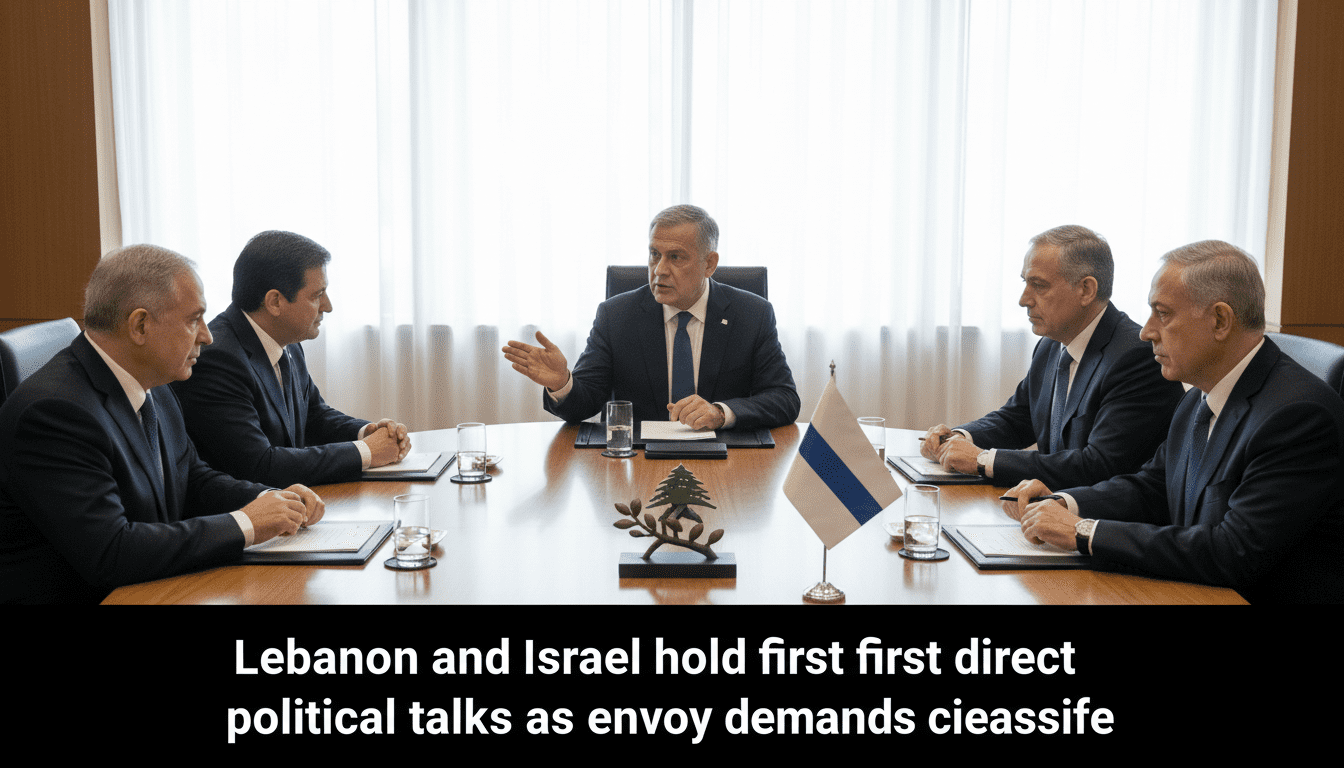
Lebanon-Israel talks in Washington mark first direct political contact in decades
Diplomatic talks in Washington seek ceasefire, return of displaced and practical relief amid weeks of cross-border fighting between Israel and Hezbollah.
Opening summary
Lebanon-Israel talks convened in Washington on Tuesday evening, bringing the Lebanese ambassador to the United States and the Israeli representative in the capital into direct political contact for the first time in decades. The talks, framed around an urgent push for a ceasefire and humanitarian relief, signal a rare diplomatic opening after weeks of mutual attacks along the border. Officials described the meeting as a preliminary effort to halt violence and address the mounting displacement and suffering inside Lebanon.
Diplomatic meeting in Washington
The discussions were led by Lebanon’s ambassador to the United States, Nada Hamadeh Moawad, alongside Israel’s Washington representative Jechiel Leiter. Delegations met in the U.S. capital amid heightened tensions after repeated exchanges between Israeli forces and the Lebanese Hezbollah militia. Observers noted the unusual bilateral nature of the contact, since formal political channels between the two neighboring states have been effectively frozen for many years.
Beirut’s demands: ceasefire and return of displaced
After the meeting, Ambassador Moawad told Lebanese broadcaster MTV that she had pressed for an immediate ceasefire, the safe return of those displaced by the fighting, and practical measures to ease a severe humanitarian crisis. Lebanese officials emphasized that restoring access to basic services and securing routes for aid delivery were urgent priorities. The delegation framed these demands as preconditions for stabilizing frontline communities and preventing further civilian suffering.
UN chief calls for Lebanon to no longer be a battleground
United Nations Secretary-General António Guterres weighed in from New York, calling on all parties to keep Lebanon out of the Israel–Hezbollah confrontation. Guterres warned that the cycle of violence has repeatedly undermined Lebanon’s fragile political institutions and urged both sides to pursue cooperation rather than escalation. The secretary-general’s comments underscored international concern that the conflict risks broader destabilization across the region.
Security realities and humanitarian strain
The Lebanon-Israel talks come against a backdrop of weeks of tit-for-tat strikes that have displaced thousands and damaged critical infrastructure in southern Lebanon. Humanitarian agencies report crowded shelters, interrupted utilities and limited access to medical care in affected areas. Security analysts cautioned that any durable arrangement will require not only a ceasefire but mechanisms to monitor compliance and limit the ability of armed non-state actors to reignite hostilities.
Political significance and potential steps forward
Diplomats described the Washington meeting as an exploratory step rather than a settlement, saying it could open channels for further coordination and multilateral mediation. International actors, including the United Nations and regional partners, are expected to play a role in translating diplomatic language into verifiable measures on the ground. Key questions remain about how to reconcile Lebanon’s internal political divisions, Hezbollah’s military capacity, and Israel’s security demands while delivering immediate humanitarian relief.
Obstacles to implementation
Observers point to several obstacles that could complicate progress from talks to tangible results, including deep mistrust between the parties and competing domestic constituencies in Beirut and Jerusalem. The Lebanese government’s limited control over armed groups and the political leverage of militias complicate conventional state-to-state diplomacy. In addition, practical steps such as safe corridors for aid and organized returns of displaced people will require security guarantees and international oversight to be credible.
The Lebanon-Israel talks in Washington represent a cautious diplomatic opening, but officials and analysts say meaningful relief will depend on rapid follow-through, robust monitoring, and sustained international engagement to prevent a relapse into wider violence.
