
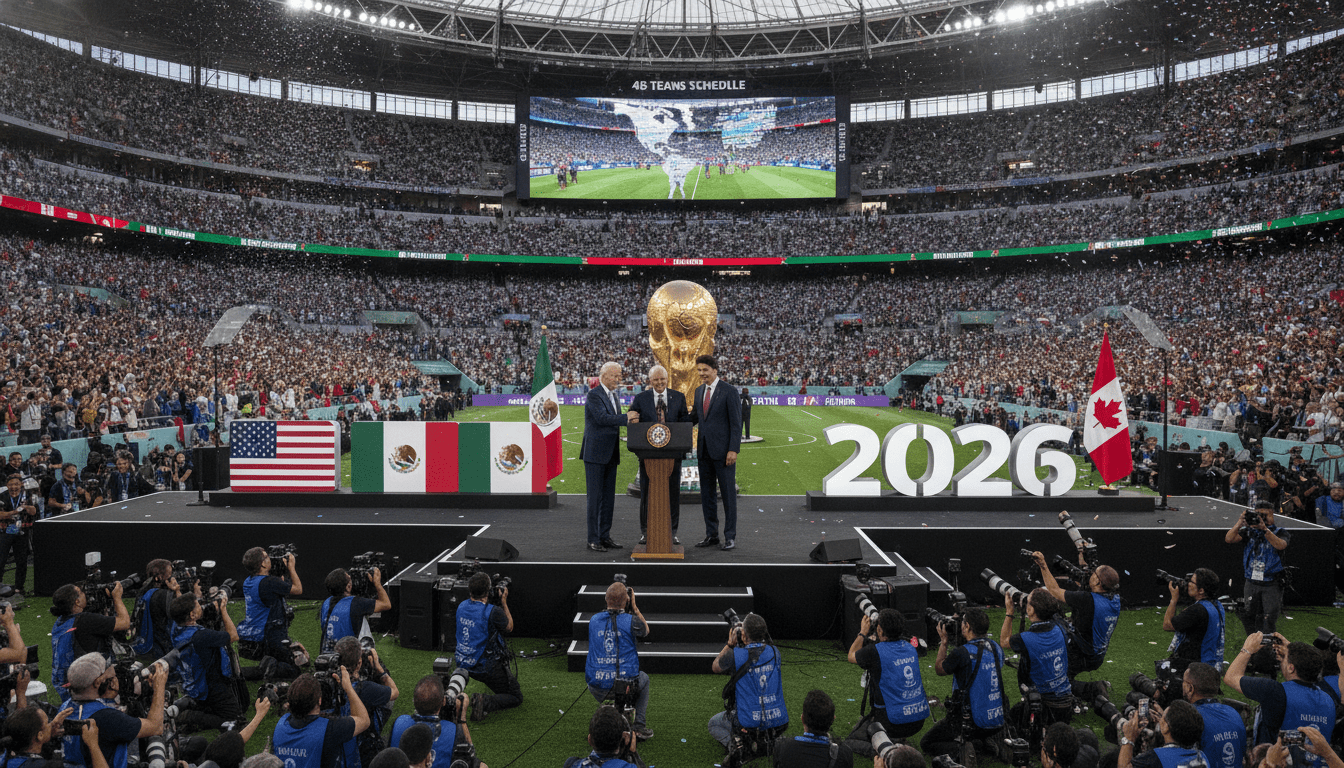
World Cup 2026 full schedule and groups with Germany results and key fixtures
Complete schedule and group overview for FIFA World Cup 2026 in USA, Mexico and Canada. Stadiums, Germany results, TV coverage and key knockout dates.
The World Cup 2026 opened as the largest tournament in history with 48 teams competing across North America. The expanded format and 16 host stadiums have produced a dense schedule of 104 matches, with group play running from June 11 to July 19, 2026. This article summarizes the schedule, group composition, Germany’s progress and where to watch the remaining fixtures.
Tournament format and schedule
The tournament features twelve groups of four teams, with the top two in each group advancing automatically to the knockout phase. In addition, the eight best third placed teams qualify for a new round of 16, creating a 32-team knockout bracket. Group play is followed by the sixteenth finals, round of 16, quarterfinals, semifinals, a third place match and the final on July 19, 2026.
Match timings are shown in Central European Summer Time for convenience because most coverage targets European viewers. Kickoff times have been adjusted for local time zones across the USA, Mexico and Canada, producing differences of six to nine hours from CEST. The compact schedule spreads 104 games across 16 venues and 39 host cities between June 11 and July 19, 2026.
Groups and key fixtures
The draw produced a mix of established powers and surprise qualifiers across the twelve groups. Notable pools include Group C with Brazil and Scotland, Group I with France and Norway, and Group E where Germany faces Curaçao, Ivory Coast and Ecuador. Several groups promise high stakes from the first matchday, increasing the importance of goal difference and goals scored under the tournament tie breakers.
Early group results have already shaped the picture for the knockout race, with big wins and tight draws altering expected pairings. The new mechanism that admits eight third placed teams means teams in certain groups must wait up to two days to confirm progression, adding uncertainty for squads finishing third in Groups A, B or C. That waiting period has tactical implications for coaches and selection decisions late in group play.
Germany campaign and upcoming tie
Germany began its campaign with a commanding 7-1 victory over Curaçao on June 14 in Houston, with Kai Havertz among the scorers in a comprehensive opening performance. The DFB team followed up with a narrower 2-1 win against the Ivory Coast on June 20 in Toronto, a match decided after a change of momentum following substitutions. Substitute Deniz Undav provided decisive influence by scoring and creating chances, while Nadiem Amiri also helped shift the game in Germany’s favour.
Having won Group E, Germany now faces a group third in the round of 16 on Monday, June 29, 2026 in Boston if fixtures hold to the published schedule. The final group match for Germany is scheduled for Thursday, June 25, 2026 in New York against Ecuador at 22:00 CEST, an encounter that will finalize seedings for the knockout phase. The coaching staff must balance rotation with maintaining momentum as the team moves into the single elimination rounds.
Stadiums, hosts and time zones
The World Cup 2026 is the first edition hosted by three countries and staged at 16 stadiums. The United States supplies 11 venues, Mexico three and Canada two, distributing 104 matches across multiple time zones. Key venues include Mexico City’s Azteca Stadium, East Rutherford’s New York New Jersey Stadium, and the large-capacity Dallas venue that will host several marquee fixtures.
Capacities range from around 45,000 in Toronto to stadiums exceeding 80,000 seats in Mexico City and East Rutherford, and a near-94,000 seat facility in Dallas. Organizers have highlighted the logistical challenge of travel and recovery for teams moving between city clusters, while broadcasters and fans outside North America rely on CEST times to plan viewing, usually six to nine hours ahead of local kickoffs.
Television broadcasting and streaming
Public broadcasters in Germany and other European markets share coverage responsibilities, with major free to air channels scheduled to carry a large portion of the tournament. ARD and ZDF are transmitting a combined block of fixtures across group and knockout stages, covering approximately 60 of the 104 matches for free to viewers in Germany. Pay and subscription services carry the full slate, offering every match live via dedicated platforms.
MagentaTV offers full coverage of all tournament matches through its subscription service, and both public broadcasters provide live streams in their respective media libraries and sports apps. Rights holders have coordinated schedules to ensure key matches reach broad audiences in Europe while also accommodating local broadcast partners in the USA, Mexico and Canada.
Knockout pathway and decisive dates
The round of 16 is set to begin at the end of June and will determine the field for the quarterfinals, semifinals and final on July 19. Important knockout fixtures include Germany’s potential round of 16 match on June 29 in Boston and the final, scheduled for Sunday, July 19, 2026 in New York at 21:00 CEST. The semifinals are slated for July 14 and 15 with venues in Dallas and Atlanta respectively.
Tie breaking in group play follows a set sequence that begins with goal difference and goals scored, then head to head results and finally fair play points if teams remain level. With the expanded format, the route to the final is longer and more variable, increasing the chance for unexpected matchups and underdog runs deep into the tournament.
The World Cup 2026 has combined an expanded field, a multi nation hosting model and intensive scheduling to create one of the most complex global tournaments in recent memory. Fans can follow every match through the mix of free to air and subscription services, while teams now prepare for a knockout phase that promises tight margins and decisive moments.
