
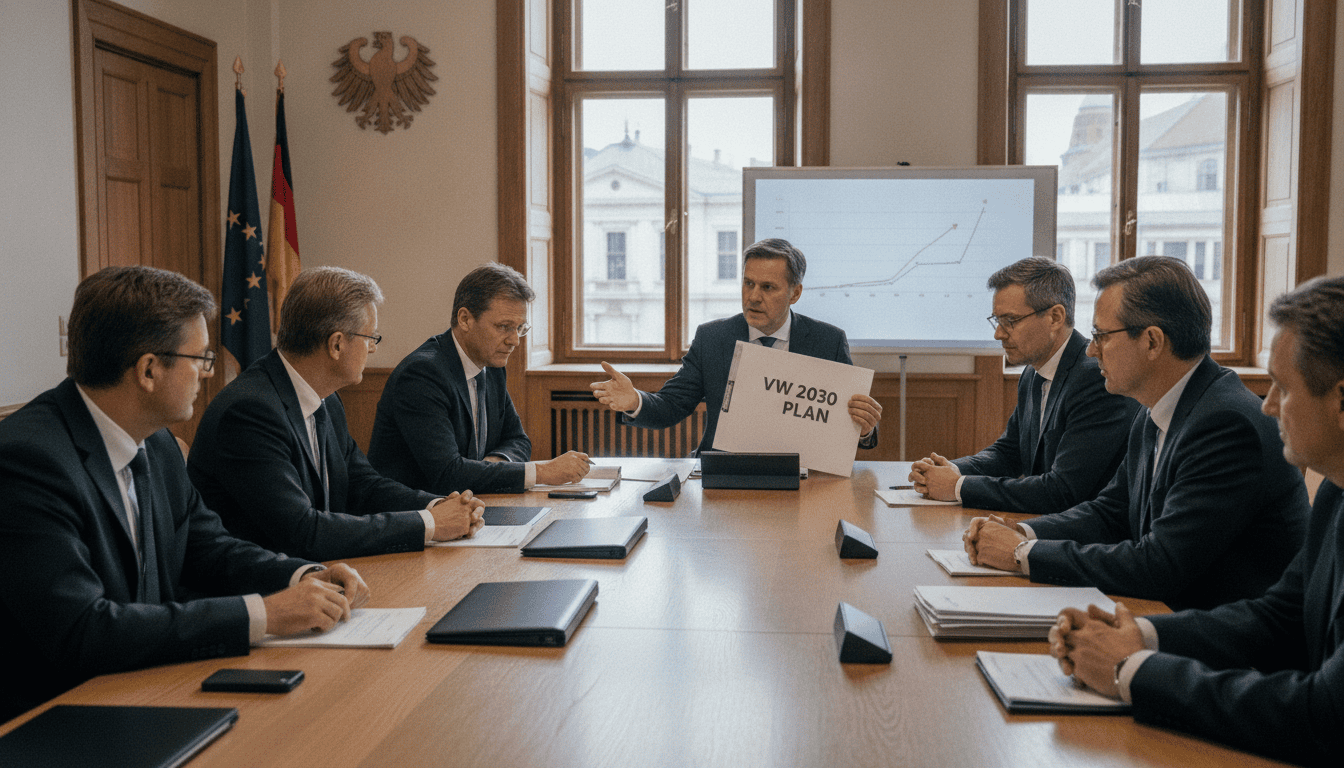
Volkswagen savings plan sparks political and union backlash as board unveils “Zielbild 2030”
Lower Saxony and unions demand clarity after Volkswagen presents a 12-point savings plan, proposing drastic model and option cuts while leaving job and plant impacts uncertain.
Volkswagen’s newly presented Volkswagen savings plan, framed by the board as a long-term “Zielbild 2030,” has prompted sharp criticism from state politicians, works councils and unions who say the company has failed to provide a clear, socially responsible roadmap. Lower Saxony’s economy minister said the uncertainty among factory workers is palpable and urged the board to deliver a coherent overall concept without further delay. Company leadership describes the package as the most comprehensive reorientation in Volkswagen’s history, but key details on staffing and site decisions remain undisclosed.
State minister demands a clear, accountable plan
Lower Saxony’s economy minister pressed Volkswagen to stop circulating anxiety among employees and to table a full, implementable strategy for the Volkswagen savings plan. He argued it is the board’s responsibility to present a credible blueprint that reconciles cost reduction with safeguarding jobs and production. The minister criticized the current communication as indecent toward the workforce and warned that continued ambiguity will erode trust across the supplier, employee and customer base.
Political leaders in the region echoed that stance, saying any cost strategy must be paired with prospects for competitive products and commitments to the German sites. They pressed the company to translate high-level initiatives into concrete measures that make sense for workers and for the region’s industrial ecosystem.
Board outlines ‘Zielbild 2030’ with model and option reductions
Volkswagen’s management told the supervisory board it had prepared a package of 12 initiatives under a target framework called “Zielbild 2030.” According to the company’s presentation, the plan would gradually reduce the model range by up to half and cut the number of optional equipment configurations by as much as 75 percent. Executive statements framed the package as a necessary step to strengthen competitiveness amid mounting global pressures in the auto industry.
Company leaders positioned the measures as risk-limiting and opportunity-enhancing, intended to sharpen product portfolios and lower structural complexity. Despite these declared aims, the presentation did not include immediate figures or timelines for potential workforce reductions or plant closures, leaving several stakeholders unsettled.
Works council and unions demand immediate answers and protections
The group representing Volkswagen employees demanded an early, public accounting from the chief executive and called for robust protections for staff. Works council leadership described the board’s communication as irresponsible, saying it was unacceptable to leave employees uncertain while sending them into leave or vacation periods. The council insisted on measures that prevent forced closures and limit layoffs to voluntary, socially compatible programs.
Union negotiators also condemned the way the savings plan was communicated, calling it a communications failure that sows fear in entire regions dependent on Volkswagen employment. They signaled readiness to resist involuntary cuts and to press for transparent, negotiated solutions that preserve employment where possible.
Regional leaders reject closures and seek firm site commitments
Senior state politicians from Lower Saxony and Saxony pressed Volkswagen to commit publicly to keeping plants operational unless an alternative that secures jobs and capacity is demonstrably superior. The governors argued that plant closures are not a strategy for long-term competitiveness and that previous assurances to certain sites must be honored. They cited specific concerns about facilities that have recently been repositioned for electric vehicle production.
These leaders warned that abrupt shifts away from pledged investments would undermine trust with employees and consumers, and could damage the company’s reputation in key domestic markets. They demanded that any rationalization be accompanied by clear guarantees and investment plans for the affected regions.
Analysts say unanswered questions could harm customers and investors
Independent analysts highlighted that fundamental questions remain about the precise implications of the Volkswagen savings plan for employment, production allocation and capital spending. Industry observers noted the paradox of calling for a leaner product range while insisting on maintaining market presence and innovation capacity. They warned that prolonged uncertainty could depress demand, damage supplier relationships and unsettle capital markets.
Some reports circulating in the business press have suggested scenarios involving large-scale job reductions and potential plant losses, figures that company spokespeople have not confirmed. Analysts urged the board to publish detailed assumptions, timelines and mitigating measures so stakeholders can assess both risks and opportunities realistically.
Volkswagen has said the package represents the company taking responsibility for a sustainable future in a highly pressured global automotive market, while representatives of workers, unions and regional governments have demanded a more inclusive, transparent process. The coming days will test whether the board can convert strategic aims into a plan that balances competitiveness with social responsibility, or whether the dispute over the Volkswagen savings plan will deepen uncertainty for employees and communities.
