
U.S. Signals Possible Hold on French Ambassador Accreditation After UN Vote Row
U.S. may delay or block French ambassador accreditation after Paris criticized Washington’s UN vote on the human-rights chief, heightening diplomatic tensions.
U.S. indicates potential delay or block on accreditation
A U.S. warning to potentially delay or block the French ambassador accreditation has thrust Franco-American ties into the spotlight. Reuters reported the move on Thursday after Paris publicly criticized Washington’s vote at the United Nations, a development that could stall the arrival of France’s proposed envoy in Washington, D.C.
French officials have not formally commented on the reported steps, but the suggestion of a hold marks an unusually direct diplomatic response tied to behavior at the UN. The prospect of delaying an accredited ambassador underscores how tensions in New York are spilling into routine bilateral protocols in Washington.
Details of the UN vote that sparked the dispute
The dispute follows a high-profile UN vote to renew the mandate of the UN High Commissioner for Human Rights, Volker Türk, who has served in the role since 2022. A strong majority of UN member states backed the renewal, with 144 countries voting in favor, while only ten voted against, according to diplomatic summaries of the session.
The United States was among the minority opposing Türk’s reappointment, aligning its vote with a small group that included North Korea, Russia and several African and Latin American states. Paris seized on Washington’s stance, criticizing the U.S. in public statements and social posts and framing the U.S. vote as out of step with broader international opinion.
Paris’s criticism and Macron’s nominee in Washington
French officials framed their response as a defense of international human-rights scrutiny, issuing pointed criticism after the U.S. opposition became public. The French UN mission’s social media posts accused the United States of isolating itself alongside authoritarian regimes, language that provoked a strong rebuttal from Washington.
President Emmanuel Macron had proposed Aurélien Lechevallier, a career diplomat and current head of the office for Foreign Minister Jean-Noël Barrot at the Quai d’Orsay, as France’s next ambassador to the United States. Lechevallier, a Sciences Po alumnus who studied alongside Macron, was slated to assume the Washington post in September, but his arrival now faces uncertainty given the reported U.S. response.
U.S. delegation’s walkout at the UN session
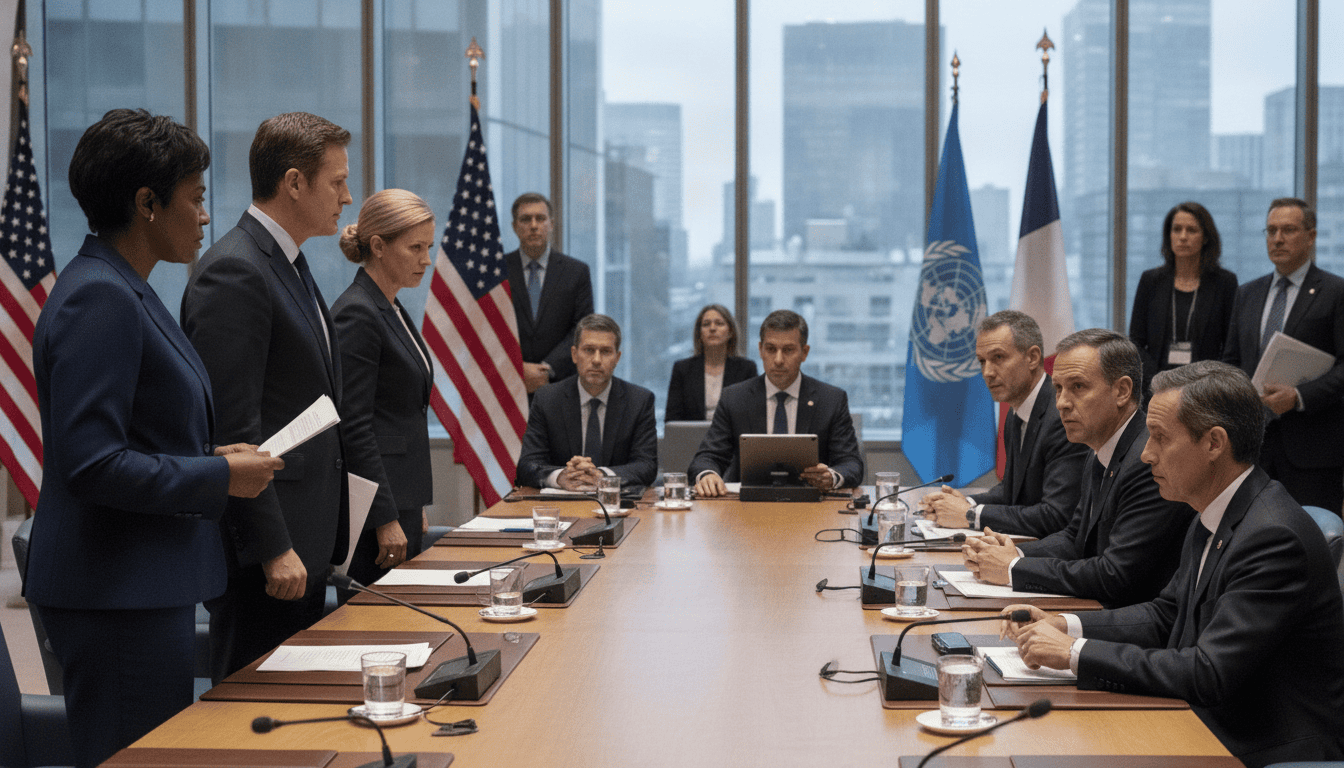
Tensions escalated on the floor of the UN when the American delegation staged a demonstrative walkout as France’s UN ambassador, Jérôme Bonnafont, took the podium. The walkout was presented by the U.S. mission as a refusal to listen to what it characterized as disrespectful rhetoric from Paris.
Dan Negrea, the U.S. ambassador to the UN, described the French statements as unacceptable and said the delegation would not remain for the speech. Negrea, a close ally of former President Donald Trump who pledged at his confirmation to reinvigorate U.S. engagement at the UN, has since advocated for funding cuts to the UN human-rights apparatus as a response.
Wider implications for bilateral ties and UN funding
The spat at the UN highlights simmering disagreements between Paris and Washington over both rhetoric and policy toward multilateral institutions. France has publicly opposed recent U.S.-led proposals to reduce funding for the UN human-rights office, arguing that such cuts undermine the institution’s mandate and credibility.
Diplomats caution that the accreditation impasse could have broader consequences if it becomes a precedent for linking ambassadorial credentialing to political disputes at international organizations. Blocking or delaying a high-ranking envoy risks adding a new layer of official strain between two NATO partners that already differ on specific policy choices.
France and the United States maintain deep strategic, economic and security ties, but episodes like this expose how quickly disputes over language and votes in New York can reverberate into capital-to-capital relations. Observers say the coming weeks will be critical to see whether the disagreement is resolved through quiet diplomacy or escalates into reciprocal measures.
The next weeks will show whether Washington follows through on reported plans to impede accreditation and whether Paris will seek to de-escalate the public rhetoric that prompted the response. International diplomats say both sides still have strong incentives to limit damage and restore working channels before long-term appointments and cooperation are affected.
