
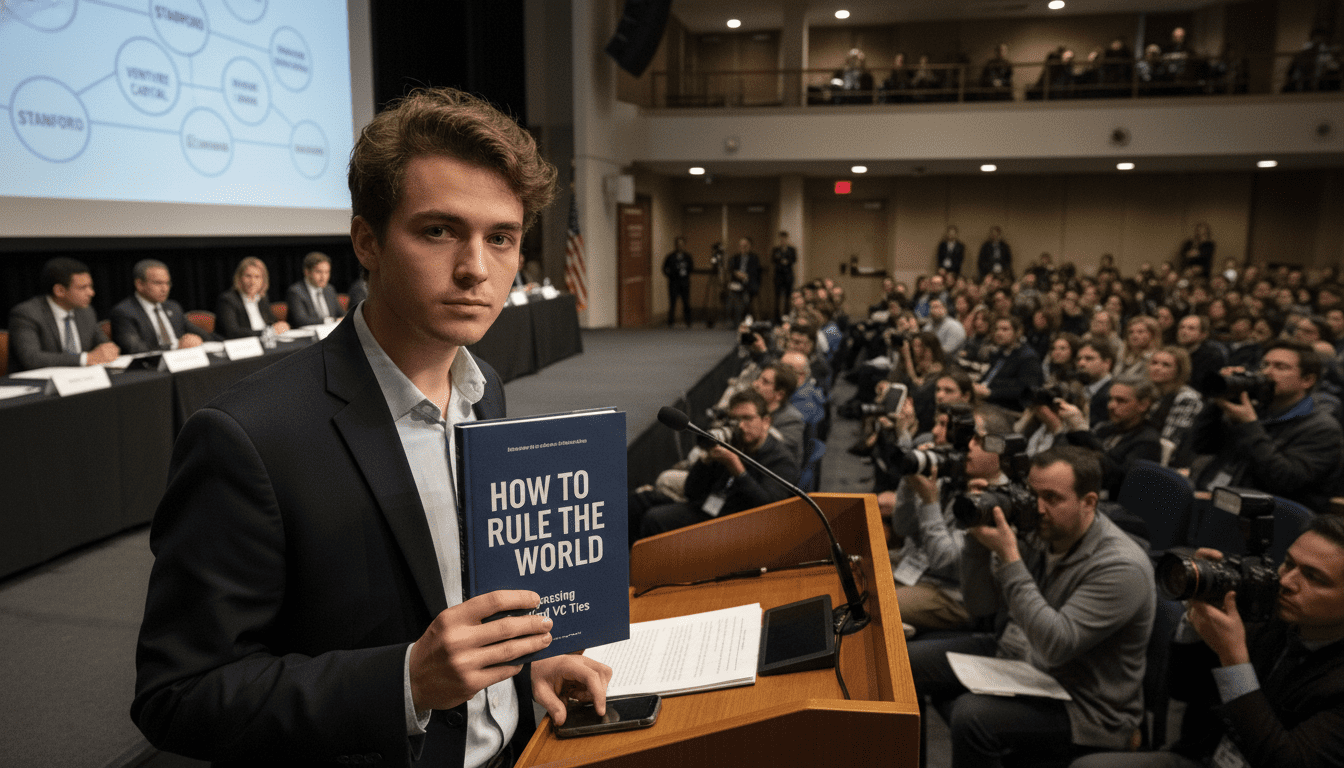
Theo Baker’s How to Rule the World Exposes Stanford’s Venture-Capital Inner Circle
Theo Baker’s new book How to Rule the World chronicles his freshman-year reporting that forced a university president’s exit and probes Stanford’s close ties to venture capital and elite feeder networks. The author — a George Polk Award recipient whose reporting has been optioned for adaptation — frames the book as an account of how talent is scouted, cultivated and monetized inside an elite campus culture. Baker’s narrative arrives as a broader conversation about universities, money and influence intensifies.
Freshman reporter to award-winning investigator
Theo Baker began at Stanford intending to study computer science and entrepreneurship, but he joined the student newspaper as a way to connect with family memory and found himself reporting serious allegations. Within months he followed online scientific critiques to questions about research integrity that ultimately triggered institutional scrutiny of the university president’s publications. His work won national recognition and drew the attention of filmmakers and major producers, accelerating debate about journalism on campus.
The scale of Baker’s impact is unusual for a student journalist: coverage that started in campus pages reverberated through national media, prompted internal investigations, and culminated in public pressure on university leadership. The trajectory from campus reporting to broad public consequence is a central strand of the book and a practical example of investigative journalism’s reach.
Allegations, investigations and institutional conflict
Baker’s reporting focused on alleged irregularities in scientific papers associated with senior university figures, and those allegations set off a chain of institutional responses that he chronicles in detail. He describes the tension between independent scrutiny and official inquiries, including the awkward dynamics when trustees with financial ties oversaw investigations into matters touching on their own investments.
The book frames those dynamics as emblematic of conflicts that can arise when academic authority, corporate connections and reputational defense intersect. Baker recounts pushback from powerful quarters, including legal challenges and public denials, and uses those episodes to explore how institutions manage — and sometimes mismanage — crises that implicate both scholarship and money.
A “secret class” and the mechanics of talent scouting
Central to Baker’s argument is an account of informal networks and selective programs that operate alongside formal campus life, which he calls a talent-extraction system that privileges access over merit. He details a small, invite-only seminar taught by an influential Silicon Valley figure and portrays it as a symbolic gateway into an ecosystem where elite connectivity confers outsized advantages.
According to Baker, this ecosystem involves venture capitalists, alumni, and upperclassmen acting as gatekeepers who steer promising freshmen into pathways that fast-track funding and mentorship. He argues this cultivation model can blur the line between legitimate development of talent and an early-stage market in students’ futures.
Campus culture amid cycles of hype: crypto to AI
Baker landed at Stanford during a moment of rapid technological and financial churn, arriving as the crypto boom collapsed and generative AI technology surged into public view. He observes that these cycles reshape student aspirations and risk tolerance, with many peers pivoting quickly from one hyped promise to the next in pursuit of breakthrough success.
That volatility, he writes, encouraged a mindset in which founding startups or securing venture backing became more attractive than traditional early-career roles, reinforcing a culture in which entrepreneurship is the expected outcome rather than one of many paths. The book connects those cultural shifts to broader labor-market anxieties and to structural incentives inside elite programs.
How networks shape outcomes and the danger of “wantrepreneurship”
Baker explores a vocabulary used on campus to distinguish between genuine builders and “wantrepreneurs,” suggesting that the allocation of attention and resources often depends on social signals rather than demonstrable achievement. He describes scenes where young students are courted at upscale venues and evaluated more for potential optics than for durable product or research foundations.
His reporting links these practices to the vulnerabilities that enable larger-scale frauds or failures in the tech world: when youth and charisma are rewarded with capital and reputation without commensurate oversight, mistakes can have amplified consequences. Baker urges readers to consider whether current selection mechanisms protect the public interest as much as they enrich private actors.
Advice for incoming students and Baker’s next steps
Baker closes the book with practical counsel for students navigating elite institutions: be intentional about motivations, distinguish meaningful work from trend-following, and prioritize projects that align with one’s values rather than simply with prestige. He emphasizes that choosing an unconventional path rooted in genuine curiosity can be more consequential than pursuing the easy route to status or wealth.
At the same time, the author reflects on his own evolution from a would-be founder to someone who has embraced investigative reporting as a vocation, noting that journalism continues to draw him even as he considers future projects. The book positions his reporting as part exposé, part campus ethnography, and part personal reckoning.
Theo Baker’s How to Rule the World aims to do more than recount a high-profile case; it seeks to interrogate how elite universities, venture capital and youth culture interact to shape power and possibility. The book will likely spur renewed scrutiny of campus networks and add a student-driven perspective to national debates about accountability in research and the commercialization of higher education.
