
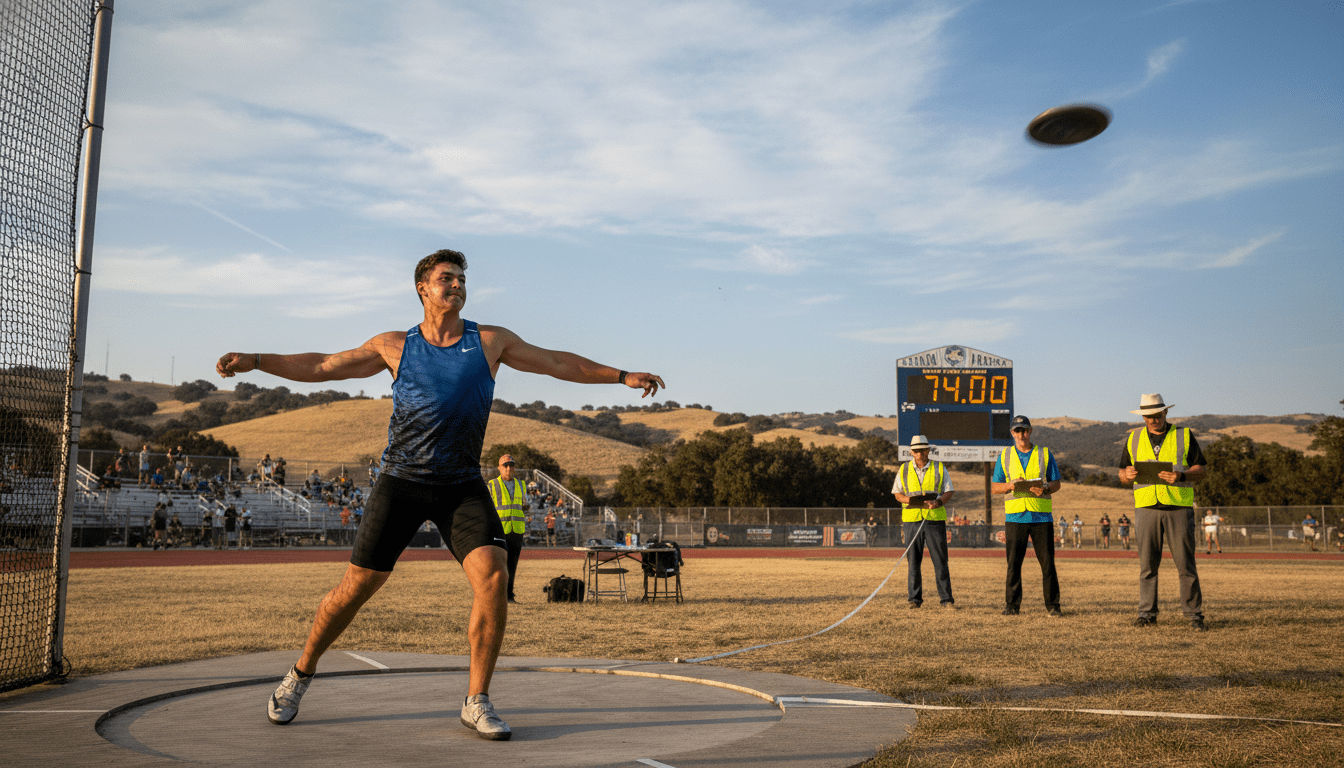
Steven Richter throws 74.00m in Ramona, reaching fourth on the all-time discus list
Steven Richter throws 74.00m in Ramona, Oklahoma, with five 70m+ attempts to reach fourth on the all‑time list and fall 8cm short of Schult’s 1986 German record.
Steven Richter announced himself among the world’s elite when he produced a 74.00 metre discus at a meeting in Ramona, Oklahoma, a performance that also included five throws over 70 metres. Richter’s 74.00m lift places him fourth on the all‑time list and left him a mere eight centimetres short of Jürgen Schult’s long-standing German record from 1986. The breakthrough came after a personal best of 69.61m, marking a dramatic shift in Richter’s competitive standing.
Richter’s Ramona performance
Richter entered the Ramona meeting aiming to clear 70 metres for the first time in his career, but the series of throws far exceeded expectations. He recorded five attempts beyond the 70‑metre mark and peaked at 74.00m, a mark that vaulted him into the sport’s historical top five. After the competition he received congratulations from Schult, who quipped that the extra centimetres were within reach.
The new mark rewrites Richter’s competitive profile and raises immediate questions about consistency outside Ramona. Richter himself conceded surprise, saying he could only estimate distances on site because the specially prepared field lacked the usual range markings. He relied on feel and the flight time of the discus to judge quality, underscoring the unexpected nature of the performance.
Why Ramona yields extreme distances
The Ramona site—nicknamed “Throwklahoma”—has become synonymous with exceptionally long discus throws due to a unique combination of geography and wind. The throwing area sits slightly elevated above its surroundings, which reduces wind disruption and allows a steady, supporting breeze to develop. Organizers also provide multiple throwing circles with different orientations so athletes can align with the prevailing wind.
Those conditions have produced several of the sport’s largest marks, including the current world record of 75.56 metres by Mykolas Alekna a year prior. Throwers in Ramona commonly report that the wind keeps the discus aloft longer, often adding metres that are harder to achieve in standard stadium environments. Richter acknowledged that the site’s boost must be weighed when projecting stadium results.
Equipment choices and data‑driven preparation
An unexpected element of Richter’s preparation was a data review of his implements using an AI tool before the competition. He said the analysis highlighted differences in rim weight across discuses, leading him to select a model with a heavier outer ring. Richter believes that heavier rim mass stabilised the discus in flight and suited his explosive, fast release, especially under Ramona’s gusting conditions.
The equipment decision illustrates a growing trend among elite throwers to combine traditional coaching with technical evaluation of implements. Richter attributed part of his Ramona success to that choice, noting the heavier rim allowed some margin for small errors at release while still producing long flight.
Coaching, training and technical targets
Richter competes for LV Erzgebirge and trains at the German federal centre in Chemnitz under Sven Lang, with additional technical input from coach Steve Harnapp. Lang’s experience—having guided world champions in the throws—frames Richter’s development, and Harnapp’s arrival has added detailed technical work to the programme. Richter says changes this year have raised his baseline, with winter training translating to unexpectedly long early‑season marks.
Physically, Richter reports no shortfall: he believes he has ample strength and rotational speed. His focus is on mobility and refining the timing between hip and shoulder rotation to create greater separation at release. He identified the “wringing” between hips and arms as an area with measurable upside, and coaches are prioritising drills that increase that twist to amplify the final sling of the discus.
Competition outlook and championship ambitions
The timing of Richter’s breakthrough coincides with shifting dynamics among the world’s top throwers after an injury to Mykolas Alekna. Richter sees opportunity for German throwers, including Henrik Jansen and Mika Sosna, to challenge for top‑five finishes at the upcoming European Championships in Birmingham. His immediate competitive plan includes the Golden Oval meeting in Dresden, where he will face Matthew Denny — the Australian whose personal best sits at 74.78 metres.
Richter frames his next targets pragmatically: reach finals in major championships and establish the ability to throw 68–70 metres in regular stadium conditions. He accepts that Ramona’s conditions can inflate distances, but insists that translating more of that form into standard events is the realistic path to medals. The German throws group now projects multiple contenders rather than a single standout.
Richter’s Ramona series alters expectations but not ambitions; he prefers to treat the 74.00m as a demonstration of potential rather than a new baseline. Continued technical refinement, targeted equipment choices and consistent results outside favourable venues will determine whether this breakthrough becomes a sustained rise amid the world’s best.
