
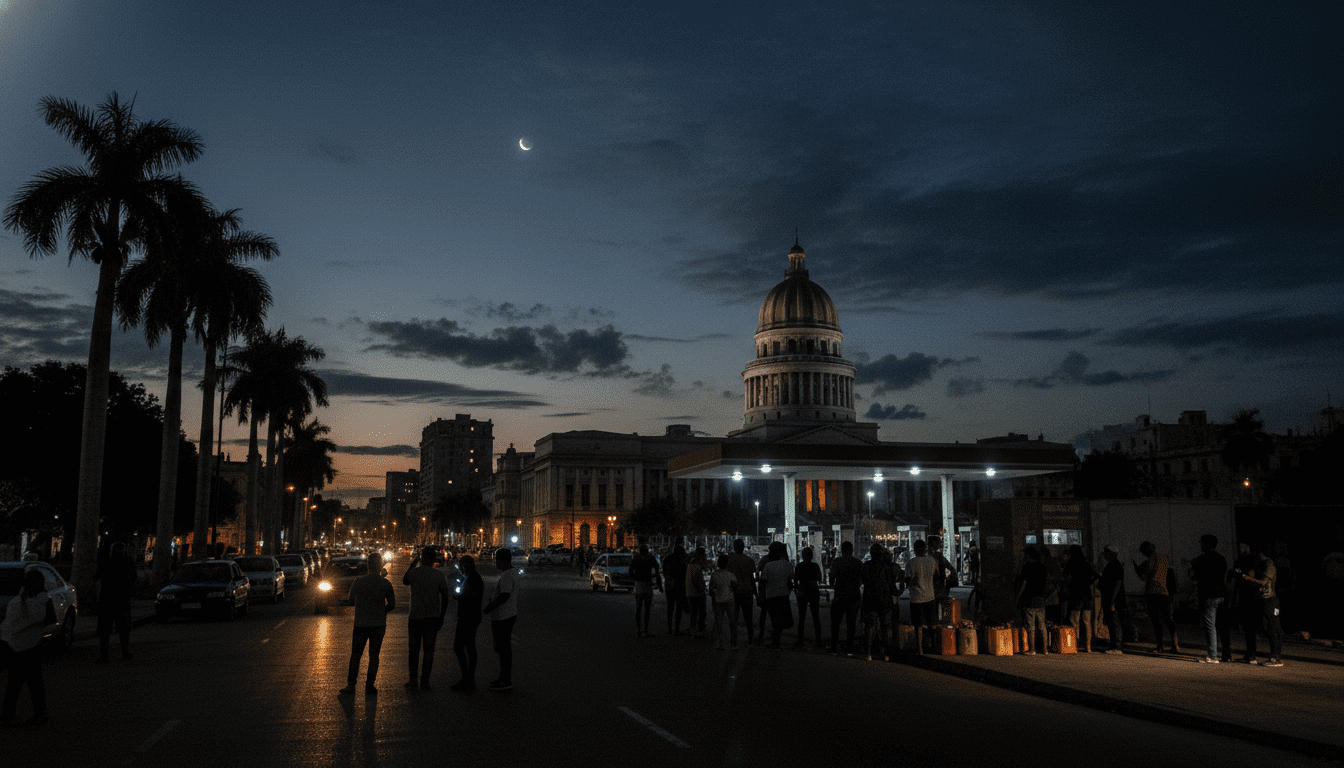
Cuba energy crisis deepens as blackouts, fuel shortages and sanctions cripple services
Cuba energy crisis intensifies with 12–16 hour blackouts, dwindling fuel after Venezuela halted shipments, and U.S. sanctions squeezing suppliers, experts say a U.S. deal is essential.
Havana endures 12–16 hour blackouts
Cuba’s energy crisis has pushed Havana and other cities into daily schedules of prolonged outages, with residents reporting up to 12–16 hours without power. The pattern of rolling blackouts has left public transport nearly absent and forced many to rely on walking or informal arrangements to reach schools and markets.
The extended outages are affecting hospitals, small businesses and household cooking routines, contributing to a growing humanitarian strain that officials and economists describe as acute. Local observers say only wealthier families or those receiving remittances can afford batteries, solar panels and other private backups.
Venezuelan shipments stopped after January leadership change
The island’s fuel supply has collapsed in part because Venezuela, long Cuba’s principal energy partner, ceased regular deliveries earlier this year. According to economic analysts, a change in Caracas’s leadership and concessions to U.S. pressure in January resulted in a halt to the oil shipments that had previously arrived on favorable barter terms.
Those Venezuelan deliveries had been a cushion for Cuba’s state-dominated economy, paid for largely with personnel and services rather than hard currency. With those barrels gone, Cuba has exhausted last large shipments and state reserves are now limited, officials and experts say.
U.S. sanctions and presidential threats squeeze remaining suppliers
Since early 2026 Washington has tightened pressure on countries and companies that supply fuel to Cuba, and senior U.S. officials’ public threats have compounded uncertainty. The measures and rhetoric have deterred alternative suppliers and contributed to a sharp drop in foreign partners willing to risk secondary sanctions.
Observers note that Mexico, previously a secondary supplier, scaled back shipments after being warned of punitive measures. Economists warn that without a relaxation of sanctions or a negotiated arrangement, Cuba’s options for emergency fuel imports will remain severely constrained.
Private diesel imports and a flourishing black market
A limited flow of private imports from the United States continues under exemptions to the embargo for certain enterprises, with small quantities of diesel arriving in isotanks on container ships. Those volumes, however, amounted to only about 30,000 barrels in the first quarter of 2026 — barely a day or two of normal national consumption.
The scarcity and high demand have fueled a black market where prices reached roughly ten U.S. dollars per liter, according to local accounts. Cuban state oil company CUPET has publicly purchased privately imported fuel to resell on official channels, effectively legalizing and trying to control an illicit supply chain.
Solar push stalled by grid failures and missing storage
Cuba has ramped up solar installation in recent years, including a major program agreed with Chinese companies that added some 1,300 megawatts of capacity. Yet authorities acknowledge that only about half of that new capacity can be used because the necessary storage systems and grid upgrades lag behind.
Decades of underinvestment have left the national grid fragile and conventional power plants operating well below capacity. Experts warn that without simultaneous investment in storage, transmission and maintenance, renewable capacity cannot replace the immediate shortfall created by oil cuts.
Tourism collapse and export setbacks deepen economic freefall
The energy crisis is intersecting with a broader economic collapse marked by a sharp fall in tourism and the withdrawal of foreign investment in key sectors. Tourist arrivals were down roughly 56 percent in the first four months of the year compared with the previous year, removing a crucial source of foreign currency.
High-profile mining and industrial partners have signaled exits under pressure from sanctions, and only niche exports such as cigars continue to generate some income. Economists argue that the loss of multiple foreign revenue streams compounds the immediate humanitarian crisis and narrows policy options for the government.
Economist warns no sustainable recovery without U.S. negotiations
Ricardo Torres, a Cuban economist now at the American University in Washington, D.C., told reporters that Cuba has no viable short-term exit from the energy crisis without external financing and an agreement with the United States. Torres emphasized that prior opportunities for domestic reform were missed, leaving the country dependent on outside relief to restart power generation and the wider economy.
He and other observers say short-term measures such as leased floating power plants or emergency fuel shipments could provide relief, but Cuba lacks the foreign currency to pay for them. For now, the combination of dwindling fuel, sanctions that deter suppliers, and a fragile electricity grid makes a rapid recovery unlikely without significant international intervention.
The human toll of prolonged outages is mounting, with families, hospitals and businesses coping in increasingly improvised ways. Economists and civic sources interviewed in Havana describe a population growing resigned to pragmatic compromises while calling for urgent external assistance to stabilize supplies and restore basic services.
