
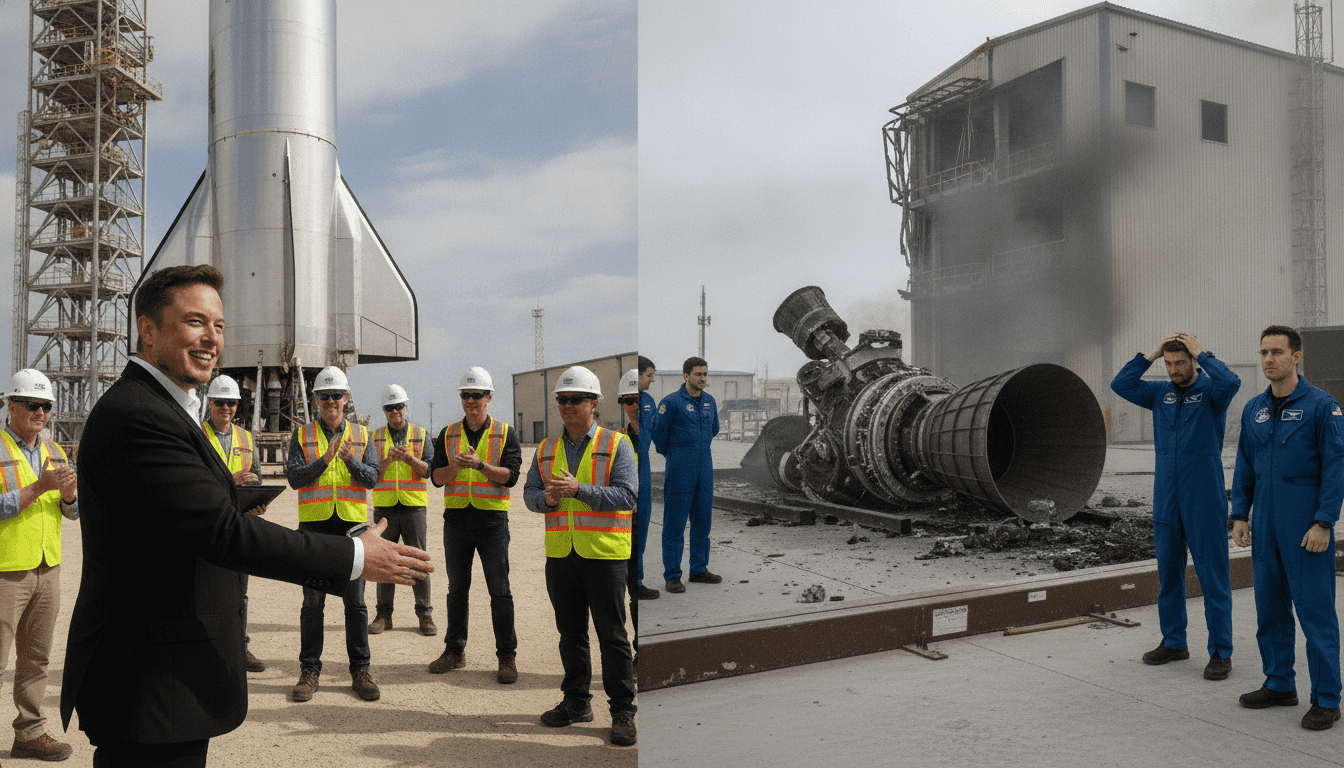
Elon Musk’s SpaceX Scores Partial Win as Blue Origin’s New Glenn Fails in Engine Test
Elon Musk’s SpaceX achieved a partial success with its Starship test on May 22 while Blue Origin’s New Glenn suffered an engine-test failure about a week later, deepening the rivalry.
Elon Musk’s SpaceX marked a mixed outcome on May 22 when the latest Starship prototype launched from Boca Chica, Texas, and its upper stage completed planned orbital maneuvers despite an engine failure and the loss of the booster stage. The launch demonstrated complex in‑flight operations and a controlled return of the upper stage, prompting public celebration within SpaceX. The events unfolded against a backdrop of heightened competition in the private space sector, underscored by a separate mishap at Blue Origin days later.
Starship flight shows advanced maneuvers despite booster loss
The May 22 Starship launch revealed both progress and persistent technical risk for SpaceX. One of the vehicle’s engines failed during ascent and the lower stage separated and crashed into the Gulf of Mexico, yet the upper stage executed demanding on‑orbit maneuvers and returned as planned. Engineers and company statements highlighted the successful demonstration of guidance, navigation and reentry sequences that are central to SpaceX’s long‑term plans.
That partial success will inform iterations of vehicle design and operations as SpaceX pursues rapid test cycles. Company insiders have long framed incremental failures as data‑rich opportunities to refine hardware and software. For Elon Musk and his teams, balancing public demonstration with iterative testing has become a consistent operating model.
Blue Origin’s New Glenn fails during engine test in Florida
About a week after the Starship flight, Blue Origin encountered a major setback when a New Glenn engine test in Florida ended in an explosion. The failure occurred during ground testing of the rocket’s propulsion system and resulted in the loss of the test asset, according to witnesses and technical observers. Blue Origin identified the incident as a significant technical challenge in its effort to bring New Glenn to flight readiness.
The timing amplified the contrast between the two companies: SpaceX advancing through flight tests while Blue Origin confronted a ground‑test catastrophe. Industry engineers cautioned that engine development is among the most complex facets of orbital launch vehicles and that such failures, while costly, are not uncommon in aggressive development programs.
Public reactions and the Musk–Bezos rivalry intensify
Public commentary from Elon Musk following the New Glenn mishap underscored the rivalry between the founders of SpaceX and Blue Origin. Musk posted a succinct reaction on social media calling the result “very unfortunate” and adding that “rockets are hard,” a remark that drew attention for its bluntness. Observers noted the rhetorical sparring reflects broader commercial and strategic competition between the two firms rather than routine corporate commentary.
Both companies have competing visions for commercial space, and their back‑and‑forth has become a staple of media coverage. Analysts say the rivalry has accelerated investment and media interest in orbital launch capabilities, with every test and failure scrutinized for technical implications and market signaling.
Technical hurdles remain central to both programs
Engine durability, stage recovery and propulsion integration continue to be the primary technical hurdles for new heavy‑lift rockets. SpaceX’s Starship program focuses on reusable hardware and high‑thrust Raptor engines, while Blue Origin’s New Glenn uses a different architecture and engine family designed for reusability of its first stage. Each approach carries distinct engineering trade‑offs that surface in tests and failures.
Experts emphasize that modern rocket development is iterative: lessons from one test are rapidly folded into design updates, flight software changes and revised test protocols. Both companies will likely adjust inspection regimes and component testing after the recent incidents to reduce the likelihood of repeat failures.
Market and strategic implications for SpaceX and Blue Origin
The recent sequence of events has implications beyond engineering, touching on investor confidence, launch market dynamics and government contracting. SpaceX’s visible flight progress bolsters its position in satellite launches and crewed missions, while Blue Origin faces the task of restoring momentum for New Glenn development. The incidents may influence timelines for commercial service entry and competition for lucrative national and international launch contracts.
Industry watchers also point to the reputational stakes for the companies’ founders and leadership teams. Demonstrable progress in flight tests can translate to market advantage, while high‑profile failures can slow customer commitments and change negotiation dynamics with partners and suppliers.
The May 22 Starship flight and the subsequent New Glenn engine failure together illustrate the volatile, high‑stakes nature of contemporary rocket development, where technical advances coexist with abrupt setbacks. As both programs press forward, engineers and executives will focus on translating recent lessons into safer, more reliable operations and preparing for the next series of tests.
