
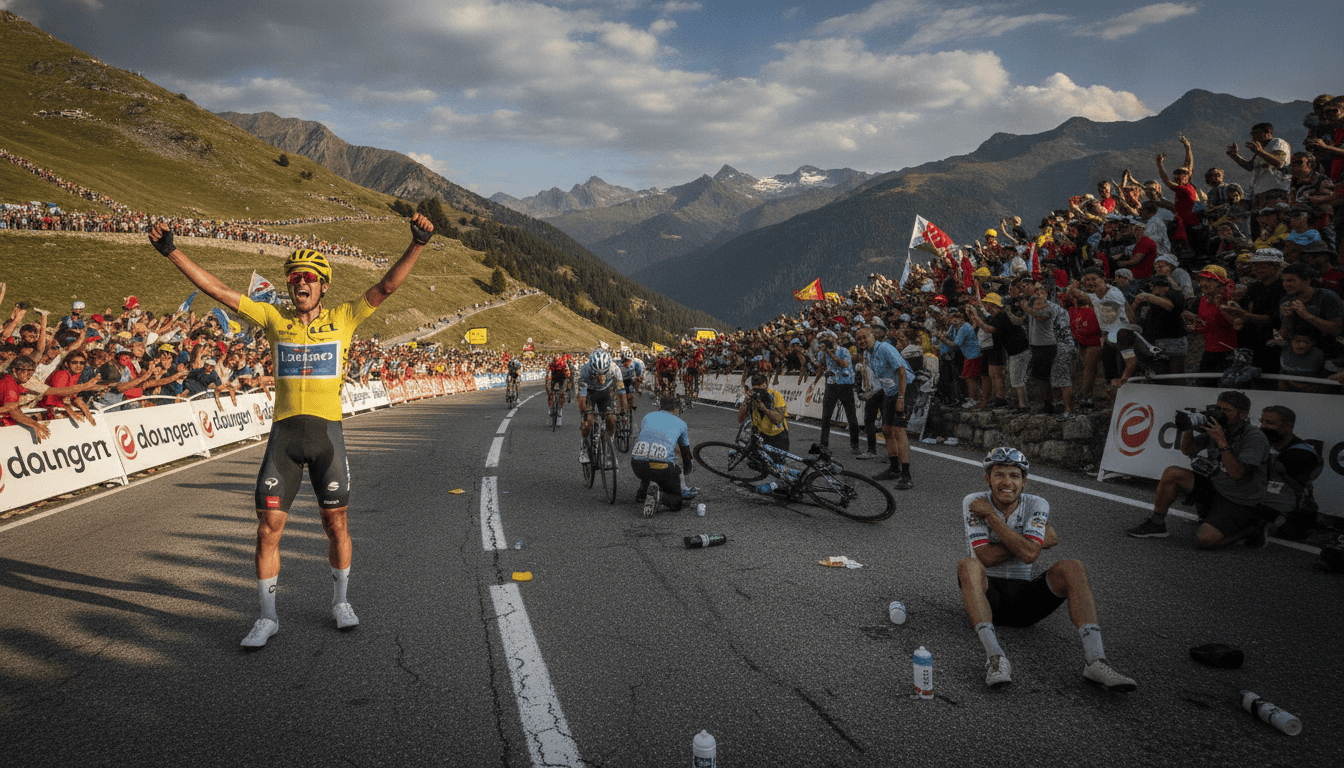
Carapaz Claims Alpe d’Huez Stage as Sepp Kuss Crashes on Tour de France’s Brutal Mountain Day
Richard Carapaz wins Stage 20 to Alpe d’Huez after Sepp Kuss’s late crash; Pogacar keeps overall lead with Paris finale looming after 5,450m of climbing.
The Tour de France’s penultimate mountain test ended in drama at Alpe d’Huez when Richard Carapaz sprinted to victory after Sepp Kuss slid out late on the ascent. The incident occurred within the final kilometres of Stage 20, and the crash reshaped the closing moments on a day that featured 5,450 metres of climbing. Tadej Pogacar retained the yellow jersey and now approaches the Paris finale poised to seal a fifth overall win.
Kuss loses control on a treacherous section near the feed zone
Four kilometres from the summit a crowd had gathered around a roadside food stand and a giant screen to watch the finish unfold. About 1,800 metres before that screen, Sepp Kuss misjudged a bend, locked his brakes and skidded along a newly installed safety netting beside the road. Spectators later said the net likely prevented a far worse fall; had Kuss been 1.5 metres further back he might have tumbled down a steep drop that runs alongside the route.
Kuss’s error allowed Richard Carapaz to slip past and press home a decisive move in the final climbs. The American had been leading earlier on, but after the mishap he could not recover contact with the front group. Kuss nevertheless finished the arduous stage but crossed the line behind the leaders, visibly affected by the late incident.
Carapaz seizes the stage and secures the polka-dot ambitions
Richard Carapaz produced a sustained attack in the closing kilometres and rode through the last hairpins to claim his second stage win of this Tour. The Ecuadorian’s performance also clinched the mountains classification for his team, a target they had pursued from the outset on the high-altitude parcours. Carapaz completed the 171-kilometre course in just under five hours, a rare sub-five-hour time on such a long, mountainous day.
Emotion and strategy mixed at the finish as Carapaz crossed the line, the polka-dot jersey effectively his after repeated offensives against the high passes. Team officials and rivals alike praised the timing of his effort, which balanced aggression with the need to manage energy over the Galibier, Croix-de-la-Croix and other historic climbs earlier in the route.
Evenepoel moves up as sprinters and domestiques pay the price
Belgian Remco Evenepoel moved around the stricken riders in the final metres and secured the runner-up placing on a stage that chewed up contenders and support riders alike. His late surge left him ahead of Kuss on the day’s classification, and his result continued a late-Tour push that has seen him aggressive on the climbs. Evenepoel’s presence on the podium underscored how quickly fortunes can change on high-gradient finishes.
Several riders were unable to complete the stage, among them Pascal Ackermann, who abandoned after a succession of earlier crashes. The attrition rate on this penultimate mountain day was high, and teams had to reshuffle their plans as the field thinned on the long ascents and technical descents.
Pogacar protects the yellow jersey with tactical support from Del Toro
Tadej Pogacar spent significant kilometres inside the leading group but eschewed a final solo bid, choosing instead to protect his overall lead alongside teammates. Isaac Del Toro, the young Mexican who wears the white jersey for best young rider, played the role of escort for Pogacar in the closing phases. Team tactics prioritized the yellow as Pogacar shepherded Del Toro and the overall classification safely toward Paris.
Pogacar acknowledged afterwards that preserving Del Toro’s position in the general classification had been a priority, and his measured approach on the final climbs reflected that. With only the procession into Paris remaining, the Slovenian enters the last day with a comfortable margin unless an unforeseen crisis occurs overnight or on the city circuits.
Race director and riders label the stage historic in severity
Christian Prudhomme, the race director, described the day as the “hardest mountain stage in Tour history,” a claim echoed by many riders who endured the 171-kilometre route and its string of legendary ascents. The itinerary included the Col de la Croix-de-Fer, Col du Télégraphe and Col du Galibier before the climactic ascent to Alpe d’Huez, putting immense demand on legs and team resources. Riders spoke of energy reserves being emptied and of the fine margins that separated success from costly mistakes.
Those margins were on full display when Kuss slipped on a corner with only kilometres remaining and when teams scrambled to reconfigure domestique support. The intensity of the stage will be debated in coming hours, but nobody disputed its impact on the race narrative in the final weekend.
The Tour’s four jersey competitions look settled after the penultimate mountain day, barring extraordinary events on the final stage. Pogacar appears set to be crowned overall winner under the Eiffel Tower for a fifth time, Isaac Del Toro is poised to take the white jersey for best young rider, and Carapaz now holds the polka-dot jersey after his decisive mountain performance.
The crowd at Alpe d’Huez witnessed both the peril and the drama of top-level cycling on one of the sport’s most iconic climbs, and the consequences of this stage will ripple through the final day into Paris.
