
Germany’s pension reform proposals ignite sharp debate over future pension level and market-based components
Greens demand protected 48% pension level as pension reform proposals provoke divisions over retirement age, capital funds and regional impacts
The government’s new pension reform package, drawn from the Rentenkommission’s recommendations, has triggered an immediate political firestorm and widespread institutional responses. The proposals — including longer working lives, a capital-funded pension component and links between retirement age and life expectancy — place “pension reform” at the center of this legislative term. Parties, unions, social organisations and business groups are now publicly divided over whether the plan secures pensions or shifts risk to households.
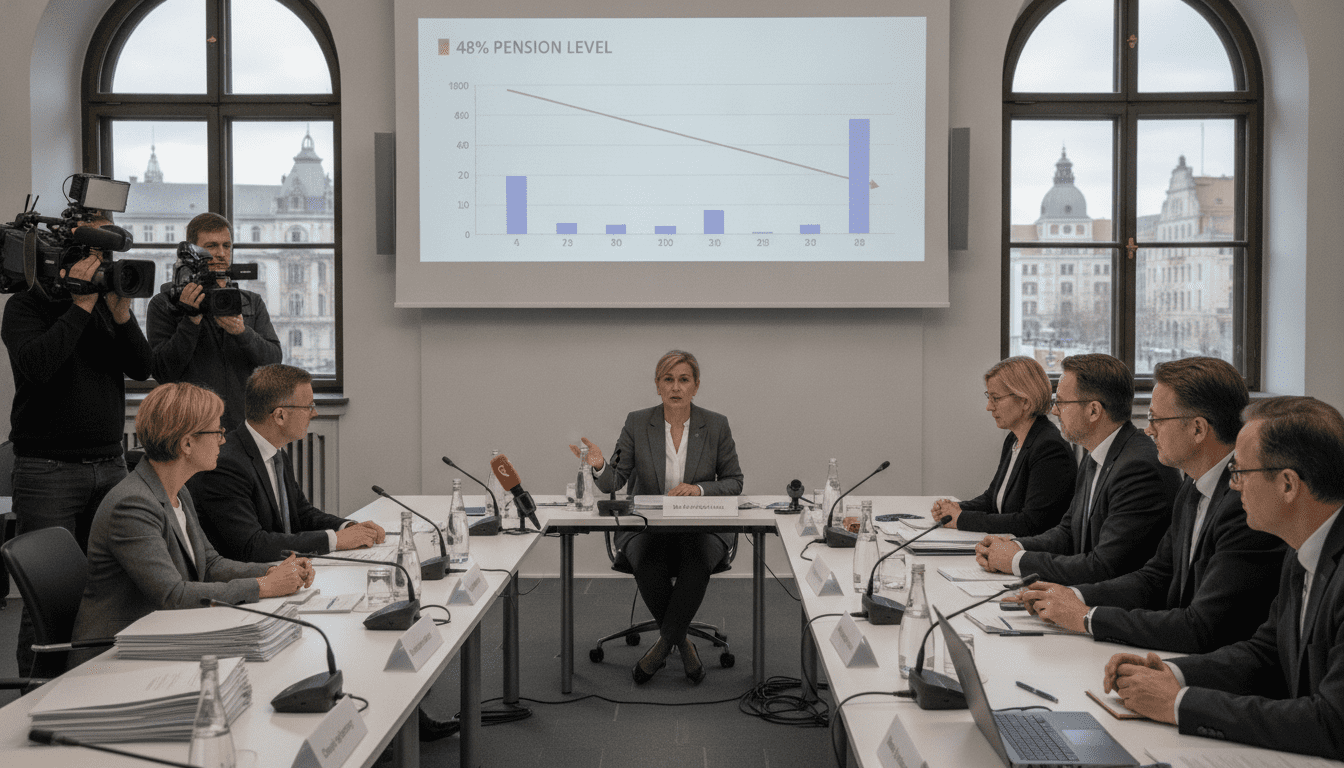
Greens demand 48% pension level
The Green parliamentary group insisted the reform must guarantee a statutory pension level of 48 percent and said anything less would widen old-age poverty. Group leader Britta Haßelmann highlighted that the average statutory pension for women presently stands near €980 and argued that an assured 48 percent level is essential to prevent insecurity in retirement.
Haßelmann praised several commission ideas, such as targeted support for long-career earners and a complementary capital-funded pillar, but she stressed that any move away from a firm pension level would be unacceptable. The Greens are preparing parliamentary initiatives to lock in the target and press for clarity from the government on implementation details.
East Germany officials warn of rising old-age poverty
Regional leaders and the government’s East commissioner warned that the reform could disproportionately harm pensioners in eastern Germany unless safeguards are added. Elisabeth Kaiser of the SPD said any reduction of the current pension level from 2031 would risk pushing many eastern residents into poverty because a larger share there rely solely on statutory pensions.
Saxony’s Minister-President Michael Kretschmer echoed those concerns, urging that the “life achievements” of eastern citizens be reflected in the new rules and calling for measures that recognise the structural differences in earnings and employment histories across regions. Both called for explicit protections for cohorts with interrupted careers or low lifetime earnings.
Chancellor and coalition signal swift legislative drive
Chancellor Friedrich Merz framed the commission’s package as an integrated reform that must be enacted largely as presented to be effective. He warned that piecemeal rejection of elements would undermine the overall design, and the government pledged to move quickly to draft legislation reflecting the commission’s package.
Union parliamentary leaders signalled conditional support while reserving the right to amend details in the Bundestag. Jens Spahn acknowledged the plan as a “total work of art” but said parliamentary debate would focus on the technical refinements needed during implementation.
Left party and labour unions decry cuts and market exposure
The Left party described the proposals as a “massive cuts programme” that would hit middle- and lower-income earners and older eastern citizens hardest. Fraktionschef Sören Pellmann argued that raising the retirement age and eliminating the penalty-free pension after long careers amount to de facto cuts, and he warned that tying benefits to demographic metrics would be unfair to lower-income groups.
Trade union leaders were equally uncompromising. DGB head Yasmin Fahimi criticised the dismantling of the Rente mit 63 and said messages that workers must simply “work longer” are misleading. The unions also criticised plans to introduce a capital-funded component, calling it a risky shift that could expose retirees to financial market volatility.
Business associations call for technical fixes and lower levies
Industry and employer groups welcomed the package’s ambition but urged concrete adjustments to limit added cost burdens on employers. The BDI and DIHK said the reforms were a step toward sustainability but insisted on clearer design to avoid extra contributions that could erode competitiveness and job creation.
Business leaders singled out overall social contribution levels as problematic and reiterated calls to stabilise the combined employer–employee burden below 40 percent. Craft and trade associations pressed for transitional arrangements to prevent sudden cost spikes for small and medium-sized enterprises.
Caritas endorses broad agenda while highlighting vulnerable groups
Caritas offered measured praise, arguing that a broad, simultaneous approach is necessary to maintain the pension system’s promise in the face of demographic change and technological disruption. Caritas president Eva Welskop‑Deffaa welcomed measures to link retirement rules to life expectancy as providing mid-term relief to contributors and supported tighter protection for disability and early-retirement pathways.
She also cautioned that many workers in physically demanding jobs or with lower qualifications cannot extend working lives without targeted support, and recommended adjustments to disability provisions and early-retirement safeguards. The charity urged the government to pair reform with active labour and health policies that help those unable to work longer.
The Rentenkommission’s blueprint has crystallised familiar fault lines: balancing fiscal sustainability with social protection, and defining how much risk to shift toward capital markets and individual savers. As parliament prepares to scrutinise and amend the package, the central questions will be which guarantees are legally anchored, how transitional costs are distributed, and whether regional inequalities are adequately addressed.
