
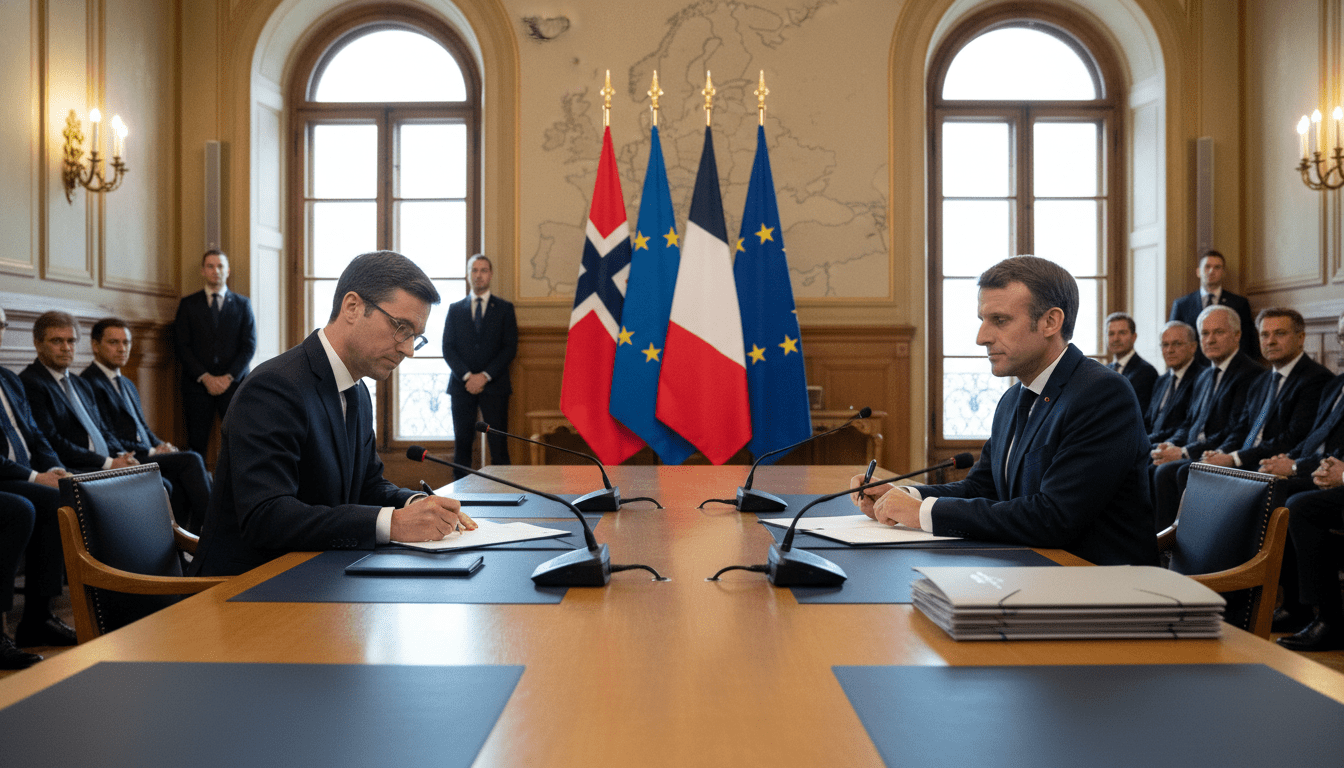
Norway Signs Pact Placing It Under France’s Nuclear Umbrella
Norway has signed a formal defense agreement with France, placing itself under France’s nuclear umbrella as Moscow expands its military capabilities and European states reassess transatlantic guarantees.
Norway’s prime minister traveled to Paris this week to sign an agreement with President Emmanuel Macron that will make France responsible for supplying a nuclear response if Norway were ever attacked with forces that threaten its survival. The move places the Nordic country explicitly under France’s nuclear umbrella while affirming that no nuclear weapons will be based on Norwegian soil during peacetime.
Norway signs pact to enter France’s nuclear umbrella
Prime Minister Jonas Gahr Støre met President Macron in Paris to conclude the bilateral pact, according to Norwegian government statements. Støre told the Norwegian news agency NTB the decision responds directly to the changing security environment in Europe and the increased military posture of Russia.
The agreement follows similar steps by other frontline NATO members and makes Norway the latest European country to seek an extended deterrent from France. Officials emphasized that the arrangement is a political guarantee rather than a deployment of weapons inside Norway during peacetime.
Leaders meet in Paris to formalize agreement
Norwegian and French leaders described the pact as a mutual commitment to collective defense within the NATO framework and as an instrument to deter aggression on Norwegian territory. The French presidency framed the move as part of France’s broader willingness to extend its deterrence umbrella across Europe at a time of heightened tensions.
Both governments said technical and legal details will be worked out in subsequent exchanges, while stressing the pact does not alter Norway’s obligations to NATO. Paris and Oslo presented the deal as complementary to NATO structures rather than a replacement for transatlantic security ties.
Security worries drive Norway’s decision
Støre cited Russia’s substantial conventional and nuclear rearmament and Moscow’s ongoing military operations in Europe as primary reasons for Oslo’s choice. He told NTB that Norway must adapt its security arrangements to address the risks posed by a neighbor that has increased its armed forces and strategic capabilities.
Norwegian officials also highlighted the country’s exposed geography, including a long Arctic border with Russia and a modest population, as factors that increase the need for credible external guarantees. They reiterated that the pact is defensive and intended to deter escalation by signaling unified European resolve.
Shift in European deterrence dynamics
The decision reflects a growing European debate over reliance on the United States for nuclear deterrence, a discussion that gained traction during the Trump administration and has continued amid shifting transatlantic politics. German and other EU officials have floated ideas about a more structured European role in deterrence that could involve coordination with France and the United Kingdom.
Poland and Lithuania, both NATO members that share borders with Russia, previously sought closer ties to France’s deterrent posture, and Norway’s move marks an expansion of that pattern among frontline states. Analysts say the French umbrella offers a political and symbolic signal of solidarity that may encourage other allies to pursue parallel or complementary arrangements.
Nuclear inventories and strategic implications
Global nuclear arsenals remain concentrated in a few states, with Russia and the United States holding the largest inventories. Public data compiled by arms-monitoring organizations indicate China, France and the United Kingdom maintain smaller but significant stockpiles, and those figures have shaped European calculations about credible deterrence.
French extended deterrence relies on the credibility of Paris’s strategic forces and political will rather than on a forward stationing of warheads in partner states like Norway. Military experts note that such pacts hinge on shared political commitment and communication channels that allow for rapid consultation in a crisis.
Arctic border and regional security considerations
Norway’s Arctic position and its maritime approaches give the pact a particular regional resonance, since the High North has become a focus of renewed military activity. Oslo has long balanced deterrence with diplomatic engagement in the Arctic, and officials say the new arrangement does not preclude continued cooperation with neighboring states on search and rescue, fisheries, and environmental issues.
The pact will likely prompt closer defense planning with NATO allies while also raising questions in Moscow about the balance of forces in northern Europe. Norwegian sources say the government intends to keep NATO coordination central and to use the agreement primarily as a deterrent signal rather than a step that escalates tensions.
Norway’s accession to France’s nuclear umbrella underscores a recalibration of European security arrangements driven by new strategic realities, with implications for alliance politics, regional defense planning and the signalling of deterrence across the continent.
