
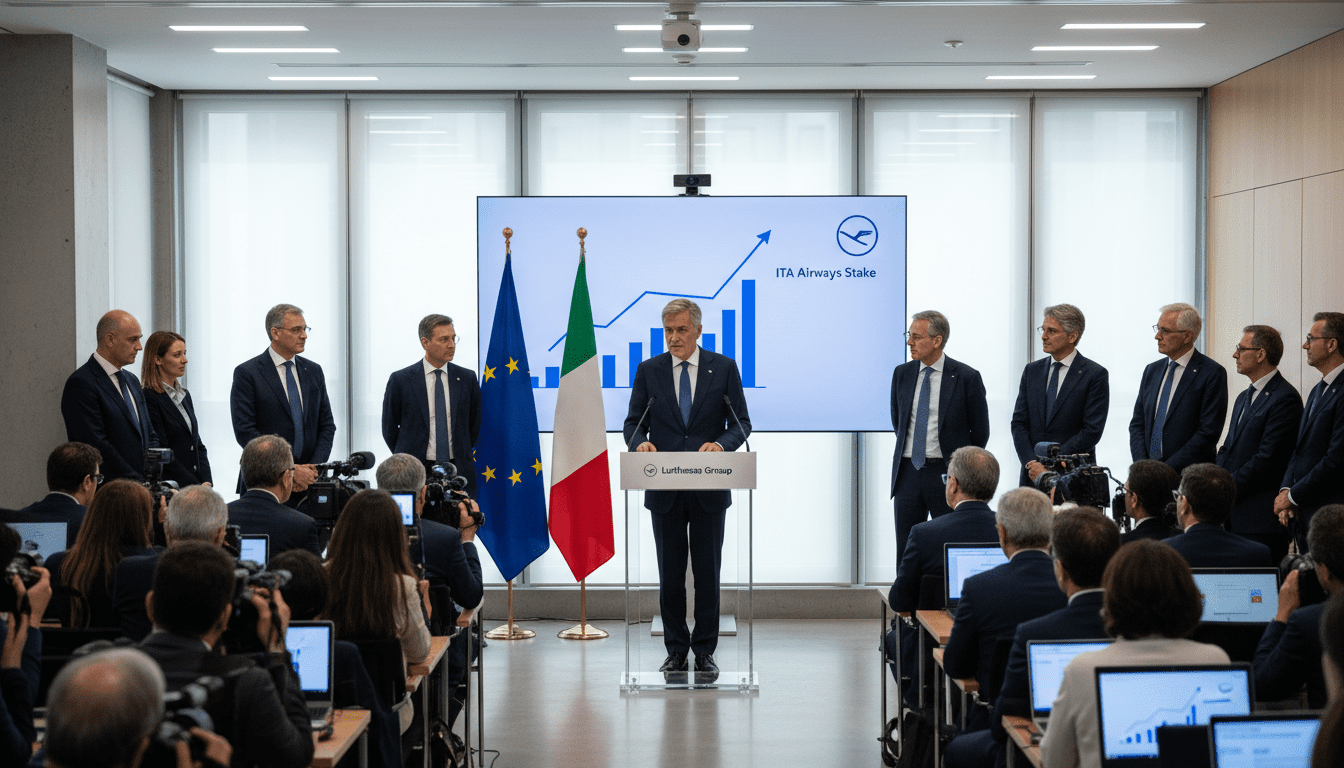
Lufthansa takeover of ITA: Group to raise stake to 90% in June by exercising €325m option
Lufthansa will boost its holding in Italian carrier ITA to 90% in June as part of a planned Lufthansa takeover of ITA, exercising a €325 million option and signalling a deeper integration of the two airlines. The move, announced at the start of the group’s annual general meeting in Frankfurt, follows approval from Lufthansa’s supervisory board and comes as the carrier reports extensive progress on operational integration. Regulatory clearances remain necessary before the transaction is fully effective, and the Italian state will retain the final 10% stake until a later purchase window.
Supervisory board clears accelerated stake increase
Lufthansa’s supervisory board gave the green light to exercise the option on Monday evening, enabling the company to advance its acquisition timetable and raise its ITA stake from 41% to 90% in June. Management framed the decision as a reward for rapid integration work completed since ITA joined the group, noting that most customer-facing systems are already harmonised. The remaining procedural step is the securing of competition approvals required for full control.
The Italian Ministry of Economy and Finance (MEF) will keep the outstanding 10% stake for the moment, with Lufthansa retaining an option to acquire those shares in 2028. The group has said it expects the necessary antitrust clearances for the majority takeover to be granted by the first quarter of 2027, a timeline that will determine when Lufthansa can exercise full ownership rights.
Integration work described as fastest in group history
Chief Executive Carsten Spohr characterised the ITA integration as the fastest airline integration in Lufthansa’s history and highlighted that core interfaces for customers are now aligned across the group. ITA inventory and bookings have been merged into central reservation systems, the Miles & More loyalty programme has been introduced to ITA customers, and Lufthansa Cargo is co-marketing belly-hold capacity. One notable exception remains the integration of ITA’s North Atlantic routes into the transatlantic joint venture, where regulatory approvals are still pending.
Management says the operational alignment has enabled a smoother customer experience and commercial coordination between the carriers, providing the justification for accelerating the exercise of the purchase option. Executives flagged the remaining regulatory hurdles as the principal external constraint to completing the takeover.
Rome positioned as sixth, southernmost group hub
Lufthansa plans to elevate Rome into its sixth major hub, using the Italian gateway to expand services to the southern hemisphere, with Latin America singled out as a priority market. The carrier intends to route more long-haul flights through Rome to improve connectivity for passengers transferring from other European and domestic services. That strategy ties into broader network planning aimed at balancing capacity across Europe and strengthening southern corridor flows.
Management described Rome’s role as central to the group’s long-haul growth, noting that the ITA acquisition helps secure runway slots, local commercial relationships and a base for expanded intercontinental services.
Fleet orders and modernisation through 2032
Lufthansa announced new widebody orders tied to its expansion and modernisation programme, agreeing to take ten Airbus A350-900s and ten Boeing 787-9s by 2032. At list prices, the deals represent roughly $7.7 billion, though industry practice typically involves discounts off list. The purchases will add to an existing order book that the company says will grow to 232 aircraft, including further long-range jets.
Company officials stressed the environmental and efficiency benefits of fleet renewal, saying newer types will reduce fuel burn and CO2 emissions while allowing simplification of long-haul fleet types from 13 to nine. Older, less efficient models such as the A340 family and the Boeing 747-400 are slated for retirement as part of that rationalisation.
Commercial and investor scrutiny over further acquisitions
Following the ITA move, Lufthansa has identified Portugal’s TAP as a potential next target after the Portuguese government indicated a plan to sell roughly 45% to a strategic investor. Lufthansa is among several suitors, with Air France-KLM publicly reported as another interested party. Management has not committed to a bid timetable, indicating any approach would be judged on strategic fit and price discipline.
Shareholder representatives at the annual meeting urged caution, urging that growth not come at the expense of returns. Deka Investments and Union Investment both warned that expanding by acquisition carries risks: complexity within the group can dilute margins, and a disciplined approach to capital allocation will be critical if Lufthansa pursues further purchases.
Regulatory timetable and transatlantic joint-venture questions
Competition authorities must still clear the inclusion of ITA’s North Atlantic services into Lufthansa’s existing transatlantic joint venture with United Airlines and Air Canada, a step seen as strategically important for Atlantic connectivity. Lufthansa expects these approvals as part of the wider clearance process and has set an internal target of receiving them by the first quarter of 2027. Until those conditions are met, some commercial coordination across the Atlantic will remain provisional.
The outcome of regulatory reviews will also shape the practical timing for Lufthansa to assume full operational control and unlock the final steps of the takeover process.
Lufthansa’s decision to accelerate the purchase option marks a decisive step in its strategy to expand network reach and modernise capacity, but the path to full ownership and seamless Atlantic integration still depends on external approvals and investor confidence in disciplined execution.
