
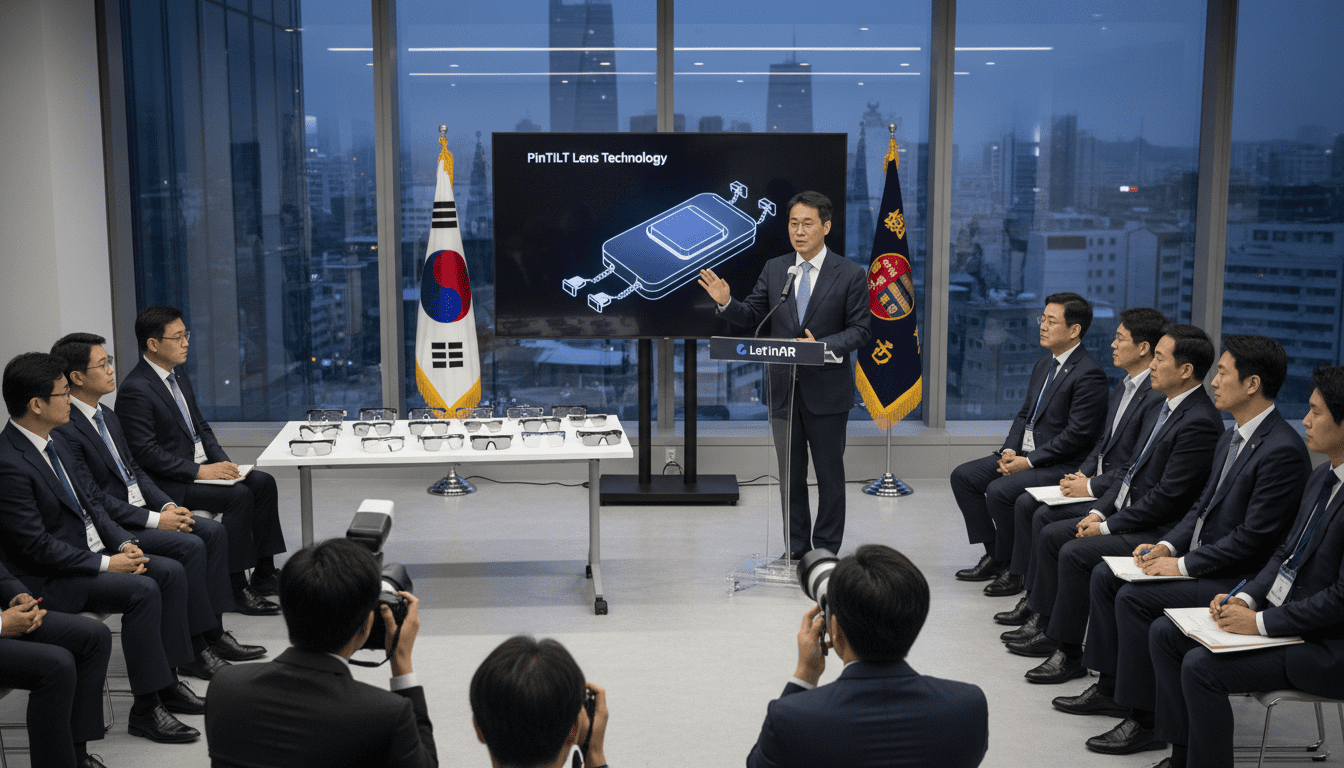
LetinAR raises $18.5M to scale PinTILT optics for AI smart glasses ahead of 2027 IPO
LetinAR secures $18.5M to mass-produce PinTILT optics for AI smart glasses, backed by Korea Development Bank and Lotte Ventures as it eyes a 2027 public IPO.
LetinAR, a South Korean optics startup, has closed an $18.5 million funding round from Korea Development Bank and Lotte Ventures as it prepares to scale production of its PinTILT optical modules for AI smart glasses. The investment increases the company’s total capital to $41.7 million and comes as LetinAR readies for a planned public IPO in South Korea in 2027. The funding is targeted at ramping manufacturing and supporting partnerships with device makers racing to deliver wearable augmented reality experiences.
LetinAR secures $18.5M as IPO approach continues
LetinAR’s latest round follows earlier backing from LG Electronics and adds institutional support intended to accelerate factory output and supply-chain readiness. Company leaders said the capital will be used to move from prototyping and low-volume shipments to higher-volume manufacturing suited to mainstream device timelines. The move signals investor confidence in optical components as a pivotal piece of the emerging AI smart glasses ecosystem.
LetinAR was co-founded in 2016 by CEO Jaehyeok Kim and CTO Jeonghun Ha, who developed the PinTILT design over the past decade. The founders describe their product as the small, power-efficient lens that enables full-featured AR experiences without bulkier headset designs. Investors are betting that superior optics will determine which device makers win consumer acceptance.
AI smart glasses market shows rapid growth
The timing of LetinAR’s raise coincides with a rapid expansion in shipments of AI-enabled eyewear. Industry trackers recorded roughly 8.7 million AI glasses shipped in 2025, a more than threefold increase from the previous year, and analysts expect shipments to exceed 15 million units this year. That market momentum has prompted major technology and consumer-electronics firms to accelerate hardware strategies and secure suppliers for optical modules.
Manufacturers and brands now face a narrow window to source components that balance image quality, weight and battery life. For many OEMs, external optical specialists like LetinAR offer a faster route to market than internal development, particularly as companies prepare product lines for late‑2026 and 2027 launches.
PinTILT lens design aims to solve power and bulk trade-offs
LetinAR’s PinTILT approach arranges microscale optical elements inside a lens to direct light specifically toward the wearer’s pupil rather than dispersing it across the entire glass surface. The company argues this targeted delivery yields brighter perceived images while reducing wasted light and energy consumption. That combination addresses two persistent hardware constraints: limited battery life and the need for a frame that looks and feels like ordinary eyewear.
Executives emphasize that reducing stray light and improving efficiency allows designers to use thinner, lighter lenses without surrendering visual fidelity. In a sector where every gram and every extra hour of battery life affects acceptance, that engineering advantage could make compact, fashionable smart glasses practical for daily use.
How PinTILT differs from prevailing optical approaches
Current dominant approaches, such as waveguide displays, create wide images by splitting and spreading light across layered structures, which keeps lenses thin but wastes much of the emitted light. Alternative mirror-based systems deliver brighter images but are bulky and ill-suited to conventional eyeglass frames. PinTILT seeks a middle path by concentrating useful light into the eye’s entrance pupil while maintaining a slim profile.
The company describes its solution as a more efficient routing of photons: by engineering the angle and placement of tens of thousands of tiny optical facets, more of the projected image reaches the retina and less is lost to the periphery. That purported efficiency gain is intended to enable brighter visuals on smaller batteries, improving comfort and usability.
Customers and real-world deployments
LetinAR’s optical modules are already in commercial products and pilot programs. The company lists partners such as Japan’s NTT QONOQ Devices and Dynabook, gaining manufacturing experience at scale through those relationships. One of the highest-profile integrations is inside an AI-enabled motorcycle helmet developed by Swiss deep-tech firm Aegis Rider, which aims to launch in the EU and Switzerland in 2026.
Aegis Rider’s helmet uses LetinAR’s module to anchor navigation and safety information to the road ahead rather than merely overlaying it on the visor, an application that demands precise, high-contrast projection and low latency. Those deployments provide early validation for PinTILT in demanding environments where brightness, clarity and energy efficiency are critical.
Supply dynamics and competitor landscape
LetinAR is operating in a crowded ecosystem of optical suppliers and display startups that includes several established names and newer entrants. Major device makers, including global technology firms and smartphone manufacturers, are simultaneously developing their own eyewear strategies and lining up suppliers. LG Electronics, an early investor in LetinAR, has reportedly begun internal development of AI-capable glasses, underscoring how strategic the component stack has become for large consumer-electronics companies.
At the same time, international competitors are advancing different technical routes to AR functionality, and component makers are racing to secure production capacity and customer design wins. LetinAR’s funding will be tested in part by its ability to convert prototype interest into multi-million-unit supply agreements as the market shifts from early adopters to mass-market demand.
LetinAR’s new financing and planned path to a 2027 public offering come amid broader industry bets that hardware like AI smart glasses will become a mainstream platform for personal AI. By focusing on the optical bottleneck, the company aims to be a critical supplier at a moment when clarity, comfort and battery efficiency will determine the commercial fate of wearable augmented reality devices.
