
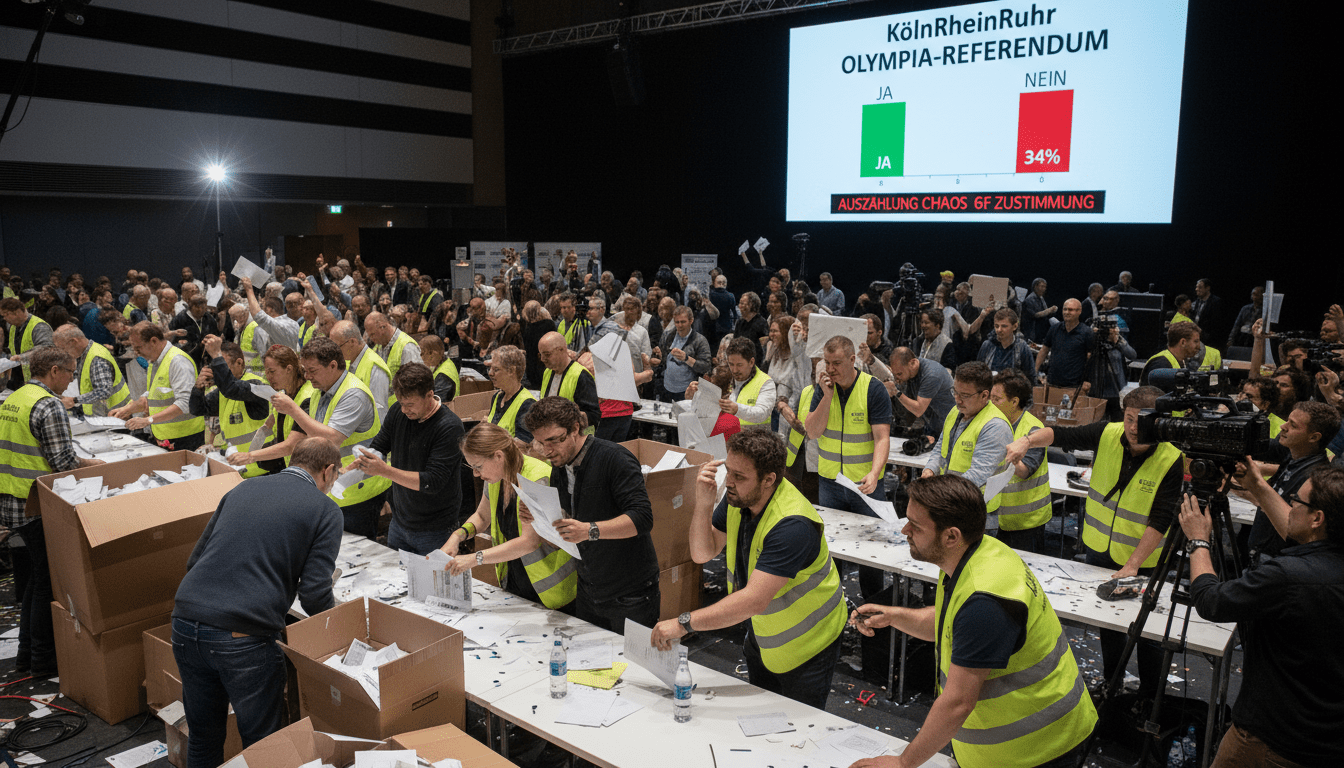
KölnRheinRuhr Olympic bid wins referendum with 66% approval despite counting delays and quorum setbacks
KölnRheinRuhr Olympic bid wins 66% approval in regional referendum; Cologne counting delays and Herten quorum failure complicate the DOSB selection ahead of national vote.
KölnRheinRuhr secured broad regional backing in a weekend referendum that returned 66.0 percent support across 16 participating municipalities, advancing the KölnRheinRuhr Olympic bid toward the national selection race. Voter turnout hovered at just over 30 percent, a figure that leaves the mandate clear but not overwhelming, and exposed organizational frictions in the campaign’s biggest city. The result sets up a contest with Munich and likely Berlin and Hamburg for Germany’s eventual Olympic nominee to the International Olympic Committee.
Referendum delivers 66.0 percent backing across 16 municipalities
The overall vote in favor of pursuing an Olympic bid under the KölnRheinRuhr banner came to 66.0 percent, a number the campaign highlighted as evidence of regional enthusiasm for hosting the Games. Sixteen municipalities reported valid results; several cities registered very high approval rates, with Aachen and Mönchengladbach among those surpassing 70 percent. The aggregate approval will be one of the metrics the German Olympic Sports Confederation (DOSB) factors into its evaluation, but it will share space with technical assessments and federation preferences.
Counting delays in Cologne expose logistical shortcomings
Plans to illuminate Cologne’s Hohenzollernbrücke in Olympic colors were delayed when vote counting in Cologne lagged well into the night, revealing capacity issues in the designated counting venue. Organizers had installed 112 spotlights and staffed security teams to stage a celebratory display, yet several counting centers reported cramped conditions and slow tallies. The lighting eventually went up as officials framed the partial returns positively, but the episode underscored operational weaknesses that supporters had hoped the campaign would avoid.
Herten misses quorum after ballot application hurdle
Despite more than 70 percent support among voters who participated, Herten failed to meet a 15 percent turnout quorum after officials required residents to apply for postal ballots rather than receive them automatically. That shortfall means Herten’s result will not count toward the campaign’s success metrics and has immediate programmatic implications. Organizers now face a likely venue reshuffle for mountain biking and other events, with Essen discussed as a possible replacement host for competitions originally planned in Herten.
DOSB faces a crowded national selection and federation-driven decision
The national fight to become Germany’s official Olympic candidate will be adjudicated by the DOSB and by representatives of the sport federations, not directly by municipal referenda, though the latter carry political weight. The DOSB’s timetable anticipates a shortlist and a formal nomination process culminating at a meeting in Baden-Baden, while federations from disciplines across the country will weigh venue suitability and technical readiness. Munich, Berlin and possibly Hamburg remain in contention, and the federation votes — influenced by where events would be staged and which regions can meet technical demands — are expected to determine the nominee more than headline referendum percentages.
Campaign tactics raise questions about information balance and turnout engineering
Campaign teams and officials acknowledged that mailing practices and the content of informational materials influenced participation and sentiment, with critics saying some mailings emphasized benefits while downplaying costs and risks. Munich and other campaigns have sent voting materials directly to households, a method credited with boosting turnout and favorable outcomes, while some municipalities opted for less proactive distribution or required citizens to request ballots. Observers noted that the composition and tone of campaign brochures, and whether critical perspectives were presented alongside advocacy, appear to have had measurable effects on both turnout and vote margins.
Conflict-of-interest concerns persist amid dense regional networks
The KölnRheinRuhr effort draws on a compact professional and political network in North Rhine-Westphalia, including past and present sports administrators and city officials, which has prompted scrutiny about potential conflicts as the process moves to national federation votes. The DOSB has signaled it will address concrete allegations of personal advantage but offered limited detail on enforcement mechanisms and recusal procedures for members with regional ties. The campaign and the DOSB point to adherence to the International Olympic Committee’s ethics code, but critics say the code leaves room for interpretation and that tighter transparency standards would be needed in the autumn’s decisive votes.
The referendum result gives KölnRheinRuhr a substantive, though not decisive, boost on the road to a national nomination, while practical missteps and legal thresholds in individual municipalities exposed vulnerabilities in the campaign’s execution. With the DOSB’s evaluation matrix and federation preferences set to shape the next phase, the region’s organizers must address logistical gaps, venue contingencies and governance questions if they are to convert regional approval into a credible international candidacy.
