
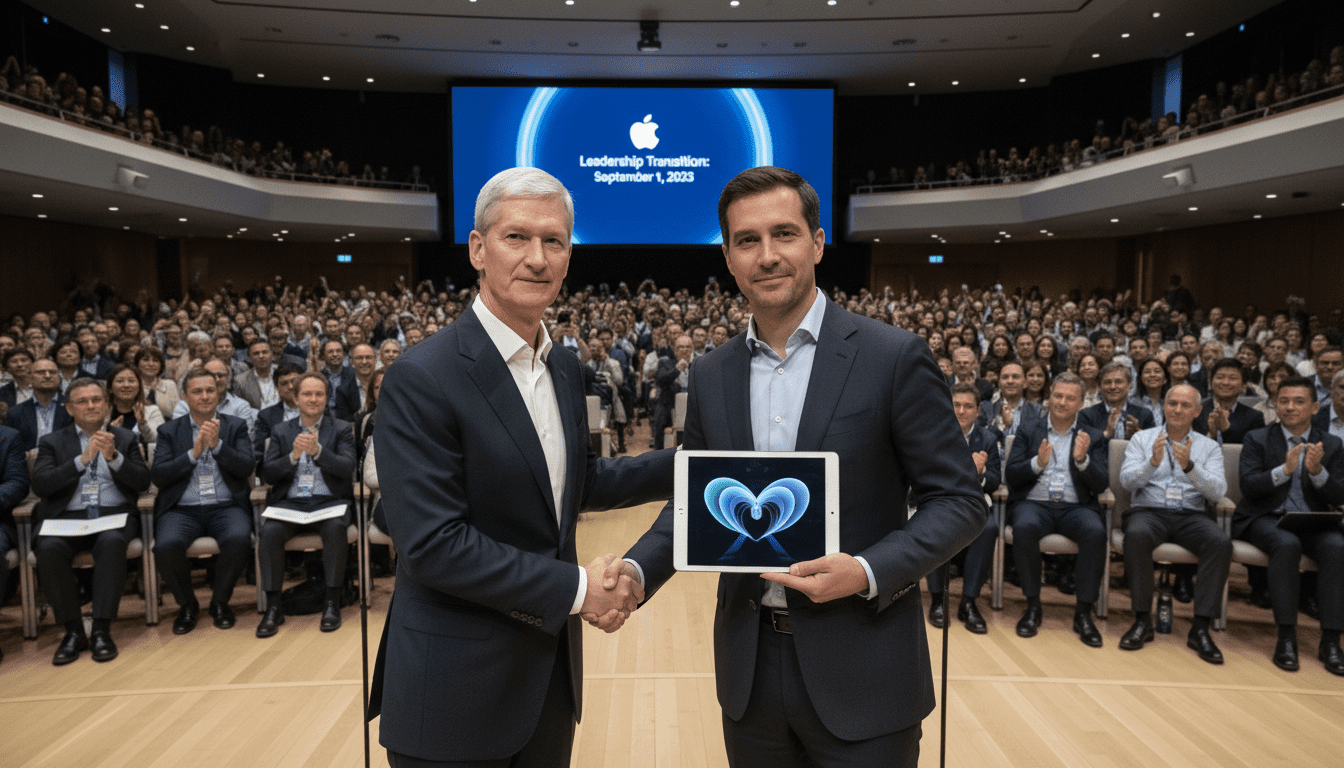
Tim Cook to Step Down as Apple CEO; John Ternus Named Successor
Tim Cook will step down as Apple CEO on September 1, 2026, handing the company’s top executive role to hardware chief John Ternus while remaining chairman of the board. The announcement ends Cook’s nearly 15-year tenure during which Apple’s market value rose by roughly $3.6 trillion.
Tim Cook Announces Departure as Apple CEO
Tim Cook, 65, informed Apple’s board and employees that he will relinquish the CEO position effective September 1, 2026. The decision marks the close of an era that began when Cook took over the role following the death of co‑founder Steve Jobs in 2011. Company communications indicate Cook will keep an active role at Apple by serving as chair of the board.
Cook’s leadership has been defined by steady operational execution and expansion of services alongside product cycles led by the iPhone. Executives and analysts point to his focus on scale, supply‑chain improvements and shareholder returns as central to the company’s performance under his stewardship.
John Ternus Named CEO Successor
Apple identified John Ternus, head of hardware engineering, as Cook’s successor, elevating a long‑time internal executive to the CEO role. Ternus has overseen Apple’s hardware product lines, including recent iterations of iPhone and Mac devices, and is widely credited inside the company with tight integration between design and engineering teams.
The choice signals continuity in product strategy, with Apple opting for an heir from within its engineering ranks rather than an external executive. Observers expect Ternus to emphasize hardware innovation, manufacturing partnerships and the coordination of hardware with Apple’s expanding software and services ecosystems.
Governance and Transition Terms
As part of the transition, Cook will shift to the role of board chairman, a move intended to provide continuity at the highest level of governance. This arrangement mirrors transitions at other major technology firms where outgoing CEOs retained board influence while new executives assumed day‑to‑day operational control.
Apple’s board will therefore oversee a period in which strategic direction is likely to be set jointly between the new CEO and the longstanding influence of Cook as chairman. The company framed the change as orderly and planned, designed to preserve stability while enabling fresh operational leadership.
Financial Record of Cook’s Tenure
During Cook’s almost 15 years at the helm, Apple’s market capitalization rose dramatically, a surge largely attributed to the sustained popularity of the iPhone, growth in services such as App Store, iCloud and Apple Music, and a diversification into wearables. The reported increase in market value near $3.6 trillion underscores how the company expanded from its earlier, more precarious position into one of the world’s most valuable corporations.
Investors rewarded Apple for consistent revenue growth, large cash reserves and share‑buyback programs implemented under Cook. At the same time, the company navigated challenges from competitors, shifting consumer preferences and geopolitical trade tensions that affected supply chains and component sourcing.
Comparisons to Other Tech Leadership Changes
Analysts have compared Cook’s departure and the internal promotion of Ternus to past leadership changes at major tech companies, noting similarities to transitions at Amazon and Netflix where founders or long‑standing executives stepped back but left structural influence in place. Those precedents suggest markets and employees often view staged, internal successions as lower risk than abrupt external replacements.
Still, each transition carries its own tests: new CEOs must build credibility while maintaining execution on current projects and demonstrating strategic vision for emerging priorities such as artificial intelligence, mixed reality devices and services monetization.
Industry watchers say the coming months will be closely watched for signals about product roadmaps, capital allocation and whether the company will accelerate investments in new categories. Observers will also gauge how Ternus differentiates his leadership style while managing expectations set by Cook’s multi‑year stewardship.
The transfer of operational control at Apple comes as the broader technology sector wrestles with slowing consumer device upgrades, intensifying regulatory scrutiny and the need to invest in next‑generation platforms. How Apple balances hardware excellence with services growth and regulatory obligations will be central to Ternus’s early agenda.
Cook’s incumbency reshaped Apple into a dominant commercial force, but the company now faces strategic choices that will define its next chapter under new operational leadership.
