
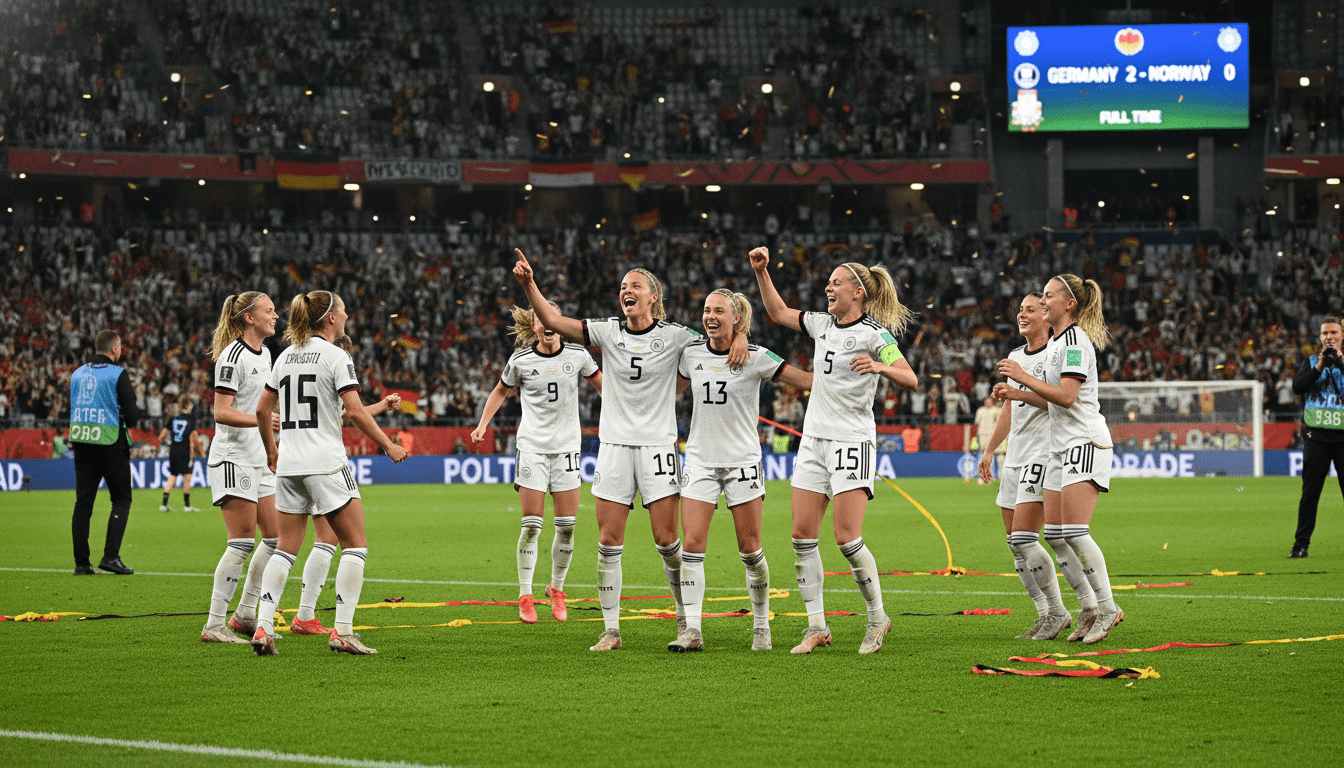
Germany Women Qualify for 2027 World Cup in Brazil with 2-0 Win Over Norway
Germany secure early qualification for the 2027 World Cup as debutant Marie Müller and Carlotta Wamser score in a 2-0 victory over Norway in Cologne. (155 characters)
The German women’s national team booked their place at the 2027 FIFA Women’s World Cup in Brazil with a commanding 2-0 win against Norway in Cologne, securing top spot in their qualifying group. The victory, sealed by debutant Marie Müller’s 18th-minute strike and Carlotta Wamser’s 27th-minute finish, confirmed Germany’s early qualification and sent 33,425 fans home satisfied. Coach Christian Wück’s side combined disciplined midfield control and incisive wide play to close out the contest.
Debutant Marie Müller Provides Early Breakthrough
Marie Müller, introduced in place of injured captain Giulia Gwinn, made an immediate impact by opening the scoring in the 18th minute. Müller, wearing the No. 7 shirt, drove forward with intent and arrived in the right positions to capitalize on a Bayern-initiated move. The goal settled Germany and allowed the team to dictate the tempo for much of the first half.
Müller’s introduction proved a tactical success for Wück, who reshuffled his full-back options to cover absences caused by injuries. The young player’s confidence on her debut underlined the squad’s depth and the manager’s willingness to trust new talent in key qualifiers. Her goal also rewarded precise build-up play from established attackers.
Carlotta Wamser Converts Flank into Decisive Second Goal
Less than ten minutes after Müller’s opener, Carlotta Wamser doubled the lead with a composed finish following a quick, wide combination. The move was initiated through a strong interplay involving Lea Schüller and Linda Dallmann, and Wamser’s direct strike left Norway with a steep deficit to overcome. The second goal highlighted Germany’s ability to transition rapidly from defense into attack.
Wamser’s overall performance was a study in contrasts: occasional defensive lapses on the unfamiliar left-back position were offset by her clear threat in the attacking third. After the break she came close again when a deflected Wamser cross struck the crossbar, underscoring her ongoing influence on the match. Her contribution was decisive in securing the three points.
Midfield Control and Tactical Setup Under Christian Wück
Christian Wück’s starting XI emphasized midfield balance, with Elisa Senß and Sjoeke Nüsken controlling the center and setting the match rhythm. Nüsken, captain for the evening in her 58th international, and Senß combined work rate and positional discipline to shield the defence and launch forward moves. Their partnership limited Norway’s access to the ball and supported Germany’s creative players.
Klara Bühl, Linda Dallmann and Jule Brand each provided moments of invention on the wings and in behind the striker, enabling sustained pressure on Norway’s backline. Germany’s game plan blended aggressive wing play with midfield stability, forcing the visitors into reactive positions for long stretches. That strategic balance was central to converting early dominance into a safe margin.
Defensive Resilience, Berger’s Save, and Controversial Call
Norway managed only sporadic chances and were kept largely at bay by Germany’s defensive structure and goalkeeper Ann-Katrin Berger’s timely saves. Berger, returning from a recent abdominal issue, produced several confident stops that prevented a comeback and reassured the back line throughout the match. Her form between the posts removed a potential vulnerability for the hosts.
A controversial moment just before halftime saw Norway’s Signe Gaupset have a goal disallowed for offside, a decision that appeared marginal and drew protest from the visitors. Ultimately the call did not change the outcome but it highlighted the fine margins that can shape international qualifiers. Germany’s defense absorbed pressure and maintained composure after the disputed incident.
Qualification Secured and Focus Shifts to Brazil 2027
With the win, Germany confirmed its position as group winners and will travel to the 2027 Women’s World Cup in Brazil, marking the tournament’s first staging in South America. The result also served as a symbolic milestone ten years after Germany’s Olympic triumph in Rio, which was commemorated during the match in Cologne. The team now turns to preparing for global competition while integrating newcomers who have bolstered squad options.
Looking ahead, the German federation and coaching staff face weeks of planning to refine tactical details and manage player fitness ahead of the tournament in July 2027, when the final is scheduled to be played at the Maracanã. Early qualification affords Wück the opportunity to experiment and consolidate a squad capable of challenging at the highest level. The focus will be on maintaining momentum and sharpening match readiness in the months to come.
Germany’s qualification in Cologne was built on a clear game plan, decisive finishing from a debutant and an adaptable squad response to injuries. The result not only guarantees a return to Brazil for the global finals but also highlights a transitional generation stepping up at the right moment. The mission toward a major tournament title in 2027 has officially begun.
