
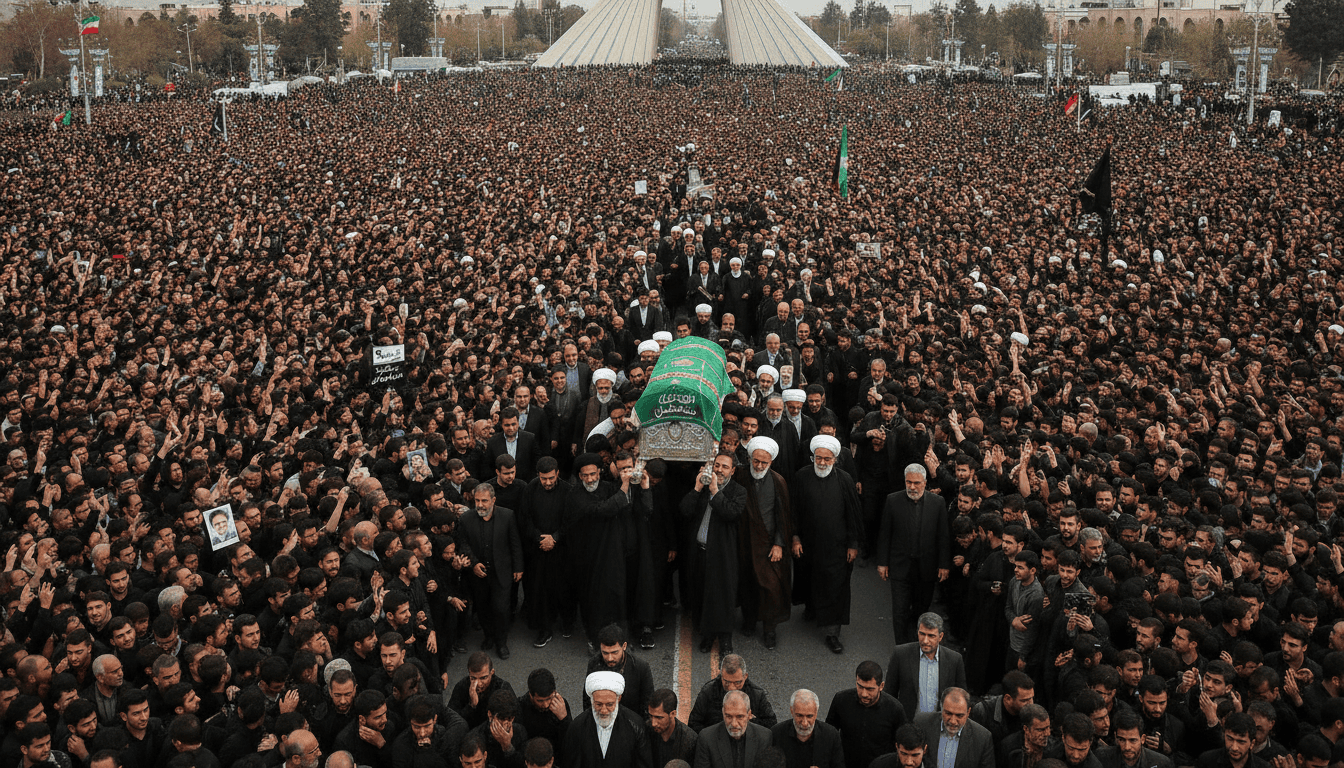
Ali Khamenei funeral begins in Tehran after four-month delay, raising security and succession questions
Ali Khamenei funeral begins in Tehran on July 3, 2026, after a four-month delay; officials cite security fears, internal power struggles and mass demonstrations.
More than four months after Supreme Leader Ali Khamenei was killed on February 28, 2026, by an Israeli airstrike on the first day of the Iran war, formal funeral ceremonies opened in Tehran on Friday, July 3, 2026. The delay, extraordinary under Islamic practice that typically requires rapid burial, reflected intense security concerns and political calculation inside Tehran. State authorities said the rites would proceed over a week with public viewings, processions and a final burial in Mashhad next Thursday.
State delays burial over security and political fears
Officials delayed burial amid fears that large public gatherings could be exploited for fresh attacks by Israel or the United States, a concern Tehran has repeatedly voiced. Security services and the leader’s inner guard moved cautiously to prevent any incident that could further destabilize the state during the ceremonies. The timing also coincides with the still-unresolved transfer of authority following Khamenei’s death, complicating decisions that usually would be handled rapidly by clerical protocol.
Succession questions shape the public narrative
The new Supreme Leader, identified by state media as Modschtaba Khamenei, has not yet publicly consolidated his authority and his possible attendance at the ceremonies has become a focal point. He assumed power in March, but his absence from public life has fueled rivalries between hardline factions and advocates for negotiation with Washington. Tehran’s apparatus remains tight-lipped about whether he will appear, and his presence or absence is widely expected to influence perceptions of the new leadership’s grip on power.
Revolutionary Guard asserts control during the rites
Senior Revolutionary Guard figures have taken visible roles in preparations, underscoring the corps’ central place in regime security and ritual control. The Guard’s commander, Ahmad Vahidi, was photographed at Khamenei’s casket and participated in the funeral committee, while other senior officers have framed the ceremonies as a display of state unity. Commanders have also issued stern warnings to the United States and Israel against interference, signaling that Tehran views the event as both a religious ceremony and a test of external resolve.
Allegations of planned attacks raise tensions
Western and regional media reports have added to Tehran’s anxieties by suggesting that foreign intelligence services discussed plans to target Iranian officials in the months before Khamenei’s death. U.S. officials are reported to have warned Tehran through intermediaries about potential threats to Iranian delegations, including an episode in April in which Iranian envoys were escorted by Pakistani jets after suspected airspace incursions. Iranian leaders point to such incidents to justify heightened security measures and the postponement of burial rites.
Mass turnout intended as show of legitimacy
Tehran has characterized the ceremonies as a national referendum on unity, calling for large public attendance to demonstrate loyalty and cohesion. Authorities plan to move Khamenei’s casket through the capital in a procession scheduled for Monday and Tuesday, followed by transfer to Qom, the clerical center some 120 kilometers south. The casket will also be taken to the Iraqi shrine city of Najaf, and public viewing in Tehran’s Mosalla complex began on Friday, where state and foreign delegations paid respects.
Foreign delegations and symbolic responses
A range of foreign representatives attended the initial laying in state, with leaders from Pakistan, Turkmenistan, Georgia, Tajikistan, Iraq and Armenia present, while Russia and China sent lower-level envoys. Moscow dispatched the deputy chairman of its national security council, Dmitri Medvedev, and Beijing sent He Wei, vice chairman of the National People’s Congress, signaling diplomatic engagement without full-scale high-level presence. The shape and rank of delegations underscore shifting international alignments and the calculus of partners in the face of regional conflict.
The week of ceremonies will pause bilateral negotiations with the United States, officials said, and conclude with an interment at the Imam Reza shrine in Mashhad the following Thursday. Tehran faces the twin tasks of managing large, emotionally charged crowds and containing the political fallout of a leadership transition that remains fragile and contested.
