
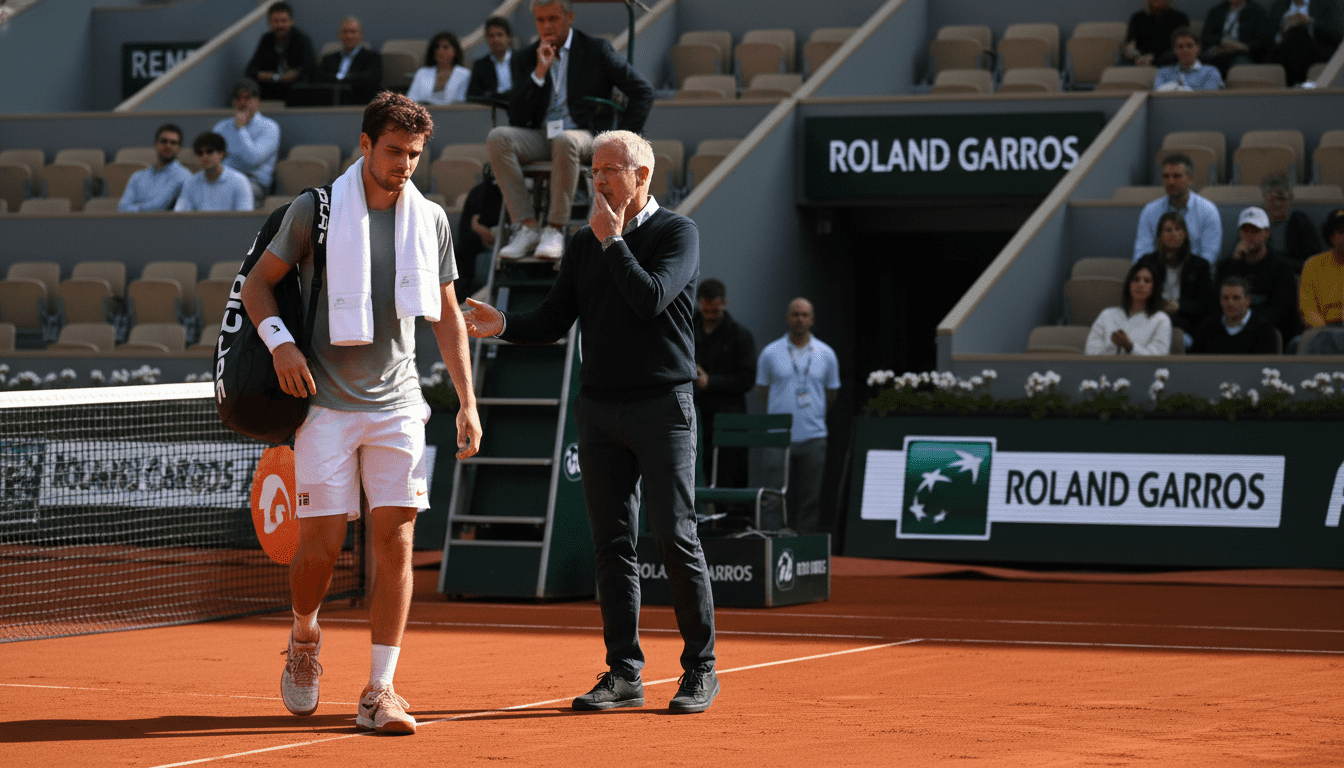
Becker Blames Mental Strain for Jannik Sinner French Open Exit
Eurosport analyst Boris Becker attributes Jannik Sinner’s French Open exit to mental strain and exhaustion after a five-set loss to Juan Manuel Cerundolo at Roland Garros.
Jannik Sinner’s French Open exit drew sharp commentary from former champion Boris Becker, who told Eurosport the world No. 1 collapsed under mental and physical fatigue during a dramatic second‑round defeat. Sinner, previously unbeaten in 30 matches, surrendered a two‑set lead before retiring after a five‑set reversal against Argentina’s Juan Manuel Cerundolo. The surprising loss — 6‑3, 6‑2, 5‑7, 1‑6, 1‑6 — has reopened questions about the Italian’s endurance and readiness for the Grand Slam grind.
Becker points to a mental breakdown rather than heat or fitness
Becker argued that the decisive factor was psychological, saying signs of distress appeared after roughly two hours of play. He noted that Sinner showed early symptoms of cramping and that the Italian himself later admitted to a poor night’s sleep ahead of the match. Becker dismissed heat and raw fitness as primary causes, observing the match began before temperatures on Philippe‑Chatrier reached the afternoon peak.
Match sequence and turning points on Chatrier
Sinner controlled the opening stages, taking the first two sets with relative ease and appearing on course for a routine progression. The momentum shifted in the third set when Cerundolo fought back to take it 7‑5, and Sinner’s level visibly dropped thereafter. The Argentine dominated the closing sets as Sinner’s movement and intensity waned, culminating in a one‑sided finish that ended the champion’s run.
Patterns in Sinner’s five‑set performances
The defeat reinforced a persistent concern about Sinner’s stamina in long matches. Across 18 five‑set encounters in his career, he has recorded just six victories, a ratio that analysts say underlines a recurring vulnerability in extended contests. By contrast, fellow top players have posted far stronger five‑set records, highlighting a gap in match‑deciding resilience at the Grand Slam level.
Recent title streak and questions over schedule management
Sinner arrived at Roland Garros on the back of a remarkable run since March, capturing high‑level titles at Indian Wells, Miami, Monte Carlo, Madrid and Rome. That sequence cemented his status as form player and Grand Slam favorite, yet it also amplified speculation that the dense schedule may have contributed to cumulative fatigue. Sinner himself was noncommittal when asked if an enforced break might have altered the outcome, suggesting the problem could have arisen regardless of prior choices.
Player statements and Eurosport reaction
After the match Sinner attributed the defeat to a “black day” brought on by sleeplessness, a remark Becker interpreted as evidence of a mental block. On Eurosport, the former champion emphasized how sleep disruption and persistent worry can sap both nervous system function and physical recovery. Becker concluded that the match was not lost to tennis tactics but to a drained athlete in whom the mind and body were misaligned.
Wider implications for Sinner’s season and Grand Slam goals
The unexpected exit forces a recalibration of Sinner’s Roland Garros prospects and raises immediate questions about his preparation for forthcoming majors. Coaches, sports scientists and fitness staff will likely examine recovery protocols, match load and mental conditioning options as the season progresses. The loss also invites scrutiny from rivals and observers who see endurance as the final attribute Sinner must fortify to translate tour dominance into consistent Grand Slam titles.
Sinner’s defeat will reverberate across the tour as players and pundits reassess the toll of a packed calendar on elite competitors, and it places fresh emphasis on the often unseen interplay between sleep, mental state and peak performance at the sport’s highest level.
