
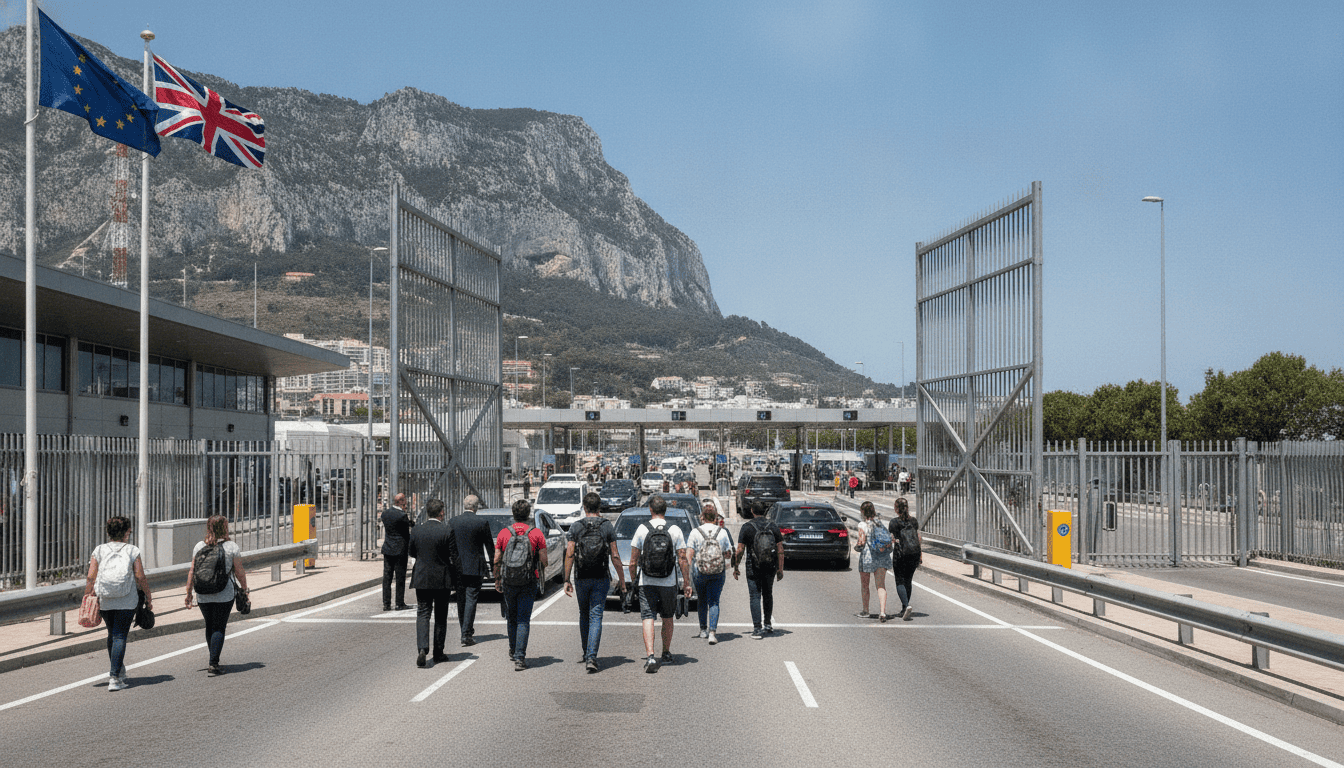
EU-UK Deal Ends Gibraltar Border Controls, Restores Free Movement with Spain
EU-UK agreement ends Gibraltar border controls with Spain, restoring freer movement for people and goods and easing daily commuting, trade and tourism.
Gibraltar border controls between Spain and the British Overseas Territory have been removed under a recent EU–UK agreement, ending more than a century of routine checks at the land frontier. The pact changes the legal framework for crossings and trade while stopping short of making Gibraltar an official member of the Schengen Area. Officials say the move will speed the flow of people and goods across the isthmus that connects Gibraltar to Spain.
Historic end to a century of frontier checks
The land boundary separating Gibraltar from Spain has been shaped by more than 300 years of diplomacy and conflict, with a more recent history of fences and formal controls that date back over a century. For generations the crossing was used as both a practical checkpoint for migration and a political lever, most notably during the Franco era when Spain closed the border for decades.
The new arrangement restores an operational normality that many residents and local businesses say was lost after Britain’s withdrawal from the EU. Authorities expect daily crossings to be quicker and less bureaucratic, reflecting a return to freer movement for workers and shoppers who travel across the frontier.
Treaty of Utrecht and long‑running sovereignty dispute
Gibraltar’s status as a British territory stems from the Treaty of Utrecht in 1713, when the territory passed from Spain to Britain after the War of the Spanish Succession. Spain launched multiple attempts to recover the rock in the 18th century, and sovereignty has remained a disputed and emotive issue throughout the modern era.
Residents have repeatedly affirmed their preference to remain under British sovereignty, most notably in referendums in 1967 and 2002 where overwhelming majorities rejected shared rule with Spain. Those results, and Gibraltar’s distinct political identity, have shaped negotiations over borders and jurisdiction ever since.
How the EU‑UK agreement will operate
Under the terms now in force, crossings between Gibraltar and Spain will follow Schengen rules for people, meaning routine passport checks at the land frontier are ended even though Gibraltar will not formally join the Schengen Area. The arrangement also adapts customs and tax treatments: Gibraltar will not enter the EU customs union, but goods will move across the border without the classic, physical customs stops that had returned after Brexit.
The deal introduces a new import regime that replaces traditional customs controls with a transaction-based system, and aligns Gibraltar’s indirect tax structure with specified EU rates. Authorities on both sides will deploy joint procedures and technology to police fraud, illicit trade and regulatory compliance while facilitating legitimate flows.
Impact on commuters and the local economy
The daily economic link between Gibraltar and neighbouring Spanish municipalities is substantial: around 15,000 people cross the border each workday, and Gibraltar itself is home to roughly 40,000 residents. Analysts warn that long waits at the frontier had become a drag on labour markets and supply chains since the post‑Brexit reintroduction of controls.
Economists point to stark regional disparities: the adjacent Spanish province of Cádiz recorded a per‑person gross domestic product near €21,300 in 2023, about half the national average, while Gibraltar’s GDP per capita ranks among the highest worldwide and is many times higher than in neighbouring areas. Smoother crossing procedures are expected to reduce commuting time, sustain employment links and stabilise supply of services and goods to both sides.
Tourism and travel changes for visitors
For visitors, the visible change is the end of land‑border passport checks for those travelling between Spain and Gibraltar, which should simplify short trips and daily tourism flows. Passengers coming to Gibraltar by air or sea from nations outside the Schengen zone will still be required to present travel documents at ports of entry, and routine checks there will remain in place.
Travel rules for third‑country nationals follow existing UK arrangements: for example, holders of German passports can typically enter the United Kingdom and British territories for up to 180 days without a visa, subject to immigration checks at ports and airports. Officials warn that travellers should continue to carry valid identity documents and check carrier or border guidance ahead of journeys.
Political reactions in Madrid and London
The agreement has drawn mixed reactions from political forces on both sides of the fence. In the United Kingdom and Spain, right‑wing critics argued the concessions undermined national claims or sovereignty, while supporters framed the deal as a pragmatic step to end unnecessary friction and reintegrate Gibraltar into European economic circuits.
Spanish and Gibraltarian officials emphasised practical benefits for residents and commerce, and some regional experts described the accord as a long overdue normalization of cross‑border relations that had been strained since Britain’s EU exit.
The removal of routine Gibraltar border controls marks a significant adjustment to post‑Brexit arrangements, combining regulatory alignment with safeguards on customs and taxation. Observers say the real test will be in daily administration and enforcement, where joint procedures will need to operate smoothly to deliver the promised benefits to commuters, traders and tourists.
