
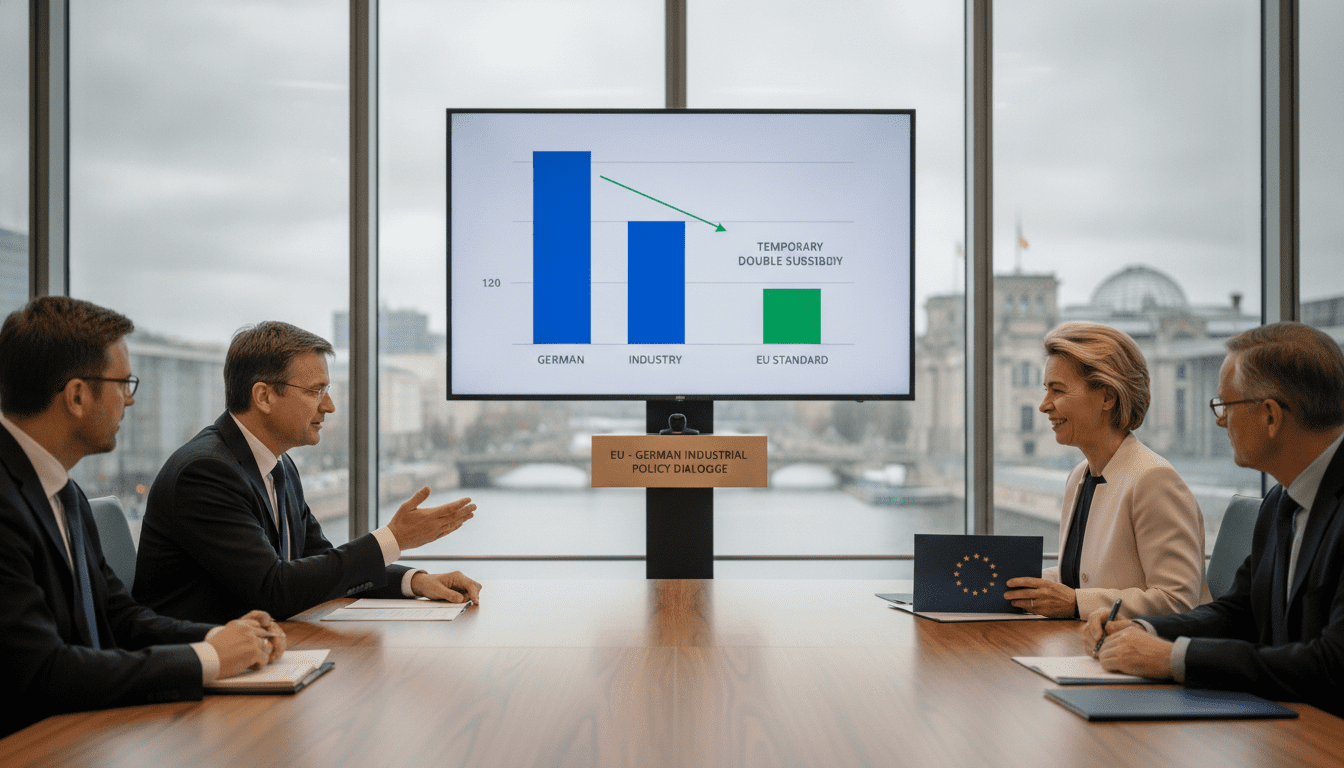
Germany to allow double support as industrial electricity price applied alongside existing compensation
Germany will let energy‑intensive industries combine the new industrial electricity price with existing electricity price compensation, temporarily easing power costs for sectors hit by the Middle East crisis.
Germany will allow the industrial electricity price to be used together with the existing electricity price compensation for the same consumption, a move aimed at cushioning energy‑intensive firms from rising costs amid the Iran conflict and shipping disruptions. The decision follows a temporary European Commission framework known as METSAF that opens limited scope for member states to stack state aid measures during the crisis. Berlin’s Federal Ministry for Economic Affairs confirmed the change on Friday, saying it targets the sectors most exposed to the shock.
Details of the industrial electricity price measure
The industrial electricity price, approved by Brussels in April, subsidizes up to half of a qualifying company’s electricity use at a headline rate of five euro cents per kilowatt hour, lowering effective power costs for heavy users. Designed for the most electricity‑intensive operations, the scheme complements an existing electricity price compensation that reimburses parts of CO₂ costs embedded in retail tariffs to prevent offshoring. Under the new interpretation of METSAF, the same kilowatt hours may be relieved both through the electricity price compensation and, for up to 50 percent of consumption, through the industrial electricity price.
Who stands to benefit and how much relief they could see
Steel, aluminium, chemical and paper producers are explicitly named as likely beneficiaries because of their high and trade‑exposed energy needs, and officials point to concrete examples of sizeable relief for single plants. Federal spokespeople cited a hypothetical steel site operating an electric arc furnace that consumes two terawatt‑hours: under the new arrangement, one terawatt‑hour could receive the industrial electricity price in addition to compensation on the remaining volume, yielding an estimated additional relief of roughly €17 million for 2026. Economists and industry lobbyists say that for firms with multi‑terawatt‑hour usage profiles this layered support materially improves competitiveness, but the total fiscal cost will depend on national uptake and final administrative rules.
European Commission stance and limits under METSAF
Brussels has framed the change within the “Temporary Crisis Framework for State Aid” (METSAF), which relaxes usual constraints so member states can react to energy market disruptions caused by the conflict in the Gulf and interruptions in the Strait of Hormuz. The Commission’s adapted rules allow subsidy coverage to rise to around 70 percent of energy costs for a limited March–December 2026 window under crisis provisions, and they remove certain conditions that normally require firms to contribute to the green transition. An EU Commission spokesperson, however, said discussions with the German government remain ongoing and that no final Commission decision on Germany’s precise application has yet been publicly confirmed.
Domestic politics and budgetary trade‑offs
Berlin’s economic ministry emphasized the measure is temporary and targeted, but acknowledged that implementing double relief will require new budget allocations and inter‑ministerial coordination. Minister Katherina Reiche’s ministry signalled it will press for roughly €1 billion in additional funds to enable the combined support, a request that has intensified debate with Finance Minister Lars Klingbeil and coalition partners over fiscal priorities. Critics within and beyond the governing parties warn that higher short‑term subsidies could deepen public deficits and create unequal treatment between industries and households, while supporters argue the aid is necessary to prevent job losses and preserve industrial capacity.
Industry reaction and questions over fairness and green conditions
Industrial groups and trade unions responded cautiously, welcoming the immediate cost relief but urging transparency on eligibility criteria and duration to avoid distortions and legal disputes. Some observers flagged that METSAF’s relaxed rules exempting beneficiaries from green‑transition contributions could undermine climate policy incentives, creating a tension between short‑term competitiveness and long‑term decarbonisation goals. Other EU member states are watching closely, with commentators noting that many countries lack Germany’s fiscal headroom to deploy comparable measures, which could concentrate benefits in wealthier economies and raise internal equity concerns.
Next steps toward implementation and likely timeline
Officials say the German government must now formalize how the cumulative relief will be calculated and allocate the required budget lines before payments begin, with the coalition having already agreed in November to a broader industrial electricity price for 2026–2028 and to extend electricity price compensation retroactively to 2025. Administrative details, state aid notifications and any final Commission sign‑off will determine the pace of roll‑out, and ministries anticipate urgent preparatory work to allow payments to flow in the 2026 cycle where legally and fiscally feasible. Observers expect regulatory guidance and application windows to be published over the coming weeks, followed by company declarations and national audits to ensure correct use of the temporary rules.
The policy marks a significant, albeit temporary, shift in German industrial relief by permitting layered state aid for the same electricity consumption, reflecting Brussels’ crisis flexibility and Berlin’s willingness to use fiscal levers to shield trade‑exposed sectors from geopolitical energy shocks.
