
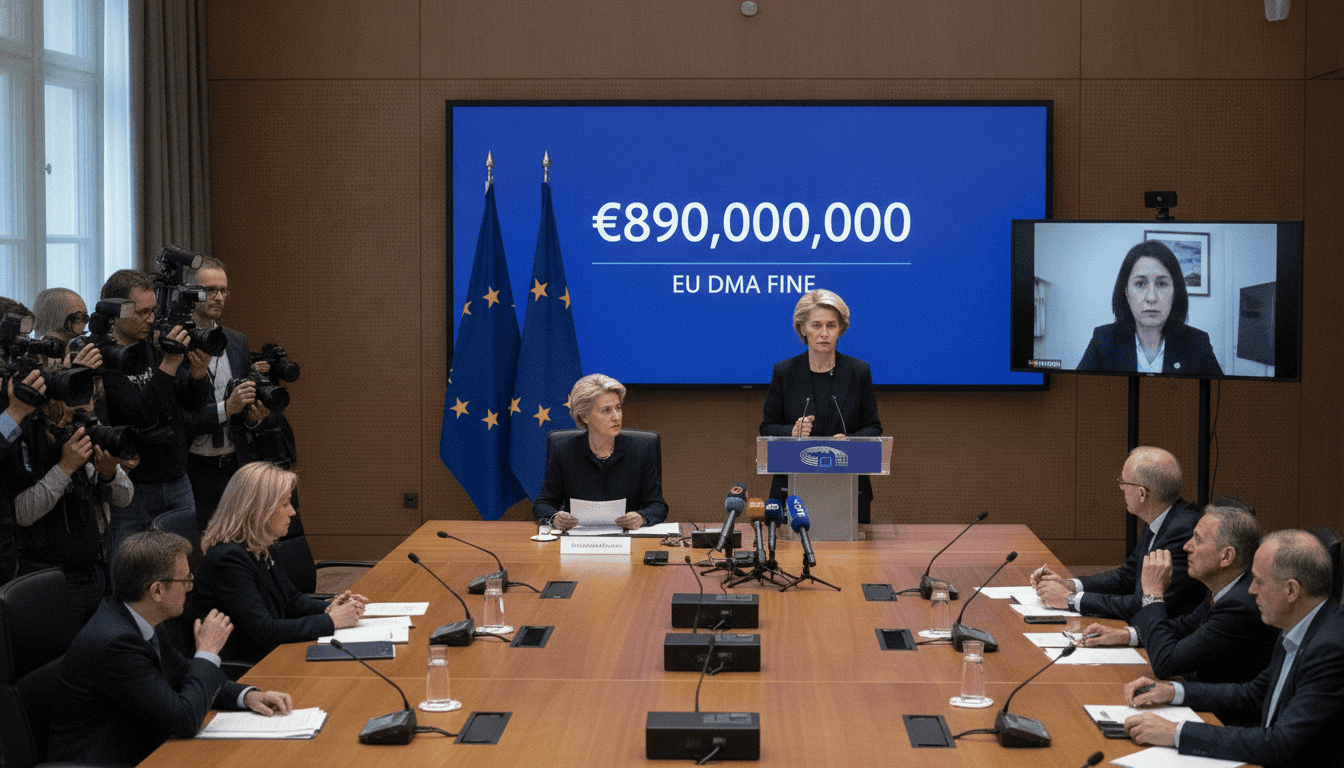
EU fine against Google sparks U.S. criticism after €890 million DMA penalty
EU fine against Google: Brussels fined Alphabet €890m under the Digital Markets Act, drawing U.S. trade criticism and a possible legal challenge from Google.
The European Commission has imposed an €890 million fine on Alphabet, the parent company of Google, in what Brussels says is the first enforcement action under the Digital Markets Act. The EU fine against Google centers on findings that Google favored its own services in search results and hindered third-party app developers from directing users to alternative app stores and payment pages. The decision has already provoked a sharp response from Washington, where U.S. trade officials warned the penalty risks creating trade uncertainty for American firms operating in Europe.
Commission finds preferential treatment in search and restrictions on Android partners
The EU’s executive arm concluded that Google used its dominant position to elevate its own services within search results, disadvantaging competitors offering comparable products. Regulators also said Google made it more difficult for app developers on Android to point users toward alternative app stores or to their own payment systems, measures the Commission viewed as limiting effective consumer choice. Officials framed the ruling as a necessary step to enforce the DMA’s rules aimed at curbing gatekeeper practices by large digital platforms.
First major sanction under the Digital Markets Act
This penalty marks the first significant monetary sanction issued under the Digital Markets Act, a sweeping EU law designed to regulate so-called gatekeepers in digital markets. The DMA grants Brussels new powers to require behavioral changes and impose fines when dominant platforms fail to comply with interoperability and fairness obligations. EU officials presented the fine as a test case for the law’s reach, signaling to other major tech firms that the Commission intends to use the DMA’s enforcement tools actively.
U.S. trade official says penalty fuels transatlantic uncertainty
In Washington, U.S. trade official Jamieson Greer criticized the EU action as a source of trade instability, arguing that measures framed as promoting predictability can, in practice, increase uncertainty for U.S. exporters. Greer warned that the decision could have knock-on effects for American businesses that rely on predictable regulatory frameworks when trading with European markets. The intervention by a senior U.S. trade representative underlines how enforcement of digital rules has policy implications that extend beyond competition law into broader trade diplomacy.
Google disputes findings and leaves legal options open
Alphabet and Google publicly criticized the Commission’s ruling, rejecting aspects of the decision and signaling that legal challenge remains a possibility. The company argued that its conduct complied with applicable rules and defended the design choices behind how services are presented and integrated on Android and in search. A court appeal would set the stage for a prolonged legal contest over the interpretation and application of the DMA, with outcomes that could reshape obligations for platform operators across Europe.
Industry and developer community brace for practical effects
App developers, payment providers and alternative app-store operators are watching closely for operational consequences of the ruling. If the Commission’s interpretation of the DMA is upheld, platforms may be required to alter default search displays, simplify mechanisms for developers to link to third-party stores, and adjust billing integrations on Android. Such changes could loosen control by dominant platforms and create new commercial opportunities, but they could also introduce transitional costs and uncertainty about compliance requirements in the short term.
Geopolitical dimensions and precedent-setting implications
Beyond commercial and technical impacts, the dispute has assumed a geopolitical dimension by pitting Brussels’ regulatory ambitions against U.S. concerns about market access and legal certainty. The case is likely to be seized upon by policymakers and industry groups on both sides of the Atlantic as an example of the tensions inherent in regulating global digital platforms from a regional authority. Legal appeals and any follow-on enforcement orders will be closely scrutinized for the precedents they set on issues such as search neutrality, app ecosystem openness and the limits of platform product design.
The EU fine against Google thus represents both a landmark moment for DMA enforcement and the opening salvo in what could become a lengthy transatlantic legal and policy debate about how major online platforms should be governed. The coming months will reveal whether Brussels’ approach prompts rapid operational change, a drawn-out court battle, or a negotiated settlement that shapes the contours of digital competition in Europe and beyond.
