
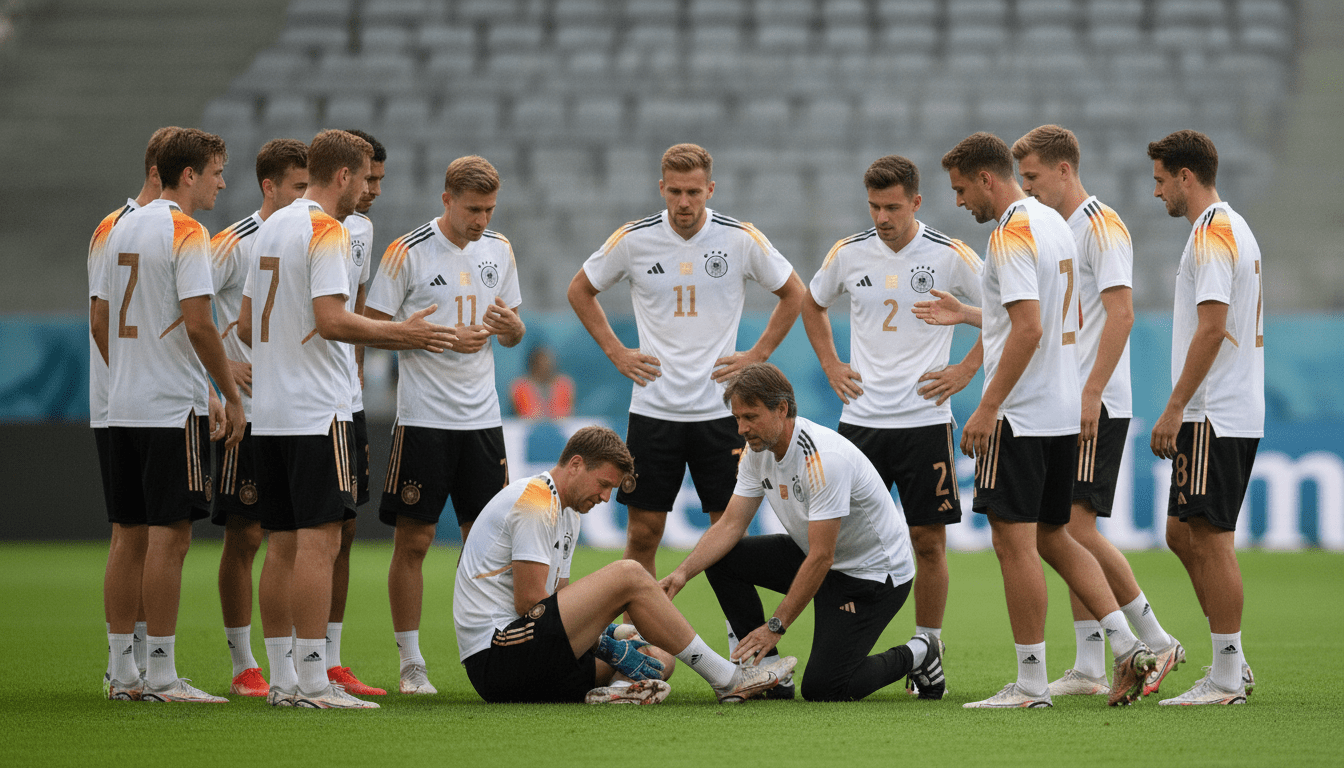
Germany World Cup squad faces questions over Neuer fitness, defensive reshuffle and midfield balance ahead of USA opener
Germany World Cup squad preview ahead of the USA 2026 opener: Neuer’s fitness, defensive choices, midfield balance and attacking options for the DFB team.
The Germany World Cup squad flew to the United States under a mix of confidence and uncertainty, with Manuel Neuer’s fitness the most immediate headline. Coach Julian Nagelsmann’s selection blends veterans and emerging talents, but key decisions about form and durability could shape the team’s opening matches. As the tournament begins on American soil, the squad’s balance between experience and athleticism will be tested from the first whistle.
Neuer’s aura vs injury risk
Manuel Neuer remains the standout figure in the Germany World Cup squad, offering leadership and a psychological edge across the dressing room. Teammates credit his presence with lifting concentration and defensive organisation, a form of influence often described as an unmistakable aura.
Yet Neuer arrives with a calf concern that casts doubt on whether he will start the opening game. That uncertainty forces Nagelsmann to weigh reputation against readiness, and it leaves the squad with the uncomfortable prospect of relying on aura without assurance of availability.
Defensive reshuffle shapes backline
The centre-back pairing now looks different from past tournaments, with Nico Schlotterbeck emerging as a key ball-playing option alongside Jonathan Tah. Schlotterbeck’s left-footed distribution has altered how the team builds from the back and helped him displace other contenders in recent selections.
Antonio Rüdiger remains a potential game-changer when deployed, offering physicality and experience although his consistency has been debated. The defensive unit’s effectiveness will hinge on cohesion between passing intent and the ability to defend in crowded penalty-area scenarios.
Kimmich’s leadership and tactical role
Joshua Kimmich arrives as one of the squad’s most experienced campaigners and a likely linchpin whether he plays in midfield or at right back. His tactical discipline and high work-rate make him a natural leader, and recent signs suggest increased composure in how he organises team play.
Nagelsmann’s deployment of Kimmich could determine both defensive stability and attacking transition. If Kimmich operates with freedom to cover ground, he could become the fulcrum that allows creative players to take more risks in the attacking third.
Midfield creativity: Wirtz, Nmecha and Musiala
Florian Wirtz and Felix Nmecha bring different but complementary creative instincts to Germany’s engine room. Wirtz’s vision and link-up play can unlock tight defences, while Nmecha’s dynamism after recovering from injury gives the side added tempo and penetration.
Jamal Musiala remains a wild-card influence whose dribbling and unpredictability can change a game but whose recent return from injury limits full explosiveness. The midfield balance will depend on Nagelsmann finding combinations that preserve defensive cover while allowing these creators to express themselves.
Attacking depth: Havertz, Sané and the forwards
Kai Havertz carries the profile of a player accustomed to big moments and will be judged on whether he can replicate decisive finishing at international level. Leroy Sané offers pace and directness on the wing, traits that suit modern attacking systems and can stretch opposition defences.
Ahead of them, the forward line includes experienced options and tournament newcomers whose roles may evolve with match situations. Nagelsmann’s rotation strategy and the team’s ability to manufacture clear chances will be decisive in assessing how potent the attack proves over the whole tournament.
Young bench and tactical flexibility
The squad’s younger cohort — including Aleksandar Pavlović, Nathaniel Brown and Malick Thiaw — provides energy and the capacity to adapt mid-game. These players offer tactical flexibility, allowing the coach to switch formations and introduce fresh legs without a dramatic drop in technical quality.
Depth also raises selection questions for backup goalkeepers and utility players whose club situations vary widely. How these bench options are used across tight tournament windows may determine whether Germany can sustain form through group and knockout stages.
The Germany World Cup squad departs for a tournament where small margins will matter and durability may prove as important as talent. With a blend of seasoned leaders and promising newcomers, the team’s immediate challenge is to translate squad potential into cohesive performances on the American pitches.
