
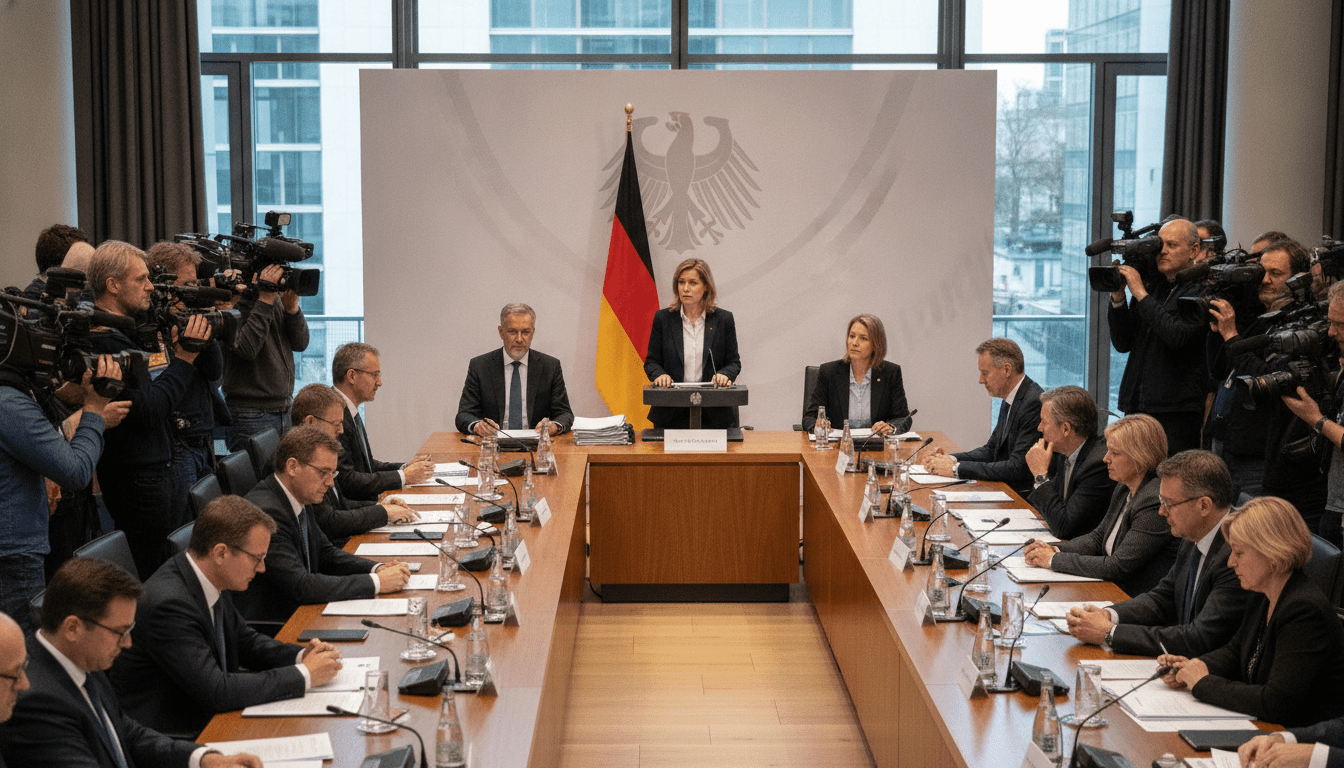
Interior ministers meet in Hamburg to debate German migration policy and deportations
Interior ministers meet in Hamburg to debate German migration policy, including deportation rules for convicted refugees, amid rising antisemitism and G7 fallout tensions.
The federal-state Interior Ministers Conference opened in Hamburg with migration policy at its center, as ministers and experts assess proposals to lower legal hurdles for deporting convicted refugees. The keyword German migration policy frames the debate, which was intensified by public security concerns and a new report documenting a rise in antisemitic incidents. Discussions are expected to shape pending federal legislation and influence cooperation with third countries on returns.
IMK chair advocates wider deportation powers
Hamburg’s Interior Senator Andy Grote, who holds the IMK chair, urged colleagues to ease legal barriers that currently restrict deportations of foreign nationals convicted of crimes. He argued such changes should apply “regardless of country of origin” and cited Afghanistan, Syria and Ukraine as possible destinations for the return of serious offenders. Grote’s intervention has pushed migration and public safety to the top of the IMK agenda and prompted debate over the balance between protection status and criminal accountability.
Legal experts raise questions over protection status
Legal scholars and practitioners warn that lowering deportation thresholds raises complex legal and humanitarian questions, especially where individuals hold a recognized protection status. Marcus Engler, a social scientist at the German Centre for Integration and Migration Research, was cited explaining why states sometimes remove protection to effect returns, noting that legal exceptions and severe criminality can justify revocation under international and domestic law. Courts will likely remain the decisive arena for contested cases, and any policy shift will require careful drafting to withstand judicial review.
RIAS report highlights surge in antisemitic incidents
At the same time as the IMK convened, the federal RIAS reporting network published its 2025 annual report documenting 8,725 antisemitic incidents for the year. That figure averages nearly 24 incidents per day and marks an increase of about 100 cases compared with 2024, the report shows. RIAS flagged a marked rise in incidents with an extreme-right background, from 562 to 807 cases, and said that 27 percent of recorded incidents occurred online, underscoring how the digital sphere amplifies hate.
Civil society warns of normalization of antisemitism
Benjamin Steinitz, managing director of RIAS, warned at the report’s presentation that antisemitism risks becoming normalized when patterns of abuse go unchecked. RIAS’s reporting network records not only criminal acts but also hurtful or intimidating remarks and everyday incidents reported by victims and witnesses. The organization’s findings are likely to factor into IMK discussions on integration, prevention and policing, as ministers consider how migration debates intersect with social cohesion and hate crime responses.
G7 outcomes and domestic political implications
The IMK’s timing coincides with the conclusion of a two-day G7 summit in Évian-les-Bains, where Chancellor Friedrich Merz emphasized cooperation on critical raw materials and artificial intelligence. German officials framed the G7 communiqué as a push to strengthen supply chains and recycling across allied countries, priorities that may interact with domestic industrial and migration policies. Parties across the political spectrum in Germany are using the international summit’s outcomes to bolster arguments about economic security and the need for robust law enforcement at home.
State-federal coordination and third-country cooperation
Ministers at the conference must also reconcile differing state-level approaches to reception, integration and enforcement, a perennial challenge in German migration policy. Several states favor stricter return measures, while others emphasize faster integration and improved legal assistance for migrants. Officials indicated they will press for enhanced bilateral engagement with countries of origin and transit to increase the feasibility of returns, but diplomats caution that cooperation depends on political and security conditions in partner states.
Germany now faces a policy crossroads in which public safety concerns, statutory protections and civil society warnings converge. Any modification to deportation rules will require not only political agreement at the IMK but also legal safeguards and enhanced capacity for case processing.
Public debate in the coming weeks will test whether proposed changes can reduce crime involving foreign nationals without undermining constitutional and international obligations. Policymakers say they aim to craft measures that are legally sound, operationally feasible and responsive to rising antisemitism and other societal stresses highlighted in recent reports.
