
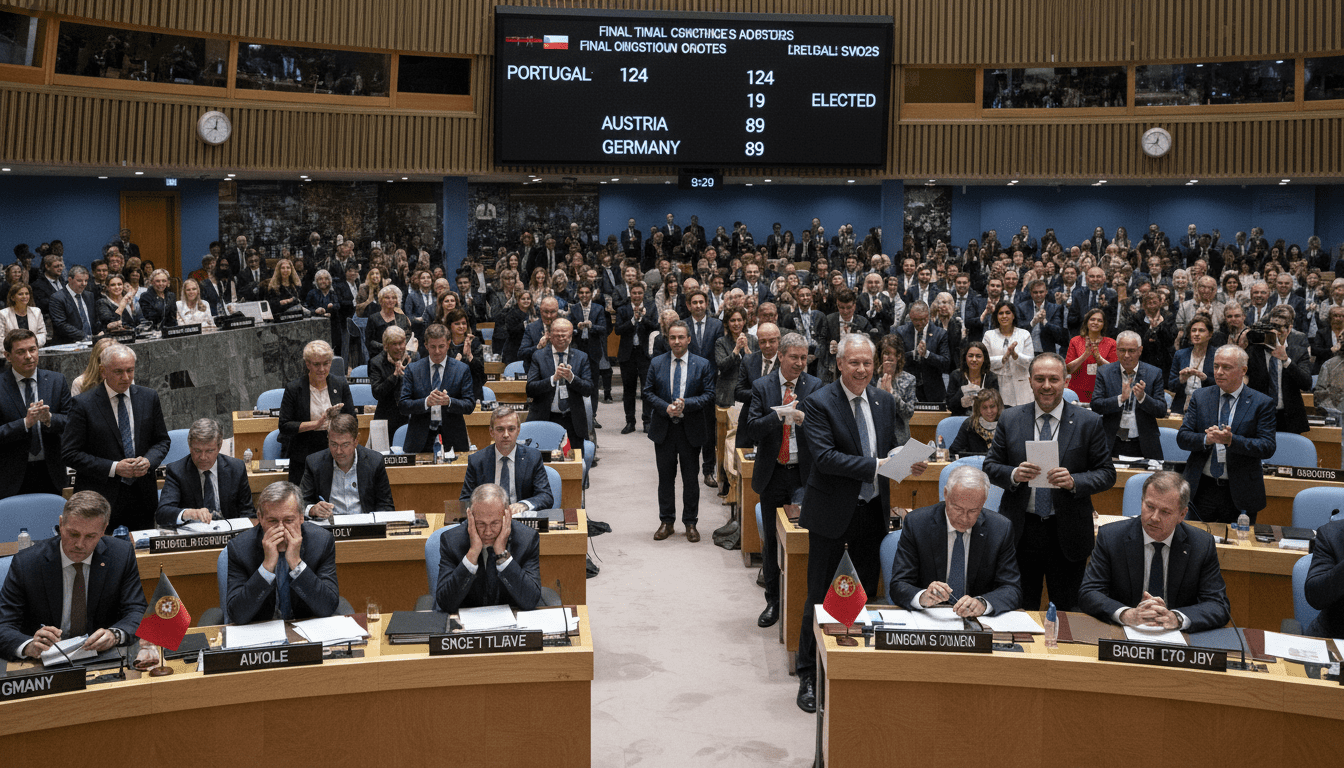
Germany fails to win UN Security Council seat in General Assembly vote
Germany failed to secure a UN Security Council seat after falling short of the required two-thirds majority in the General Assembly vote in New York.
General Assembly vote tallies
The United Nations General Assembly elected two members from the Western European and Others Group with Portugal receiving 134 votes, Austria 131 and Germany 104. A two-thirds majority of the ballots cast — 127 votes in this round — was needed for victory, and Germany’s total left it outside the threshold. In the same election cycle Zimbabwe and Trinidad and Tobago were also elected to non-permanent seats, while Kyrgyzstan and the Philippines failed to reach the two-thirds threshold in the Asia group first round.
The Security Council’s ten non-permanent seats join the five permanent members — the United States, Russia, China, France and the United Kingdom — which together shape the UN’s central security body. The newly elected non-permanent members will serve two-year terms beginning in January 2027 and will participate in deliberations on peace, sanctions and international crises.
German government response
Chancellor Friedrich Merz stressed that Germany will continue to support a rules-based multilateral order despite the unsuccessful bid for a UN Security Council seat. Merz congratulated the countries elected and framed the result as not changing Germany’s commitment to the UN and its responsibilities within the international system.
Foreign Minister Johann Wadephul, who led Germany’s campaign effort in New York, rejected calls for personal consequences and said he bore no blame for the outcome. He attributed the result largely to the timing of Germany’s candidacy, which was announced in 2019, and therefore came later than the bids from Portugal and Austria.
Campaign timing and diplomatic dynamics
German officials acknowledged that the late start of the campaign placed Berlin at a structural disadvantage in a competitive, multi-year contest for a coveted UN Security Council seat. Portugal declared its candidacy in 2011 and Austria in 2013, giving both governments longer lead times to mobilize support among UN member states.
Wadephul and other diplomats engaged in last-minute lobbying in New York to sway undecided delegations, but that effort could not overcome the long-standing relationships and coordinated outreach executed by Portugal and Austria. Observers noted that sustained, coordinated diplomatic campaigning often proves decisive in bloc voting and regional horse-trading at the UN.
Portugal and Austria secure seats
Austria’s foreign minister characterized her country’s victory as the product of an “intensive and coordinated” 15-year campaign, while Portugal’s leadership framed the result as a vindication of continued support for UN principles and multilateralism. Both governments noted this will mark their fourth time serving as non-permanent members beginning in January 2027.
Campaigning by Portugal and Austria emphasized continuity in Europe’s contribution to the Security Council and a readiness to take on responsibilities for international security issues. Their successful bids underline the political payoff of long-term diplomatic investment and voter outreach across geographic regions and issue portfolios.
Political and policy implications for Germany
Domestically, the result represents a setback for Chancellor Merz and the Foreign Ministry, which had sought to elevate Germany’s global profile through a stronger presence at the UN’s most powerful council. The defeat may feed debates within Berlin about campaign planning, foreign-policy messaging and the government’s ability to marshal sustained international support.
Analysts say the loss could also reflect unease among some UN member states with aspects of Germany’s recent foreign-policy stances, including reactions to conflicts in the Middle East and positions on broader geopolitical tensions. Regardless, Berlin can still pursue influence through other multilateral bodies, coalition-building, and targeted diplomacy ahead of future candidacies.
Next steps and broader consequences
Germany has emphasized that the work invested in the campaign will yield long-term benefits for its multilateral engagement, including deeper bilateral ties developed during the outreach effort. Officials signaled intentions to analyze the election results, refine diplomatic strategies and remain active in UN forums on peace, humanitarian response and global norms.
For Portugal and Austria, the victory provides a platform to shape Security Council debates on sanctions, peacekeeping mandates and conflict resolution over the 2027–2028 term. For Germany, the immediate priority will be to translate domestic reflection into concrete diplomatic measures that restore momentum for any future bids to join the Security Council’s non-permanent ranks.
Germany’s failure to win a UN Security Council seat marks a significant diplomatic moment, but officials in Berlin stressed continued commitment to multilateralism while Portugal and Austria prepare to assume their roles in January 2027.
