
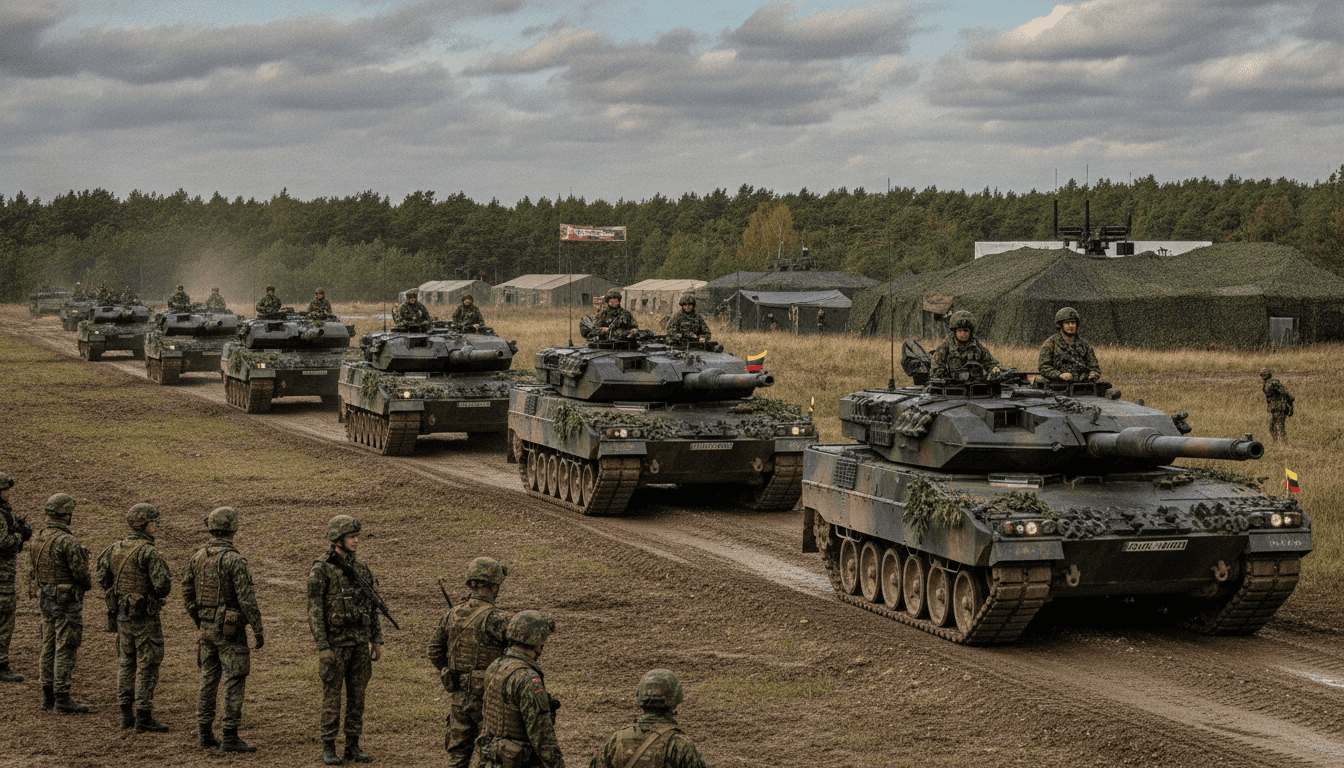
Freedom Shield 2026: German Panzer Brigade Launches Large-Scale NATO Drill in Lithuania
Freedom Shield 2026: Germany’s panzer brigade trains in Lithuania with tanks, 300+ drones and allied forces to strengthen NATO deterrence and regional security.
Germany’s newly formed panzer brigade has begun large-scale exercises in Lithuania as part of Freedom Shield 2026, testing combined-arms tactics against simulated, modern threats. The exercise, which explicitly incorporates lessons from the war in Ukraine, will train armored units, mechanized infantry and drone teams to prepare for future combat scenarios. Commanders say the drill is designed to sharpen readiness and to strengthen NATO deterrence along the alliance’s eastern flank.
Germany’s Panzer Brigade and the 2027 Readiness Goal
The brigade leading Freedom Shield 2026 is being fielded as a central element of Germany’s reinforced NATO posture in the Baltics. Officials say the unit will reach full operational strength by 2027, with about 4,800 soldiers and 200 civilian staff planned for the formation. Its deployment to Lithuania reflects Berlin’s response to perceived risks from Russia and its allies in the region.
Armored Maneuvers and Mechanized Assaults on the Training Ground
On the main training ranges, Leopard main battle tanks and Puma infantry fighting vehicles moved into position and conducted live maneuvers with training ammunition. Mechanized infantry dismounted under armored cover, cleared simulated obstacles and engaged targets from prepared positions in a scenario designed to replicate high-intensity combat. Organizers emphasized that the exercise replicates dynamic battlefield conditions rather than static, attritional fighting.
Advanced Simulation Systems Record Hits and Casualties
The exercise uses the AGDUS laser simulation network to register hits on vehicles and individual soldiers, giving referees a high-resolution picture of battlefield effects. When soldiers are judged hit, their vests signal and they cease engagement to simulate casualty procedures and force degradation. Several vehicles were marked as heavily damaged or destroyed after the opening runs, allowing commanders to test command-and-control responses under stress.
Multinational Scale: Troops, Vehicles and NATO Partners
Freedom Shield 2026 has drawn roughly 2,900 troops and about 800 vehicles from eight NATO countries to the Lithuanian training area, with approximately 2,300 soldiers contributed by Germany. The exercise marks the first time the newly formed brigade is training on Lithuanian soil, and allied contingents are integrating with German formations for combined-arms tasks. Organizers describe the multinational presence as a deliberate effort to enhance interoperability and deterrent signaling.
Unmanned Systems and Counter‑Drone Operations Integrated into Drills
Planners have deliberately integrated more than 300 drones of various types into the scenarios to reflect their growing battlefield role in surveillance and strike. Drone-defense systems and tactics are being exercised alongside electronic warfare measures to simulate the contested airspace seen in recent conflicts. German leaders said previous testing in April on a training area in Lower Saxony informed the approach to unmanned systems and dispersal tactics during Freedom Shield 2026.
Strategic Rationale: Deterrence and Adapting to Future Wars
Military planners stress that the exercise is aimed at deterring aggression against Baltic states that border Belarus and the Russian exclave of Kaliningrad. Commanders argue that future conflicts may unfold differently from the current fighting in Ukraine, and that forces must prepare for rapid, distributed operations rather than predictable massed formations. The brigade’s commanders said they study Ukrainian battle experience to adapt tactics and to avoid prolonged frontline attrition.
The exercise leadership underscored a shift in operational thinking: concentration of forces—long a precondition for decisive action—now carries higher risk from precision fires and unmanned systems, and must be balanced with dispersion, mobility and active countermeasures. Training in Lithuania is intended to test those concepts under realistic pressure while demonstrating NATO’s capacity to operate collectively in the eastern theater.
Germany’s commanders also highlighted the enduring role of armored maneuver despite changing threats, noting that tanks, mechanized infantry, artillery and engineers remain central to combined-arms operations. At the same time, troops are learning to integrate tactical drones for reconnaissance and targeting and to employ layered defenses against enemy unmanned systems.
This iteration of Freedom Shield 2026 is intended to be both a training milestone for the German brigade and a message of deterrence: by rehearsing high-intensity operations with allied partners and modern simulation tools, NATO aims to raise the costs of potential aggression and to enhance the readiness of forces deployed on the alliance’s eastern flank.
