
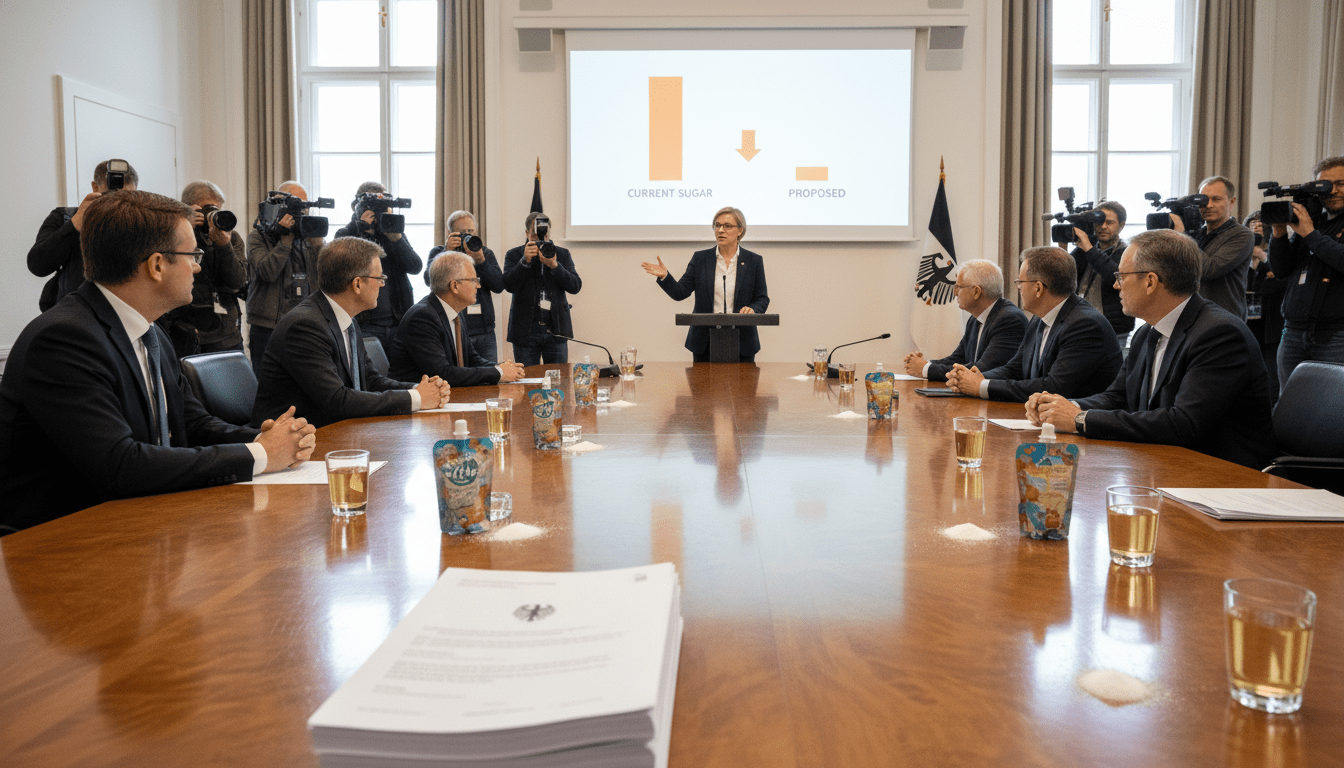
German sugar tax could halve sugar in popular kids’ drinks, Foodwatch finds
Germany’s proposed sugar tax could cut sugar in children’s beverages by nearly half, Foodwatch reports, showing an average of ten sugar cubes per product and specific reformulation targets for Fanta, Capri‑Sun and others.
Foodwatch’s market check of ten popular soft drinks and juice pouches found that items commonly consumed by children contain about ten sugar cubes on average, a level advocates say a new sugar tax in Germany would curb. The federal government is considering a levy on sugar‑sweetened beverages starting in 2028, and experts have proposed a tiered charge designed to encourage manufacturers to reformulate recipes. Industry responses in the United Kingdom after a similar policy saw many companies reduce sugar to avoid paying the levy, a development German campaigners say could repeat here.
Foodwatch analysis of popular drinks
Foodwatch examined ten products including bottled sodas, canned soft drinks and juice pouches sold to children and families.
The group calculated that the sampled items average roughly ten sugar cubes per serving, with some single‑serve products containing the sugar equivalent of 15–20 cubes.
Those high levels, Foodwatch argues, underline why advocates are pressing for a sugar tax in Germany to change consumption patterns and product composition.
Proposed levy structure and thresholds
An expert commission advising the government recommended a tiered levy that applies once sugar content exceeds set thresholds per 100 milliliters.
Under the proposal, beverages with more than 5 grams of sugar per 100 milliliters could face a charge equivalent to around €0.26 per liter, while those above 8 grams would be taxed at about €0.32 per liter.
Officials say the design mirrors the U.K. approach, where differential bands were used to push producers toward lower‑sugar formulations.
Product examples and required reformulation
Foodwatch translated the thresholds into concrete reformulation targets for specific products to show their potential impact on children’s drinks.
A 500‑milliliter juice pouch marketed as a “thirst quencher” was measured at roughly 60 grams of sugar — about 20 sugar cubes — and would need to reduce sugar to about 24.5 grams to fall below the levy threshold.
Similarly, a 330‑milliliter Fanta can would have to cut roughly nine grams of sugar, while a 200‑milliliter Capri‑Sun Orange pouch would need about six grams less to avoid the charge.
Lessons from the United Kingdom
Policymakers frequently point to the U.K. soft‑drinks industry levy as evidence that fiscal measures can prompt reformulation.
After the U.K. introduced a tiered sugar levy in 2018, many manufacturers lowered sugar levels or launched smaller‑sugar product lines rather than pay the higher rates, according to public health analyses.
Advocates in Germany argue a similar mechanism would produce rapid changes in recipes and portion sizes here, reducing children’s sugar intake without relying solely on consumer behavior change.
Health advocates and industry reactions
Foodwatch and other public‑health groups say a German sugar tax would be “a boon for child health,” and call for swift enactment without concessions to beverage industry lobbying.
At the same time, beverage associations are expected to push back on new levies, citing costs for producers and potential impacts on employment and small retail margins.
The debate is likely to focus on where to set thresholds, how to phase in rates, and whether exemptions or offsets will be allowed for reformulation efforts.
Policy timeline and political outlook
The German government has signaled a broader package of health‑related fiscal measures, and the sugar tax is slated for potential introduction from 2028 under current planning.
Parliamentary debate and consultations with industry, health groups and consumer organizations will shape the final design and any accompanying measures such as public education campaigns.
How quickly reformulation happens will depend on the final banding, the size of the charge, and whether the government pairs the levy with incentives for healthier recipes.
Supporters say the levy’s primary effect will be to change product composition rather than simply raise revenue, reducing children’s routine sugar exposure.
Opponents warn that price increases could be passed to consumers and that manufacturers may instead shift marketing tactics.
Lawmakers now face a choice between a strict, incentive‑driven structure that encourages fast reformulation and a more flexible approach that industry favors.
Whether the German sugar tax in its final form can replicate the U.K. outcome remains to be seen, but Foodwatch’s calculations show that targeted charges would force sizeable sugar cuts in several widely consumed products.
If those reductions occur, public‑health advocates argue they could translate into measurable improvements in dietary sugar intake for children over the coming years.
