
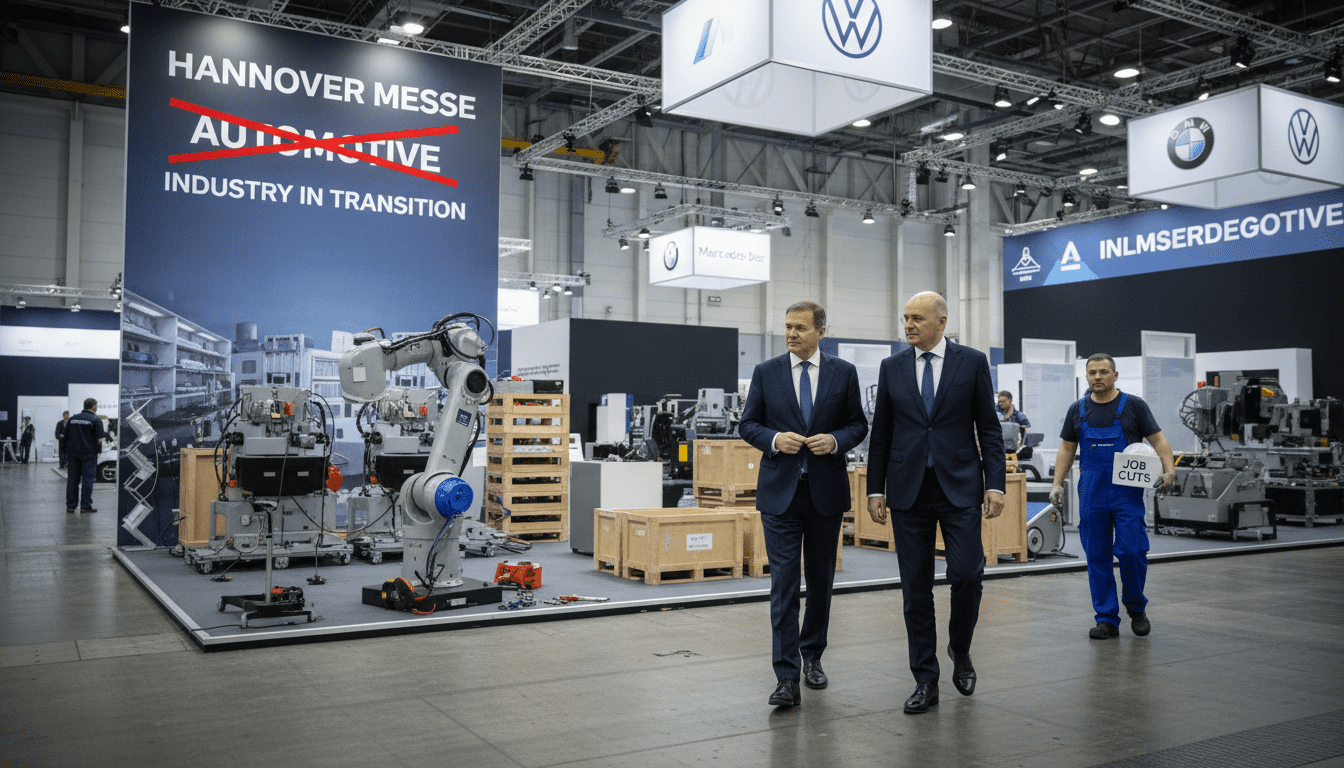
German industry at a crossroads as Hannover Messe opens amid rising costs and global competition
Germany’s industry faces mounting pressure from supply shocks, soaring input prices and intensified Asian competition as Hannover Messe convenes next week. The German industry is coping with shrinking revenues, rising insolvencies and significant job cuts, forcing firms and policymakers to reassess strategies. Delegates will confront choices over investment, regulation and the technological shift that could determine the sector’s trajectory.
Hannover Messe convenes under strain
The world’s leading industrial trade fair arrives at a fraught moment for German manufacturers, with executives and ministers expected to discuss crisis responses and future priorities. Organizers say the gathering will focus on digitalisation, supply chain resilience and investment incentives as attendees seek practical steps to halt recent declines. With global tensions adding volatility to trade flows, the fair is being framed as a test of whether Germany can translate engineering leadership into renewed competitiveness.
Revenue declines highlight a faltering export engine
An analysis by a major consultancy shows industrial revenues fell to about €537 billion in the fourth quarter of 2025, down 1.4 percent year-on-year, continuing a multi-year slide that began in late 2022. For the full year 2025, industry sales were roughly 1.1 percent lower than in 2024, with domestic receipts down 1.6 percent and foreign sales falling 1.2 percent. The trend underscores a sputtering export sector after three and a half years of retreat in outbound shipments.
Insolvencies and employment trends point to deeper weakness
Bankruptcy filings among industrial firms surged from 2023 and remained elevated through 2025, with nearly 1,500 insolvency proceedings by industry companies between January and November 2025. That figure represented an 11 percent increase on the prior year and marked the highest level since 2013, signaling financial stress across supply chains. Employment has mirrored the downturn: industrial payrolls stood at about 5.4 million at the end of 2025, and more than a quarter of a million jobs have been lost since 2019.
Automotive sector contraction drives headline figures
The vehicle industry has borne the brunt of the adjustment, shedding roughly 50,000 positions in a single year and leaving total auto-sector employment near 721,400 — its lowest level in about a decade and a half. Suppliers such as ZF, Bosch and Continental have reported particularly steep cuts, and several plants face evaluation or closure as OEMs rework model lineups and cost structures. Leading manufacturers have announced sweeping efficiency drives, and some plan tens of thousands of further reductions through the remainder of the decade to align capacity with demand.
Shifting investment patterns and global competition
Large German firms are increasingly directing major investments abroad, with one chemical group committing roughly €9 billion to expand in China and others pursuing opportunities in the United States and Asia. Official data show substantial German direct investment volumes abroad, with the United States and China among the largest destinations for outbound capital. Companies cite regulatory complexity and slow permit procedures at home as reasons to accelerate overseas projects, even as geopolitical shifts make foreign markets less predictable.
Policy costs and the race to digitalise production
Long-term policy choices are adding to near-term financial burdens: the domestic energy transition alone is estimated to require trillions of euros in investment through mid-century. At the same time, rapid advances in automation and digital technologies are remapping industrial value chains and business models across sectors. Firms that adopt data-driven production and robotics can raise productivity, but scaling those solutions within Germany is often slowed by regulatory fragmentation and lengthy approval processes.
Industry leaders call for clearer incentives and faster reform
Executives and economic researchers are urging a mix of targeted incentives, streamlined regulation and strategic investment in skills to arrest the decline and restore competitiveness. Proposals on the table include faster permitting for industrial projects, tax measures to spur capital spending and coordinated EU-level approaches to secure critical inputs and semiconductor supply. Observers say a coherent mix of policy and private-sector action will be essential to retain high-value manufacturing in Germany.
Germany’s industrial future will be shaped as much by how companies adapt to digital and geopolitical change as by the policy choices made in the coming months. The Hannover Messe will offer a platform for short-term crisis management and longer-term strategy, but reversing the recent trends will demand sustained commitment from firms, government and international partners.
