
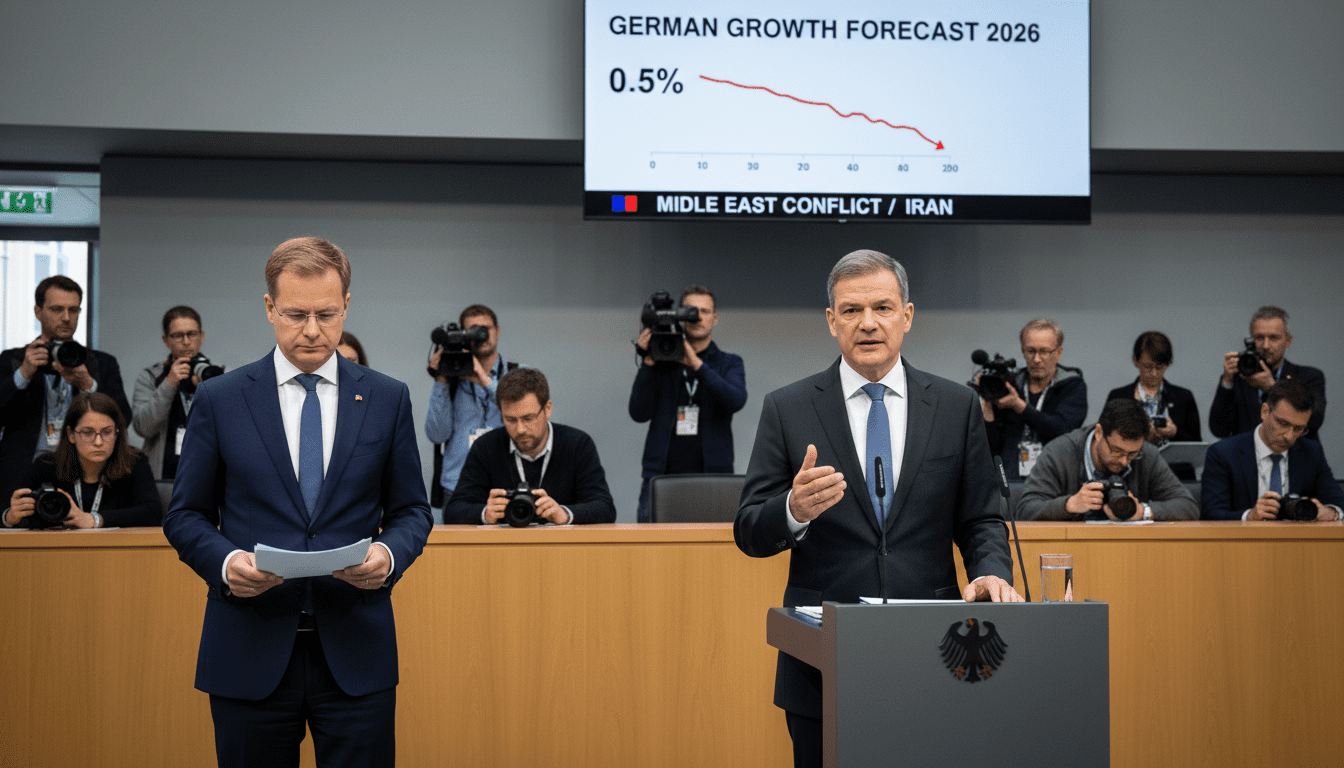
German growth forecast cut to 0.5% for 2026 as Iran conflict hikes energy costs
German growth forecast cut to 0.5% for 2026 as the Iran war drives energy and commodity prices higher, prompting a warning of stronger inflation and continued uncertainty.
Government Lowers 2026 Growth Outlook
The German government has revised its 2026 economic forecast, now projecting GDP growth of just 0.5 percent for the year. This downgrade, announced by the Federal Ministry for Economic Affairs, marks a sharp reduction from the 1.0 percent estimate published in January and the 1.3 percent projection issued last October.
Federal Economics Minister Katherina Reiche (CDU) said the expected recovery has been stalled by external geopolitical shocks tied to the conflict involving Iran. She highlighted that rising energy and commodity prices are weighing on households and raising input costs for businesses across Germany.
Energy Disruptions and Inflation Dynamics
Officials singled out disruptions to global energy flows — including restrictions on traffic through the Strait of Hormuz and damage to Gulf energy infrastructure — as a principal driver of higher fuel prices. Those developments have translated into more expensive production and transport for a wide range of goods and services, pushing consumer prices up.
The government now anticipates inflation of 2.7 percent in 2026, rising slightly to 2.8 percent in 2027. In March, consumer price inflation already reached 2.7 percent, up from 1.9 percent in February, underscoring how quickly cost pressures have intensified in recent weeks.
Institutes’ Forecast Revisions Feed Government Projection
The new federal projection follows a series of cuts by Germany’s leading economic research institutes, which more than halved their growth estimate for 2026 at the start of April to roughly 0.6 percent. The ministry said it based its downward revision largely on the institutes’ updated modelling and on the latest data on energy markets and trade routes.
Analysts note that such forecasts remain highly sensitive to further geopolitical developments. Any escalation or de-escalation in the Middle East could materially change commodity price trajectories and, by extension, growth outcomes for Germany and its trading partners.
Business and Household Impacts
Higher energy and raw material costs are squeezing both consumers and companies. Household purchasing power has been eroded by rising prices for fuel and utilities, while manufacturers face higher input bills that could depress investment and production plans.
The sectors most exposed to energy volatility — chemicals, transport, and energy-intensive manufacturing — are likely to absorb the brunt of the cost shock in the near term. Firms may pass some of the added costs onto consumers, but that risks further feeding inflation and dampening demand.
Fiscal Policy and Investment Outlook
The government had counted on a renewed upswing in public investment to help revive growth in 2026, including substantial spending aimed at infrastructure modernization and defense. Those measures remain on the books, but the timing and effectiveness of fiscal stimulus may be blunted by the inflationary environment and tighter global energy markets.
Budget planners now face a trade-off between accelerating investment to support the recovery and guarding fiscal sustainability amid slower-than-expected growth. Policymakers will also be watching employment and wage developments closely as indicators of resilience in domestic demand.
Uncertainty and Downside Risks
Officials stressed that the outlook carries unusually large uncertainty. Forecasts hinge on whether oil and gas markets stabilize and whether supply routes can be secured, as well as on the broader geopolitical evolution in the Middle East.
Should energy prices continue to climb or if further infrastructure attacks occur, the risk of a deeper slowdown or stagflation-like conditions would rise. Conversely, a rapid de-escalation could ease price pressures and allow the economy to regain momentum more quickly than currently expected.
Germany narrowly avoided a third consecutive year without growth in 2025 when GDP expanded by just 0.2 percent. The latest projections suggest that the hoped-for reacceleration in 2026 will be much weaker, putting greater emphasis on policy responses and external developments to determine the trajectory ahead.
The federal government says it will continue to monitor the situation and update its projections as more information becomes available, while businesses and households brace for a period of heightened price volatility and economic uncertainty.
