
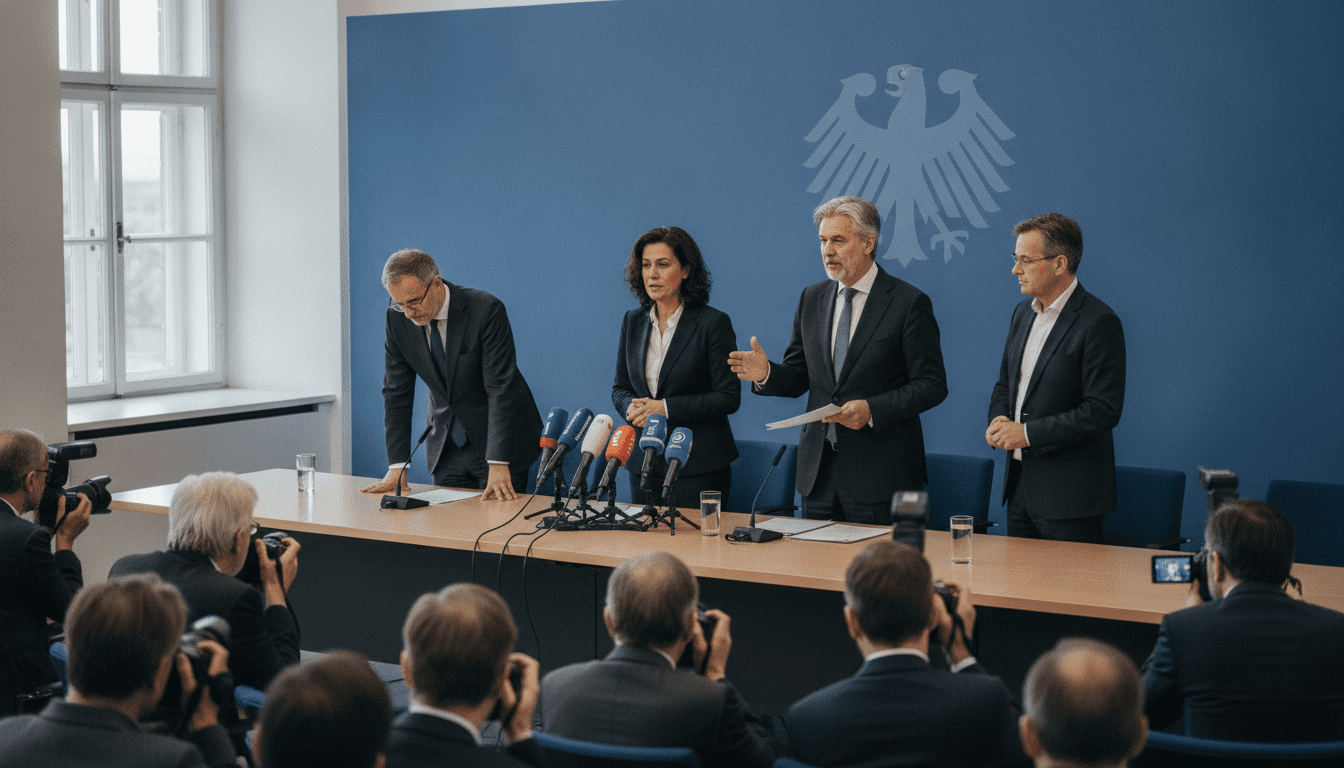
German business groups demand reform timetable ahead of June 10 government summit
German business associations demand a clear reform timetable from the federal government ahead of the June 10 summit on taxes, pensions and the labour market.
The four leading German business associations have urged the federal government to provide a concrete reform timetable ahead of a high-level meeting at the Federal Chancellery on June 10, 2026. In a joint statement, the BDA, BDI, DIHK and ZDH said the session should be used to identify large areas of agreement on contested reforms and to set out clear timing for measures affecting taxation, pensions and the labour market.
Employers press for timing and clarity
The BDA (Confederation of German Employers’ Associations), BDI (Federation of German Industries), DIHK (Association of German Chambers of Industry and Commerce) and ZDH (Central Association of German Crafts) issued their demand one day before the scheduled roundtable.
They said a “Meinungsaustausch” — an exchange of views — must be turned into a roadmap that specifies when key reforms will be introduced and implemented. The associations framed the timetable request as essential to restoring investor confidence and supporting competitiveness amid sluggish growth.
Government tempers expectations for the June 10 meeting
Coalition officials have publicly dampened hopes that the June 10 meeting will produce binding decisions. CDU Secretary General Carsten Linnemann and SPD Secretary General Tim Klüssendorf both described the encounter as primarily an opportunity to keep dialogue open rather than to adopt concrete measures.
Government spokesman Stefan Kornelius characterized the meeting as a political exchange of positions and ideas, not a decision-making summit, underscoring the limits of immediate outcomes from the Kanzleramt session.
Scope of the planned reform package
Officials have said the coalition aims to agree a reform package by mid-July 2026, ahead of the parliamentary summer recess, with measures touching income tax, labour-market rules, pension adjustments and reductions in bureaucratic burdens.
The package will sit alongside statutory reforms already on the table for health insurance and long-term care, making the June consultations one node in a broader legislative push through the remainder of the spring and early summer.
Points of contention between employers and social groups
Employers are prioritizing lower taxes, limits on social contributions and streamlined regulation, including more flexible working hours to boost productivity and hiring.
Trade unions and social welfare organisations have reacted cautiously or negatively; Yasmin Fahimi, chair of the German Trade Union Confederation (DGB), warned that the current reform agenda appears focused on cuts and austerity rather than on strengthening social protection.
Social associations demand protection for low- and middle-income households
Representatives of social organisations have urged the government to avoid turning reform into a savings-only exercise. Michaela Engelmeier of the Sozialverband Deutschland called for decisions that strengthen social security, ensure fair financing and deliver concrete relief for small and medium incomes.
Her organisation said such outcomes are difficult but achievable if the government balances fiscal consolidation with targeted support for vulnerable groups.
Business associations signal willingness to compromise within a growth package
While pressing for a detailed reform timetable, the employer federations also said they would be prepared to accept compromises as part of a broader package aimed at competitiveness, growth and employment.
Their joint statement framed participation in negotiations as conditional on a clear focus on growth, arguing that only a growth-oriented package can produce sustainable employment gains and fiscal stability.
The June 10 summit at the Chancellery will test whether the coalition can translate broad political dialogue into a timetable that reconciles competing priorities on taxation, pensions and social spending. The meeting may not yield immediate legislative outcomes, but businesses are watching closely: they want to see not only policy outlines but concrete dates and sequencing for the measures that will affect investment decisions and labour-market planning.
