
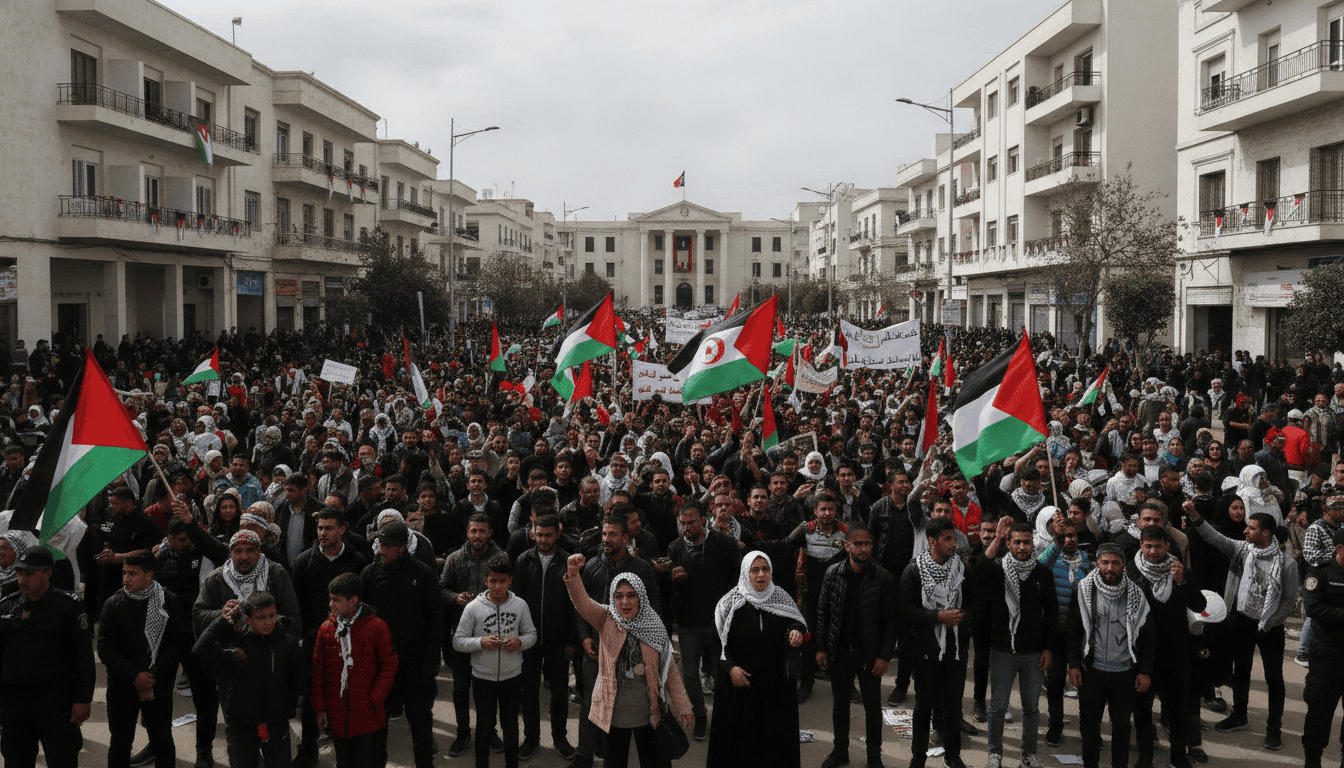
Sidi Bouzid Gaza protests reignite political expression amid deepening economic pain
Sidi Bouzid Gaza protests rekindle public debate in Tunisia as solidarity with Palestinians merges with rising local poverty and frustration with leaders.
Fifteen years after Mohamed Bouazizi’s self-immolation in December 2010 helped spark the Arab uprisings, Sidi Bouzid is again a focal point for public emotion as Gaza protests sweep the town. The protests, driven by outrage over Israel’s campaign in Gaza and by long-standing economic hardship, have reopened political conversation that many residents say had been silenced. Vendors, students and unemployed young people cite both distant violence and immediate deprivation as reasons for taking to the streets.
Market scenes and daily struggle
Life in Sidi Bouzid’s central markets carries the rhythm of routine: traders call prices, customers haggle and fruit is inspected for freshness. Yet beneath that familiarity, prices have risen and purchasing power has fallen, leaving many households struggling to afford basic foodstuffs. Residents describe a city where economic insecurity compounds the sense that political change has not delivered tangible improvements.
Memory of 2011 shapes current mood
The memory of the 2011 uprising that followed Bouazizi’s act remains sharply present for older residents and for a new generation learning the history in school and on social media. For many, the original revolt is a measuring stick against which the last decade’s political developments are judged. That history gives current demonstrations a symbolic weight, linking local grievances to a broader narrative about dignity and state accountability.
Gaza conflict reframes local grievances
The war in Gaza, located more than 2,000 kilometres away, has become a catalytic touchpoint for Sidi Bouzid’s protests. Solidarity with Palestinians has merged with complaints about unemployment, lack of services and declining living standards, turning an international crisis into a lens for domestic frustration. Residents say that outrage at the civilian toll in Gaza has provided a moral and emotional spur to voice long-suppressed discontent at home.
Voices on the ground question leadership
Public sentiment in Sidi Bouzid is sharply critical of national leaders and regional officials, whom many residents accuse of delivering rhetoric rather than action. A fruit seller who gave his name as Wajdi expressed disbelief that repeated declarations of support for Palestine had corresponded with any concrete measures to help. The perception that political elites have failed to address both foreign policy and everyday economic needs has intensified scrutiny of the government.
Public space and political expression re-emerging
After years in which many Tunisians withdrew from political debate—citing apathy, disillusionment or the tightening of political space under President Kais Saied—residents in Sidi Bouzid report a renewed willingness to speak openly. Protest gatherings, street conversations and public displays of solidarity have multiplied, suggesting a partial reopening of civic space at the local level. Observers say these expressions are less about restoring the old partisan order than about asserting the right to be heard amid persistent hardship.
The reunification of international solidarity and local grievance has created a precarious mix. While demonstrations in Sidi Bouzid remain largely peaceful, the combination of economic strain and deep moral outrage over the Gaza conflict raises the potential for escalation if the underlying issues are not addressed. For many here, the question is whether renewed public voice will translate into policy change or simply mark another cycle of protest without sustained reform.
Tunisia’s broader political response remains uncertain, with national authorities under pressure from multiple directions while coping with mounting economic challenges. In Sidi Bouzid, however, the immediate effect is clear: Gaza protests have become a catalyst that reconnects public sentiment with the memory of 2011 and the everyday realities of poverty and powerlessness. The coming weeks will test whether that reconnection can produce concrete demands, new forms of organization or a recalibration of the relationship between citizens and the state.
