
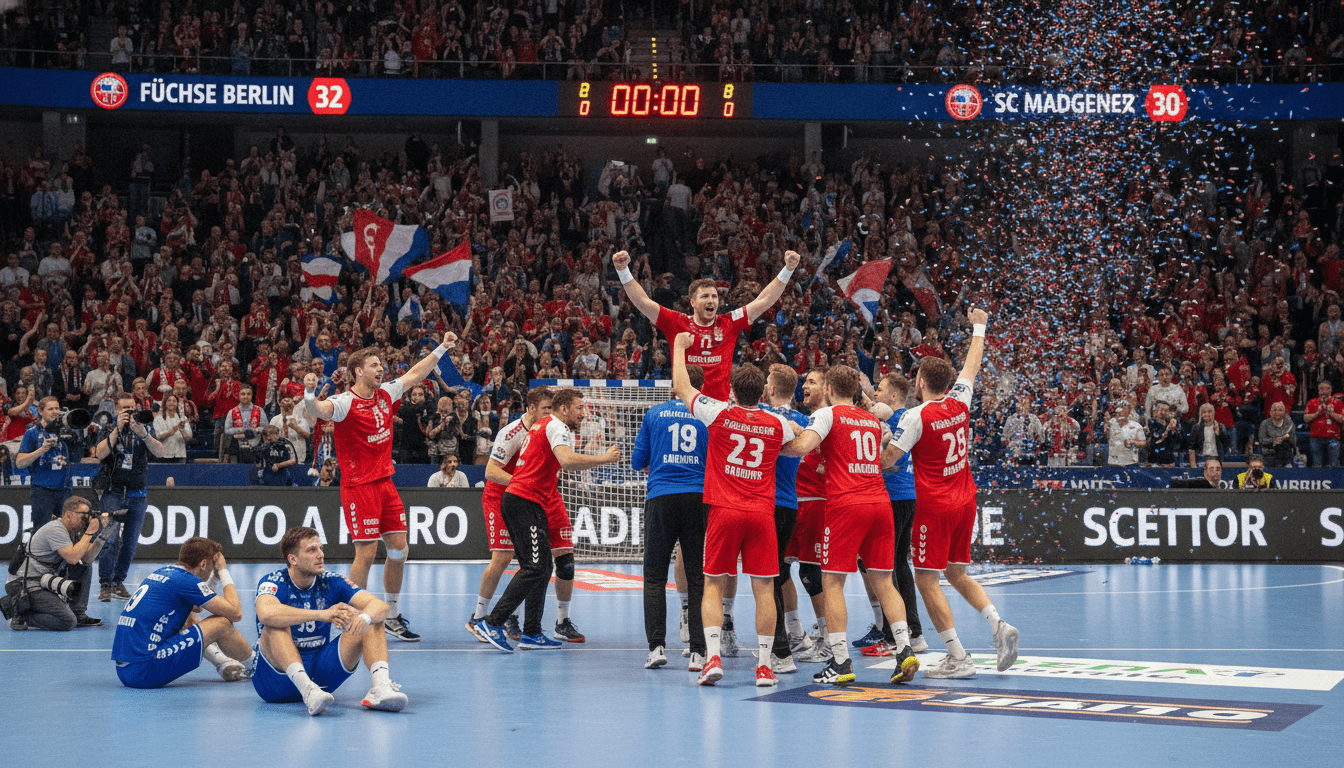
Füchse Berlin Reach Champions League Final After 40-35 Win Over SC Magdeburg
Füchse Berlin reach Champions League final with a 40-35 semi-final victory over SC Magdeburg in Cologne, propelled by Mathias Gidsel’s nine goals and a decisive late surge.
Füchse Berlin reach the Champions League final after an intense, high-scoring semi-final in Cologne, defeating defending champions SC Magdeburg 40-35 on Saturday. The German vice-champions produced a sustained offensive performance before a sell-out crowd of 20,122 that ultimately secured their place in the title match. Mathias Gidsel led the attack with nine goals, and Berlin will now face the winner of Aalborg Handbold versus FC Barcelona in Sunday’s final.
High-scoring semi-final electrifies Cologne
The semi-final opened with a tentative spell before turning into an end-to-end contest that rarely allowed either goalkeeper to dominate. Berlin’s fast breaks and aggressive transition play generated the early momentum, and the match became a showcase of attacking efficiency for both sides. The scoreline reflected that tempo, with the capital club carrying a narrow 19-17 lead into the interval.
Gidsel’s nine goals drive Berlin’s attack
Mathias Gidsel emerged as the match’s most productive scorer, combining finishing precision with the creative instincts that have made him one of world handball’s most dangerous backs. His nine strikes came from a variety of distances and situations, forcing Magdeburg to adjust its defensive focus and opening space for team mates. Gidsel’s influence extended beyond scoring; his ability to initiate quick transitions and find passing lanes under pressure repeatedly put Berlin on the front foot.
Berlin’s effectiveness on the counter was decisive, with the team exploiting turnovers and rapid outlet passes to catch Magdeburg out of position. The capital club’s wings and pivots finished clinically when presented with fast-break opportunities, turning fleeting advantages into a sustained lead during the match’s middle stages. That collective finishing compensated for moments when Berlin’s goalkeeping offered fewer stops than usual.
Magdeburg fightback forces tense closing stages
Magdeburg demonstrated why they are the reigning champions by refusing to yield after falling behind by four goals early in the second half. The Elbe side engineered a spirited comeback, drawing level at 29-29 in the 44th minute and taking a 32-31 lead shortly thereafter. Those exchanges underscored the tactical battle between Magdeburg’s structured buildup and Berlin’s quicker transitional rhythm.
As the clock wound down the match turned into a sequence of critical phases, with Berlin regaining composure and shrinking Magdeburg’s chances to capitalize. A 36-33 advantage for Berlin in the 55th minute and an important 38-33 goal three minutes before time effectively ended the contest. The late scoring spree delivered a decisive margin and triggered jubilant celebrations among the Berlin supporters.
Tactical patterns: Berlin’s transition edge and Magdeburg’s set play
Tactically the game highlighted the contrast between Berlin’s emphasis on rapid outlet play and Magdeburg’s reliance on organized half-court systems. Berlin’s shift from defense to attack created frequent numerical advantages, while Magdeburg often sought to slow the game through set systems that probe for openings. The capacity of Berlin to convert quick opportunities proved the difference across several scoring runs.
Defensive moments also mattered, even if few goalkeepers registered standout nights; timely stops and successful defensive rotations interrupted Magdeburg’s rhythm when it mattered most. Berlin’s discipline in maintaining spacing and recovering on counter-presses limited the number of easy second-chance opportunities for the opponents. That balance between offensive daring and defensive structure delivered the platform for the final sprint.
Looking ahead: Final opponent and historical context
Berlin will meet the winner of the second semi-final between Aalborg Handbold and FC Barcelona on Sunday at 18:00 CET, with the exact opponent carrying distinct tactical and historical implications. Barcelona, the competition’s record winner, would present a pedigree and depth of experience in decisive fixtures. Aalborg, meanwhile, offers a physically demanding, well-drilled side that can disrupt opponents with high intensity and set-piece acumen.
The two clubs also represent contrasting threats: Barcelona’s depth and versatile shooting options versus Aalborg’s cohesion and direct play. For Füchse Berlin, the final will be an opportunity to claim their first Champions League trophy and to settle scores after last year’s final in which SC Magdeburg prevailed. The match will carry heightened significance for Berlin’s aspirations on the continental stage.
Implications for German club handball
The result extends the presence of German teams at the highest level of European competition and underscores the Bundesliga’s depth across top clubs. A Berlin victory on Sunday would mark a landmark achievement for the capital club and further burnish the league’s reputation. Even as Magdeburg fell short in this semi-final, their performance reaffirmed their status among Europe’s elite and contributed to a compelling all-German contest on a major stage.
Berlin’s run to the final also has domestic resonance, where league form and cup successes have combined to create momentum for the club. The opportunity to lift the Champions League trophy would be the culmination of sustained investment in squad development and tactical coherence. Supporters and national stakeholders alike will watch Sunday’s final as a barometer of German club handball’s standing in Europe.
Füchse Berlin will enter the final with confidence from a 40-35 semi-final win but will face a formidable opponent in the title match, where execution in both attack and defence will determine whether the club can secure its first European crown.
