
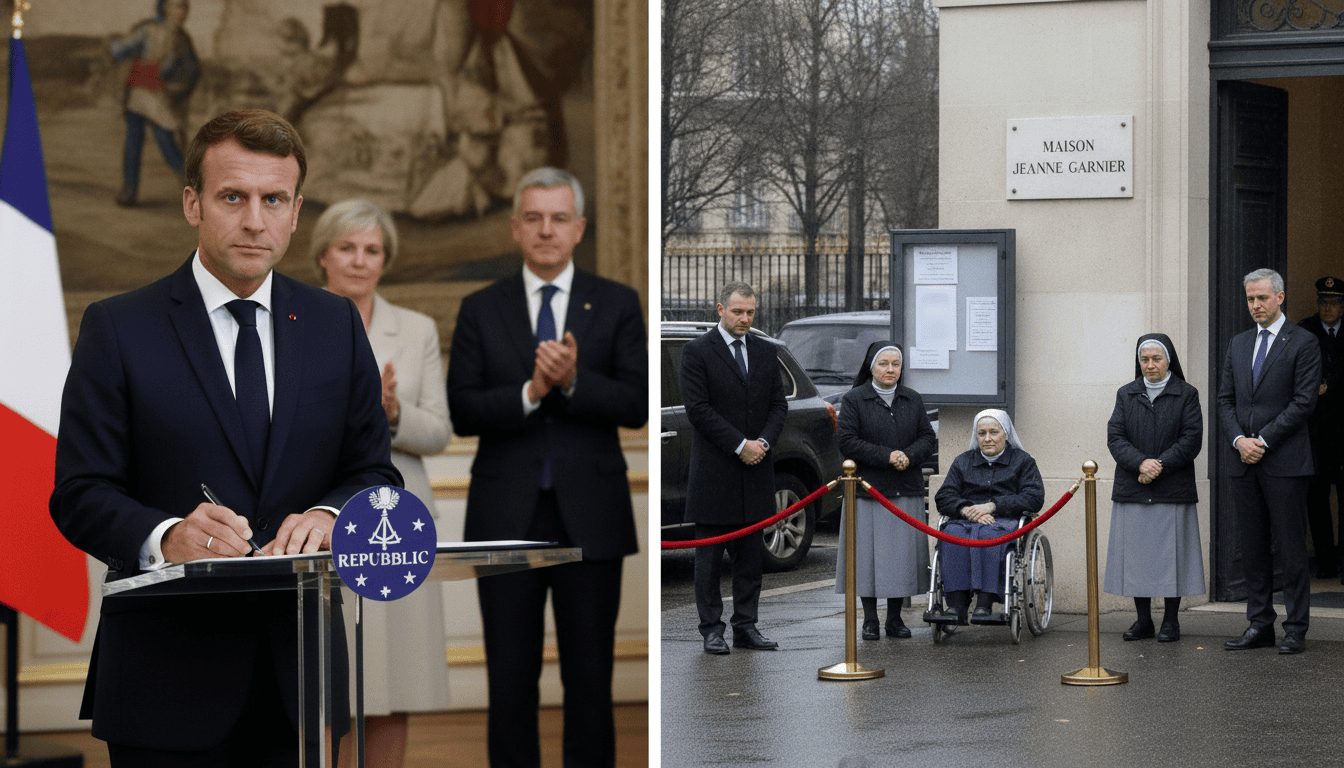
Pope visit to France altered after parliament legalises active euthanasia
Pope visit to France altered after parliament legalised active euthanasia; Vatican drops planned stop at Paris palliative home amid church protests in Paris.
The Pope visit to France has been reshaped after the French parliament approved a law legalising active euthanasia, a development that prompted the Vatican to remove a planned stop at a Paris palliative care home. The decision to drop the visit to Maison Jeanne Garnier — a Catholic palliative facility where many seek end-of-life care — came amid heightened tensions between France’s new law and the Catholic Church. The change underscores how the legislation has become a focal point for debate ahead of the papal trip scheduled in September.
Parliament passes new law on “self-determined dying”
The French National Assembly approved the measure on July 15 with 291 votes in favour and 241 against, creating what lawmakers describe as a right to a self-determined death for certain patients. The law applies to adults who are unambiguously terminally ill and whose death is deemed imminent in the short or medium term, and it permits active assistance in dying under defined conditions.
The legislation sets strict eligibility criteria: only patients with full mental capacity may request aid in dying, excluding those with Alzheimer’s disease and other dementias. It also restricts access to French citizens in an effort to prevent so-called “death tourism,” according to debates in parliament.
Medical safeguards and constitutional scrutiny
Lawmakers built procedural safeguards into the bill, including the requirement that a panel of physicians review each request and that active assistance be considered only when no effective pain-relieving treatment is available. The law marks a departure from the 2016 statute that allowed deep sedation for incurable patients but stopped short of permitting active euthanasia.
Both Prime Minister Sébastien Lecornu and Senate President Gérald Larcher have petitioned the Conseil constitutionnel, France’s highest constitutional court, to review the law’s compatibility with the constitution. If the court intervenes, implementation could be delayed or altered, leaving institutions and practitioners in a period of legal uncertainty.
Palliative homes face institutional conscience dilemma
The measure does not, at present, include an institutional or collective conscience clause for palliative care centres, which has alarmed some providers and church leaders. Under current provisions, only individual staff may invoke a personal conscience exemption, modelled on regulations used in abortion cases, rather than allowing entire facilities to refuse to participate.
Critics warn that, without an institutional safeguard, homes dedicated to palliative care could be pressured to facilitate procedures that conflict with their mission of preserving comfort and accompaniment until natural death. For communities and staff committed to hospice-style care, the lack of a broader conscience protection raises practical and ethical concerns.
Catholic Church leaders denounce the law
Senior figures in the French Catholic hierarchy have strongly criticised the reform, describing it as a rupture with France’s caregiving traditions. The bishop of Nanterre called for the obligation on medical establishments to administer death to be lifted, arguing facilities should not be compelled to carry out procedures that contradict their ethos.
The head of the French bishops’ conference warned the law represents a grave break with the historical role of medicine to relieve suffering and accompany people to a natural end. Church leaders have urged clear pastoral guidance, and many in the hierarchy are looking to the forthcoming papal visit for moral and spiritual direction on how to respond.
Vatican alters programme for the papal visit
According to reports, the Vatican had planned for the Pope to make a pastoral stop at Maison Jeanne Garnier, where a delegation had already conducted a preliminary visit. That stop was omitted after the parliament’s vote, reflecting the sensitivity of the issue and the Vatican’s desire to avoid being drawn directly into a national political dispute.
The papal trip — billed under the theme “That the world may have life” — remains scheduled for September and will include a speech at UNESCO, liturgical events in Paris and a major youth encounter at the Stade de France. The itinerary also foresees a pastoral visit to Lourdes and a stop in Lorraine to honour Robert Schuman, one of the founding figures of the European project.
Political dimensions and European engagement
Organizers say the visit is intended to highlight care for the sick and to renew a message about Europe’s role as a peace project rather than to intervene in domestic politics. Still, the trip places the Pope in close contact with senior French officials, including a planned reception by President Emmanuel Macron, who championed the reform.
The programme in Metz includes a gathering of European leaders in a venue bearing Robert Schuman’s name, and invitations were reportedly extended to international figures, including Ukraine’s president. German participation has not been definitively confirmed, but French officials anticipate attendance by senior European representatives.
The coming weeks will test how church leaders, medical institutions and the state navigate the new legal framework and the constitutional challenge pending before the Conseil constitutionnel. As the September visit approaches, Rome and Paris face the delicate task of balancing pastoral care, legal obligations and public debate over the end of life.
