
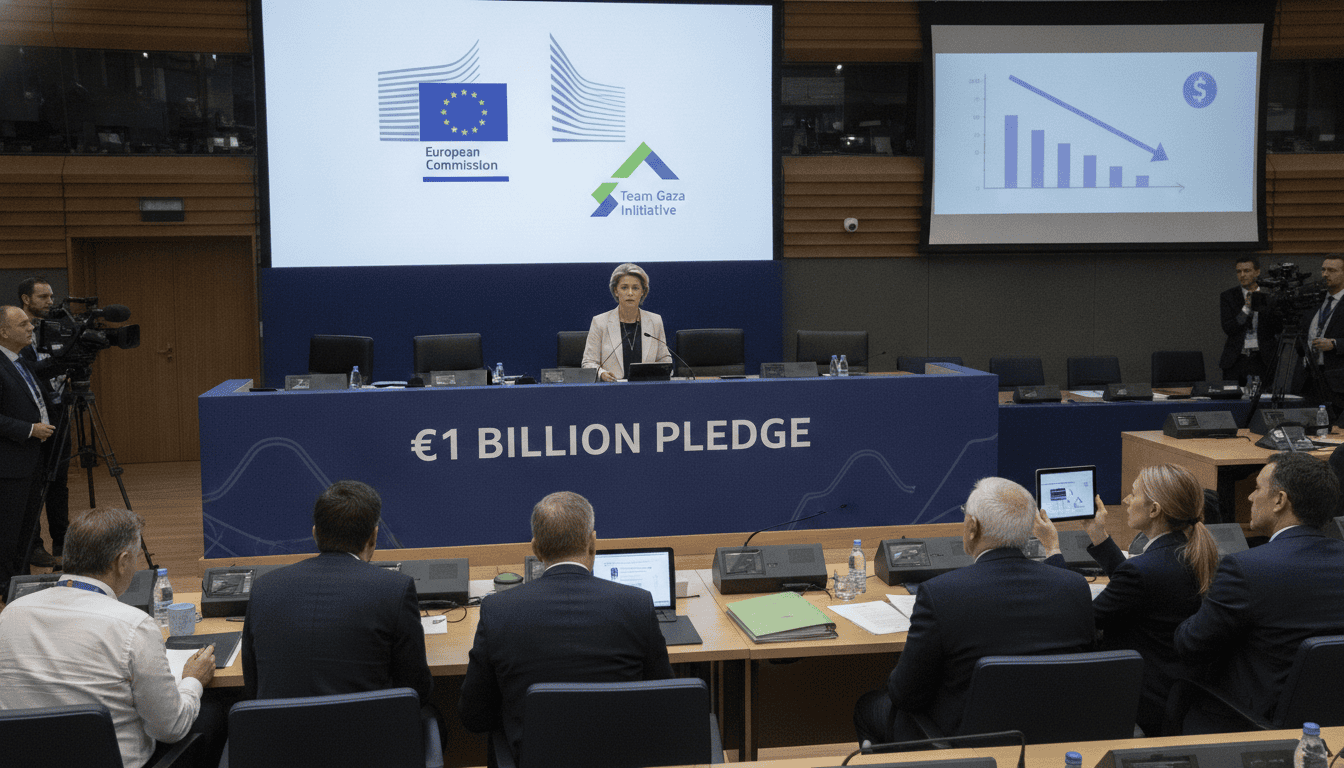
EU unveils $1bn Team Gaza Initiative to kickstart Gaza recovery
EU launches the Team Gaza Initiative with nearly €900m ($1bn) to fund water, health and debris removal in Gaza, but a $71bn reconstruction gap remains.
The European Commission on Monday launched the Team Gaza Initiative, an almost €900 million (approximately $1 billion) aid and reconstruction package aimed at early recovery in Gaza following more than two years of intense conflict. The fund was announced at a donor meeting in Brussels and is intended to support immediate restoration of water and sanitation, debris removal and health services across the Palestinian territory. EU officials described the package as an initial step to “build hope, resilience and a better future” for the population, while stressing it does not replace longer-term reconstruction needs.
EU donors present initial package in Brussels
The Team Gaza Initiative was unveiled by EU Commissioner Dubravka Šuica at a donors’ meeting convened in Brussels, where she said the Commission would present the initial package of almost €900 million. A mix of EU member states and international financial institutions participated in the launch, and several other countries were reported to be expected to join the effort. Commissioners framed the move as an “early recovery” push intended to demonstrate political will and to catalyze further commitments for Gaza’s reconstruction.
Funding gap dwarfs the new package
The new fund is a small fraction of the sums international agencies say are required to rebuild Gaza, with the EU and United Nations estimating roughly $71 billion will be needed over the next ten years. A separate Gaza Rapid Damage and Needs Assessment identified about $26.3 billion needed in the first 18 months to restore essential services, rebuild critical infrastructure and jump-start economic recovery. Donors and aid agencies have warned the scale of destruction and the size of the financial shortfall mean the €900 million initial package will only address a narrow set of immediate priorities.
List of participating states and institutions
Participating governments named by the Commission include Spain, France, Denmark, the United Kingdom, Germany, Norway, Finland, Italy, the Netherlands, Japan, Switzerland, Sweden and Belgium, alongside the World Bank and the European Investment Bank. Australia and Canada were reported as likely to join the initiative, and the Commission itself is a contributor. Officials did not publish a breakdown of individual pledges at the launch, leaving questions about how much each partner will commit and how the pooled resources will be allocated.
Priority projects and early recovery aims
According to the Commission, Team Gaza Initiative funds will target core emergency and early recovery activities such as restoring water and sanitation networks, clearing and disposing of rubble, and re-establishing health, energy, agricultural and food systems. The stated objective is to stabilise basic services and reduce immediate risks to public health while laying groundwork for wider reconstruction. Donors emphasised the focus on projects that can be implemented quickly and that meet urgent humanitarian and public-service needs.
Access, security and operational hurdles remain
EU officials repeatedly warned that delivering aid and reconstruction support will depend on conditions on the ground that enable safe, sustained access to Gaza’s population. While a US-brokered ceasefire was agreed in October, the Commission noted breaches have continued, and aid delivery faces significant security and logistical obstacles. EU statements cited continuing shelling, outbreaks of disease and ongoing casualties since the ceasefire, underscoring the fragility of the operating environment and the risk that materials and personnel cannot reach intended beneficiaries.
Transparency, coordination and timelines unresolved
At the Brussels meeting officials acknowledged they need clearer plans for implementation, oversight and coordination with United Nations agencies and local authorities in Gaza. The absence of a public breakdown of contributions or a detailed timeline for disbursement has prompted calls from humanitarian organisations for greater transparency. Donors signalled they want the Team Gaza Initiative to be seen as a starting point that should unlock additional multilateral support, but they also warned that political and security conditions will determine how quickly funds can translate into reconstruction on the ground.
The Commission and participating partners have framed the Team Gaza Initiative as a necessary early step to address urgent needs in Gaza, but they also face the immediate reality that the funding announced on July 13, 2026, is far from sufficient for full-scale recovery. Delivering results will require not only additional pledges from international donors but sustained access and a coordinated operational framework to ensure that water, health and shelter projects reach the communities that need them most.
