
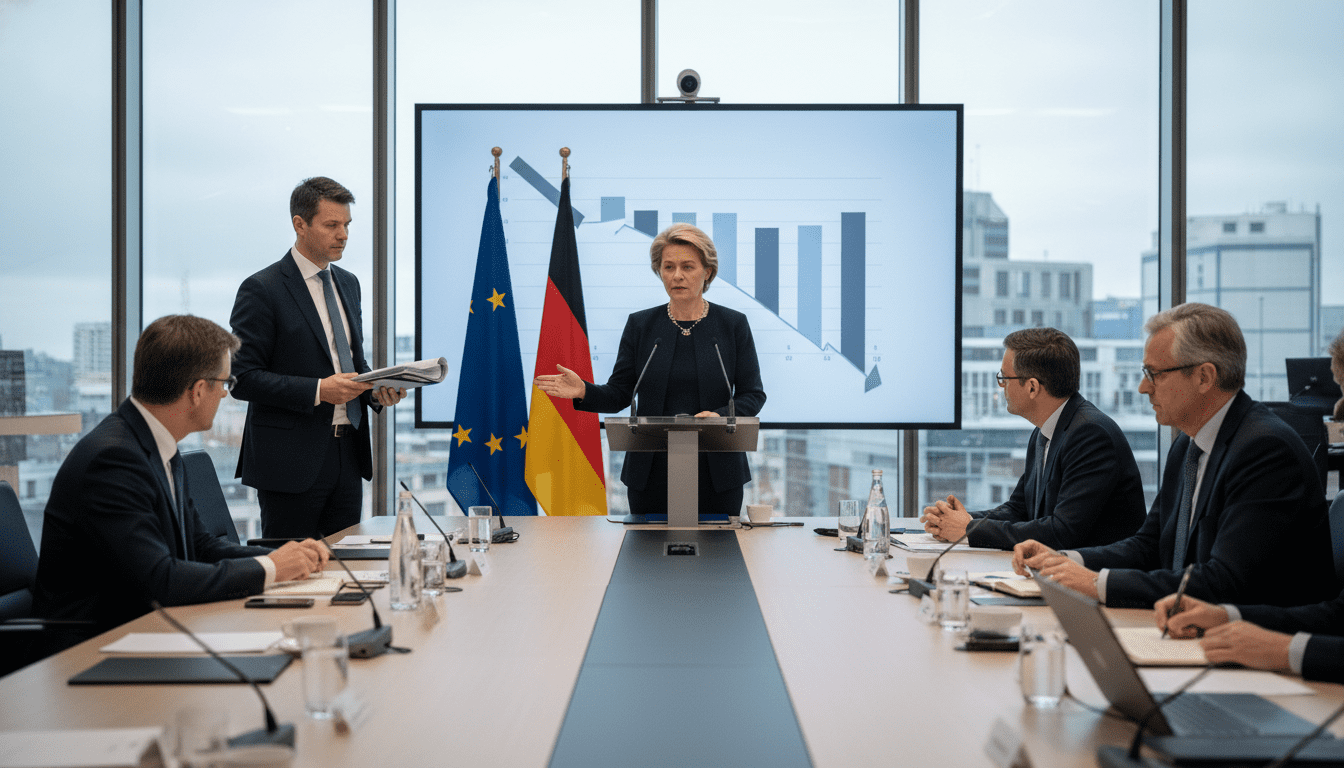
EU cuts growth forecast for Germany to 0.6% amid energy-price shock
EU cuts growth forecast for Germany to 0.6% amid Middle East energy shock; Commission warns higher prices and supply strains will further slow 2026 recovery.
The European Commission has revised its outlook and now projects GDP growth for Germany of just 0.6% for 2026, down from a 1.2% estimate made last autumn. EU cuts growth forecast for Germany amid soaring energy costs tied to the Middle East conflict, a change the Commission says will weigh on investment and consumption. The downgrade places Germany below the Commission’s updated projections for the eurozone and the EU as a whole.
Commission cites Middle East energy shock as main driver
The European Commission attributes the downward revision largely to higher energy prices caused by renewed conflict in the Middle East that intensified at the end of February 2026. As a net energy importer, the EU’s economies are particularly exposed to oil and gas price swings, the Commission’s statement said, and those higher costs feed through to inflation and production expenses. The Commission now expects EU-wide growth of 1.1% and 0.9% for the 21 countries of the eurozone, leaving Germany’s outlook notably weaker than the regional average.
German first-quarter growth reflected one-off public spending
Despite the weaker outlook for the year, Germany’s economy registered modest expansion in the first quarter of 2026, with GDP rising 0.3% quarter-on-quarter. German industry bodies, including the Bundesverband der Deutschen Industrie (BDI), attribute much of that early-year growth to higher public spending on defence and infrastructure projects. Officials caution that two of the first three months of the year were not yet fully affected by the post-February spike in energy prices, which complicates the picture for the remainder of the year.
Industry output has been contracting since 2022
Manufacturing and energy-intensive sectors have come under sustained pressure: production in chemical, paper, glass and metal industries has fallen sharply since February 2022. The data point to a 15.2% decline in those sub-sectors and a roughly 9.5% contraction for industry overall over the same period, underlining structural strains beyond short-term price shocks. Firms facing higher input costs and disrupted supply chains are delaying investments and, in some cases, reducing capacity, which depresses export potential and domestic demand.
Household spending and consumer confidence are weakening
Rising energy bills are eroding households’ purchasing power and prompting more cautious spending patterns, according to consumer research groups. Surveys by the Nuremberg Institute for Market Decisions (NIM) and GfK show consumer sentiment at its weakest level since February 2023, with falling income expectations cited as a major factor. Retail and trade associations have echoed the assessment, reporting that elevated headline inflation and uncertainty have dampened discretionary purchases across sectors.
German government and institutes offer slightly different forecasts
Berlin’s own projections and the assessments of major economic research institutes are broadly aligned with the Commission but contain modest differences in outlook. The federal government halved its projection in late April 2026 and now anticipates growth of about 0.5% for Germany in 2026, marginally below the Commission’s 0.6% figure. Five large economic research institutes issued a joint revision earlier in the spring that likewise lowered their forecast to 0.6%, matching the Commission and underscoring a consensus that growth will be subdued.
Regional disparities across the EU remain wide
The Commission’s revised outlook highlights significant variation in national prospects, with some member states expected to expand while others contract. Ireland is forecast to see the largest decline within the bloc, with a projected contraction of 1.2%, while smaller economies such as Malta and Poland are expected to grow by 3.7% and 3.5% respectively. Those divergences reflect differences in export profiles, energy dependencies and the composition of domestic demand across member states.
Looking ahead, the Commission and national authorities underscore two central risks for the remainder of 2026: persistent elevated energy and commodity prices and ongoing supply-chain disruptions that could prolong cost pressures. Policymakers face a delicate balancing act between supporting short-term demand, containing inflation, and encouraging the structural shifts necessary to boost resilience and long-term growth.
