
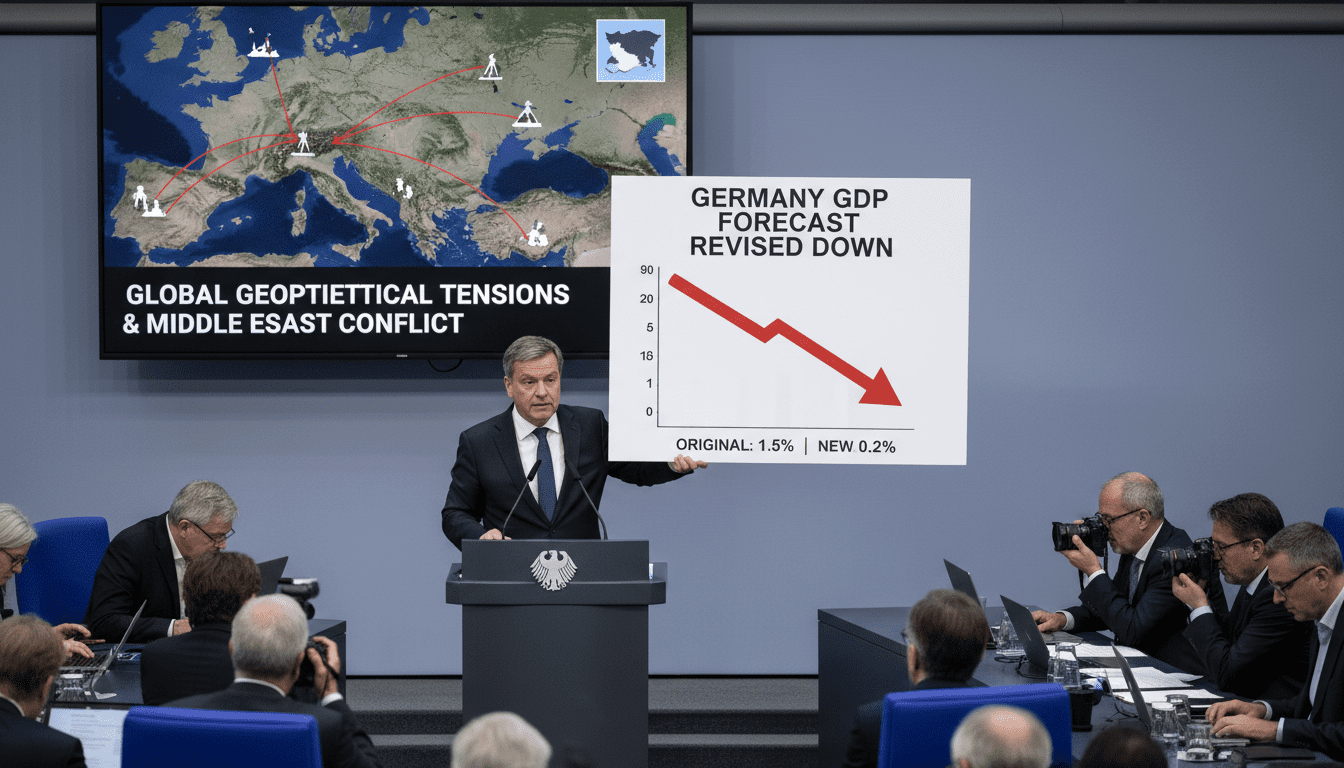
German growth forecast cut as Economy Minister Reiche cites Iran war; inflation and budget gaps set to rise
German growth forecast slashed after Economy Minister Reiche cites Iran war; inflation expected at 2.7–2.8%, billion-euro budget gaps, defence expansion and EU aid shifts.
Germany’s economy ministry has sharply revised the German growth forecast downward, citing heightened geopolitical risk linked to the Iran conflict, with immediate implications for inflation and public finances. Economy Minister Reiche now projects 2026 growth of 0.5% and 2027 growth of 0.9%, down from earlier estimates of 1.0% and 1.3% respectively, while consumer prices are expected to rise to 2.7% in 2026 and 2.8% in 2027. The revision signals mounting pressure on the federal budget and sets the economic context for a string of political and security decisions unfolding in Berlin and Brussels.
Economy minister’s revised figures and rationale
The ministry’s new baseline reduces near-term expansion and pushes up inflation expectations, a combination that narrows fiscal headroom and raises borrowing needs. Officials said the reassessment reflects commodity and logistics disruptions tied to the Iran war and a reassessment of global demand prospects, prompting a more cautious outlook for exports and investment. The downgrade is modest in absolute terms but significant for a large economy that has traded on narrow growth margins in recent years.
Immediate fiscal consequences and budgetary shortfalls
Lower growth coupled with higher inflation widens the gap between projected revenues and planned spending, increasing the likelihood of “billion-euro” shortfalls in coming budget cycles. Analysts warn that slower GDP growth reduces tax receipts while rising prices drive up indexed expenditures, notably social transfers and health-related outlays. The ministry is expected to consult with finance authorities on contingency measures, with options including spending reprioritisation and targeted borrowing.
Defence strategy accelerated amid heightened security concerns
Concurrently, Defence Minister Pistorius unveiled the federal government’s first formal military strategy, which prioritises faster deployment capabilities and a substantial personnel increase. The plan envisages raising active forces to as many as 260,000 soldiers, augmenting reserve components and streamlining procurement and administrative processes to speed technological modernisation. Officials framed the strategy as a response to a deteriorating security environment in Europe, stressing readiness and interoperable capabilities with NATO partners.
EU financial package for Ukraine cleared after Hungarian concession
In Brussels, a long-contested 90-billion-euro support package for Ukraine advanced after Hungary’s Prime Minister Orbán signalled he would drop his blockade, removing a key barrier to approval. With no EU member expected to object by the afternoon of April 23, 2026, the loan framework is set to proceed, and roughly 60 billion euros of the package are earmarked for defence-related expenses. The agreement also includes additional sanctions against Russia, reflecting a coordinated shift toward bolstering Kyiv’s military resilience.
New telecom data retention powers aimed at online crime
The governing coalition has moved to strengthen tools against internet-enabled crime by proposing a new statutory mechanism authorising temporary preservation orders for telecommunications data. The draft law would allow prosecutors and law-enforcement agencies to direct telecom providers to retain IP address logs and related metadata for a defined period to investigate child exploitation, fraud and organised cybercrime. Justice Minister Hubig and Interior Minister Dobrindt defended the measure as necessary for effective prosecutions, and it has drawn praise from the Police Union and the Association of Judges.
Labour cost pressures under Chancellor Merz and policy implications
At the same time, Germany faces a high labour tax and contribution burden that experts say undermines work incentives and competitiveness, with overall charges on labour costs at around 49.3%. That rate reflects rising contribution rates for health and long-term care insurance and the removal of a tax-free inflation compensation payment, placing Germany among the most heavily taxed countries in the OECD on employer labour costs. The administration under Chancellor Merz is thus confronted with competing pressures: finding revenue to plug budget gaps while addressing calls to reduce labour taxation to stimulate employment.
The intersecting developments — a downgraded German growth forecast, rising inflation expectations, defence expansion, fresh EU support for Ukraine, tougher cyber-investigation tools, and high labour levies — create a complex policy environment for Berlin. Policymakers will need to reconcile fiscal discipline with strategic investment in defence and digital security while seeking measures to sustain household purchasing power and labour market incentives. The coming weeks are likely to see technical follow-up from ministries and renewed debate in parliament as officials translate the revised outlook into concrete budgets and legislative proposals.
