
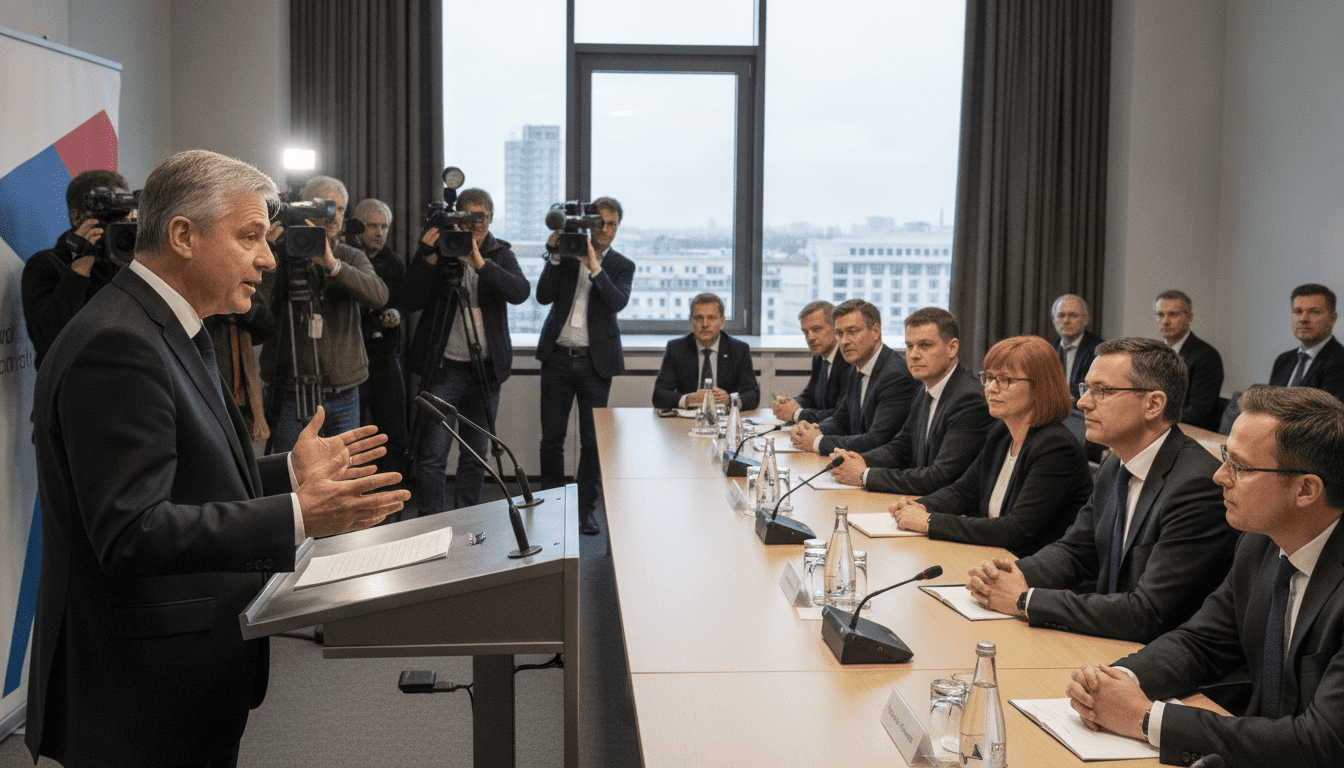
Germany eyeing mandatory workplace pensions as SPD and DGB press for employer-funded schemes
Germany debates mandatory workplace pensions as SPD and DGB press for employer-funded schemes, while employers warn of cost pressure and unresolved questions on funding.
The government’s pension commission is finalizing reform recommendations as debate intensifies over mandatory workplace pensions, a proposal the SPD and the German Trade Union Confederation (DGB) have recently amplified. The push centers on extending employer-funded occupational pensions to a wider share of workers while protecting the stability of contribution rates to the statutory pension system. Political leaders and social partners are publicly split on whether compulsion, subsidies or voluntary expansion should form the backbone of future pension architecture.
SPD and DGB intensify push for mandatory workplace pensions
Yasmin Fahimi, chair of the DGB, publicly called for a compulsory occupational pension scheme intended to guarantee broader access to workplace retirement benefits. SPD leader Lars Klingbeil expressed sympathy for the idea and framed it as complementary to measures the coalition has already taken to strengthen statutory pensions. Both parties argue that a combination of stronger occupational and private provisions is necessary to make the overall system sustainable amid demographic pressures.
Employers warn mandatory schemes would raise costs and hurt competitiveness
Employer groups strongly oppose adding new compulsory obligations for companies, saying higher payroll-related costs would curb investment and job creation. Rainer Dulger, president of the Confederation of German Employers’ Associations, emphasized that reforms should focus on reducing costs to spur growth, not on introducing further levies that risk pushing total social charges higher. Business representatives link recent rises in social contributions and slower growth to reduced hiring and competitiveness in certain sectors.
Funding and contribution levels remain the core unresolved issue
A central unresolved question is who would pay and at what level if occupational pensions became mandatory, and how such an obligation would interact with statutory contribution rates. The DGB wants employer-financed occupational pensions to become widespread and calls for accelerating rises in statutory pensions, while employers say Germany cannot afford higher combined burdens. Current headline pension contributions stand at about 18.6 percent of gross wages, and long-term projections have signaled an increase toward roughly 20 percent, a point that underpins much of the bargaining over redistribution between wages, employer costs and public financing.
Trade unions split on social-partner model and scope of state role
The debate also exposes rifts among unions and between unions and political parties over the proper balance of statutory guarantees and employer-based schemes. IG Metall has taken a firm stance against the social-partner model for occupational pensions, insisting that primary retirement security should remain the responsibility of the statutory system. Other unions and parts of industry have negotiated social-partner arrangements in some sectors, but uptake of these models has been uneven and politically contested.
Coverage gap highlights limits of voluntary approaches
Data cited by pension authorities indicates that voluntary private and occupational products have not closed the retirement-income gap hoped for when the multi-pillar model expanded two decades ago. Only around 30 percent of employees hold a state-subsidized private Riester contract, and roughly half of workers currently expect a company pension. Overall, about 62 percent of employees have at least one form of supplementary provision aside from the statutory pension, leaving a substantial share of the workforce without additional coverage ahead of retirement.
Political stakes for the coalition as commission approaches final recommendations
The government’s pension commission is due to deliver final recommendations that aim to reconcile stabilizing statutory contribution rates with broader access to occupational pensions and targeted support for low earners. Chancellor Friedrich Merz has argued previously that occupational and private savings must play a larger role than they do today, while also flagging the need for a tightened focus on economic growth. The coalition faces a politically thorny decision: whether to make workplace pensions mandatory, and if so, how to calibrate contribution, subsidy and regulatory arrangements without undermining business investment or the statutory safety net.
As the commission prepares its report, stakeholders across the political and economic spectrum are preparing detailed proposals and warnings for legislators. The next phase of the debate will hinge on concrete cost estimates, the design of employer and state contributions, and cross-party agreement over how to protect living standards in retirement while keeping Germany’s labor market competitive.
