
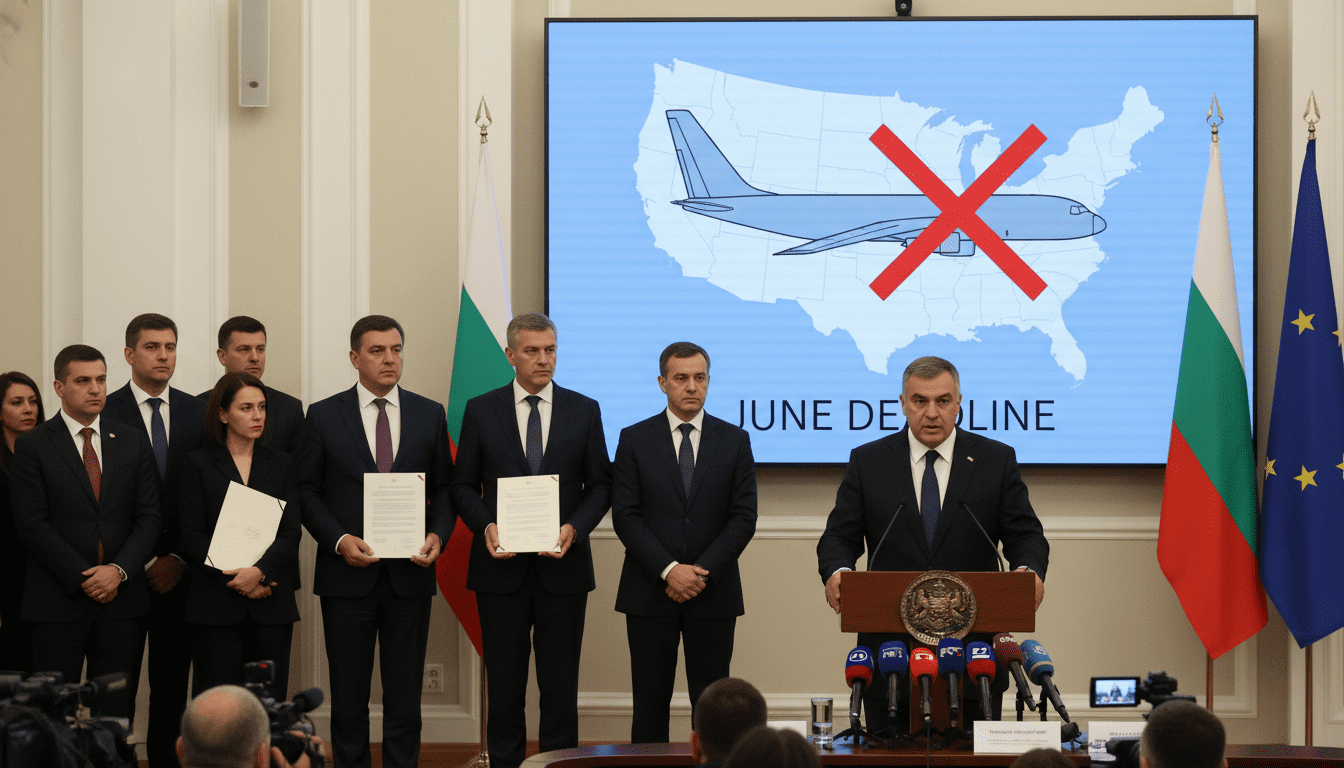
Bulgaria to Bar US Tanker Stationing Amid Visa Dispute, Extends Deadline to End of June
Bulgaria will end the US tanker stationing after a diplomatic row over visa rules, Prime Minister Rumen Radev said, extending the deadline to the end of June to allow the United States time to relocate or reconsider.
Immediate decision and deadline extension
Prime Minister Rumen Radev announced that Bulgaria will no longer permit the long-term stationing of US military tanker aircraft, citing an unresolved dispute over entry and visa conditions for Bulgarian citizens. He said he has extended the authorization only until the end of June to give Washington time to find an alternative basing arrangement or to change course. Radev told the Bulgarian news agency BTA that he had not received a “positive answer” after discussing the matter last week with US President Donald Trump.
Radev framed the decision as a matter of national procedure and priority, indicating that while he understands the complexity of foreign visa systems, Bulgaria must uphold its own rules. The prime minister’s statement effectively sets a hard deadline for the US to remove or reclassify the deployed aircraft unless a diplomatic agreement is reached.
Visa dispute at the center of the row
At the heart of the dispute is Bulgaria’s status as one of the few European Union countries whose citizens still require a visa for short tourist travel to the United States. Radev has made liberalizing that requirement a priority since taking office and has signaled he will push to change the visa regime “immediately.” That domestic political goal now directly intersects with NATO cooperation and bilateral military arrangements.
Bulgaria’s insistence on reciprocity and on advancing its citizens’ travel freedoms has become a bargaining point in negotiations with Washington. Officials in Sofia say they sought assurances and clarifications about entry procedures for Bulgarian nationals but have so far judged US responses insufficient to justify extended US military presence on Bulgarian soil.
Background: KC-135 deployment and NATO cooperation
The United States Air Force deployed KC-135 Stratotanker aerial refueling aircraft to Bulgaria in mid-February, days before the outbreak of hostilities with Iran, as part of NATO cooperative arrangements. Sofia initially approved the temporary stationing under alliance frameworks and set an authorization period that was due to expire at the end of May.
The deployment has supported regional operations and force projection, providing mid-air refueling capability for allied aircraft. With the authorization now formally limited until late June, the US faces a narrow operational window to either relocate the aircraft elsewhere in the theater or negotiate an extension under revised terms.
Regional diplomatic fallout and Iranian protest
Bulgaria’s decision follows heightened diplomatic sensitivity in the region. In April, Sofia said it received a formal protest note from Tehran over the presence of US military assets on Bulgarian territory. Iranian objections added a public dimension to what had been largely a technical authorization, increasing political pressure in Sofia to reassess the arrangement.
Regional governments and NATO partners are likely to watch closely for further diplomatic escalations. The intersecting concerns — bilateral visa policy, NATO logistics, and Tehran’s objections — underscore how a seemingly technical host-nation decision can reverberate across geopolitical fault lines.
Operational implications for US forces
Military planners in Brussels and Washington will confront short-term operational questions if the KC-135s must depart by the end of June. Air refueling assets are a force multiplier, and their relocation could complicate sortie-generation rates and regional reach for US and allied aircraft. Potential alternatives include moving tankers to other NATO bases in the Balkans or Southern Europe, or temporarily rerouting missions through allied airspace and facilities.
A rapid redeployment would require coordination of airlift, basing clearances, overflight permissions, and host-nation logistics. US defense officials have typically maintained that posture adjustments are manageable, but the tight deadline narrows the margin for diplomatic and operational maneuvering.
Domestic politics and EU ties in Sofia
Radev’s stance reflects domestic political priorities as well as broader questions about Bulgaria’s relationship with Western partners. The newly elected prime minister campaigned on a platform that included revising the US visa requirement for Bulgarians, and his firm handling of the tanker issue signals a willingness to leverage security cooperation to press that agenda.
Brussels will monitor developments because changes to bilateral U.S.-Bulgaria arrangements could affect NATO cohesion and the alliance’s logistical posture in southeastern Europe. At the same time, member states that host US assets may face renewed requests for burden-sharing or adjustments to basing practices if Bulgaria’s deadline triggers wider redeployments.
Rumen Radev has left open the possibility of a negotiated resolution before the end of June, while making clear that lengthy or indefinite stationing under current conditions is unacceptable to his government.
The extended deadline gives the United States a narrow window to present a viable alternative to Sofia or to secure an agreement that addresses Bulgarian concerns about visa reciprocity and procedures. Failure to reach a settlement will require Washington to reassign tanker assets and could reshape NATO logistics in the region.
