
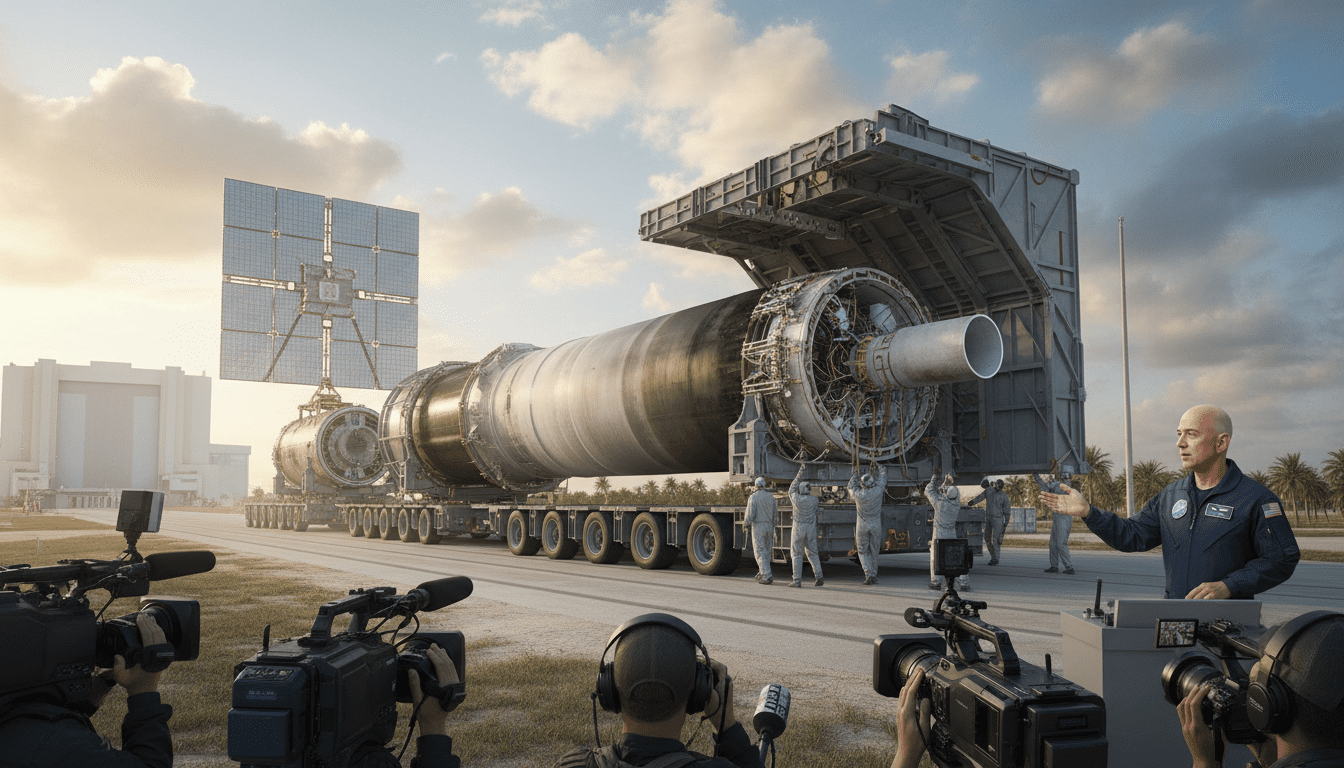
Blue Origin’s New Glenn Reused Successfully but Upper Stage Misses Target, Forcing Satellite Loss
Blue Origin’s New Glenn was reused on April 19, 2026, but the rocket’s upper stage placed AST SpaceMobile’s BlueBird 7 in a lower-than-planned orbit, forcing de-orbit.
Blue Origin launched the third New Glenn mission from Cape Canaveral at 7:35 a.m. local time on April 19, 2026, achieving the program’s first booster reuse. The booster, previously flown on New Glenn’s second mission, returned to a drone ship and landed as planned, marking a technical milestone for the company.
Booster Reuse and Landing Executed as Planned
The New Glenn booster separated and descended to a drone ship approximately ten minutes after liftoff, where it achieved a controlled touchdown similar to its prior mission. Company footage circulated on social media showing the recovery, underscoring the operational progress in first-stage recovery for the heavy-lift vehicle.
Observers noted the successful reuse as a step toward routine, lower-cost launches for Blue Origin, a capability the company has emphasized since New Glenn’s development concluded. The recovered booster had been expected to demonstrate the hardware’s reusability under commercial flight conditions.
Upper Stage Delivered Satellite to Off-Nominal Orbit
About two hours after launch, Blue Origin announced that the New Glenn upper stage had inserted the AST SpaceMobile BlueBird 7 satellite into an orbit lower than planned. AST SpaceMobile confirmed the satellite separated and powered on, but stated the altitude is insufficient to sustain operations and the vehicle will be de-orbited.
The company added that the satellite will be intentionally left to burn up in Earth’s atmosphere, ending the mission for BlueBird 7. Blue Origin described the insertion as “off-nominal” and provided limited public detail about the cause or the stage’s performance parameters.
AST SpaceMobile Says Loss Is Insured and Replacements Are Ready
AST SpaceMobile issued a statement indicating the financial loss from BlueBird 7 is covered by its insurance policy and will not imperil the firm’s longer-term deployment plan. The company said additional BlueBird satellites are nearing completion, with successor units expected to be ready in roughly a month.
AST SpaceMobile also emphasized it maintains launch arrangements beyond Blue Origin and plans an aggressive deployment schedule, projecting the ability to launch dozens more satellites through 2026. The firm confirmed it will continue work to expand its constellation despite the setback.
New Glenn Program Faces First Major Mission Failure
The outcome marks the first major failure credited to the New Glenn program since the rocket’s inaugural flight in January 2025 after more than a decade of development. New Glenn’s second mission in late 2025 carried twin spacecraft for NASA, making this the second customer payload mission to fly on the vehicle.
Blue Origin’s decision to fly commercial payloads during early missions reflected confidence in New Glenn’s design and testing pedigree. The off-nominal upper stage performance now raises fresh questions about the reliability of the vehicle’s second stage under operational loads.
Potential Impact on Blue Origin’s Lunar and Commercial Ambitions
The timing of the anomaly is consequential for Blue Origin’s wider ambitions, which include supplying lunar landers and competing for NASA mission contracts. The company has been testing a lunar lander and had previously discussed launching lander hardware on an early New Glenn flight, although the company elected to fly the AST SpaceMobile satellite on this mission instead.
Any technical issue affecting New Glenn’s upper stage could influence NASA’s confidence in contracting the rocket for high-stakes lunar missions, particularly those with strict payload and insertion requirements. Blue Origin leadership has publicly stated a commitment to supporting lunar return efforts, and the company will need to address the cause of this off-nominal insertion to reassure customers and partners.
Industry Context and Historical Comparisons
Launch providers have long treated early failures as part of the maturation of complex rockets, and high-profile providers have recovered from setbacks in the past. For example, other operators experienced significant losses during early operational years but continued to iterate on design and procedures to improve reliability.
Blue Origin’s limited public commentary since the incident contrasts with more detailed failure investigation reports sometimes provided by other firms and agencies. The company and AST SpaceMobile will likely conduct internal and independent reviews to determine the sequence of events that led to the lower-than-planned orbit.
Blue Origin has not released a full technical briefing on the upper stage anomaly and did not immediately respond to requests for additional information beyond its initial post. Investigations of this type typically examine telemetry, guidance systems, propellant management, and staging events to isolate causal factors.
Operational follow-up, including detailed anomaly reports and corrective actions, will be closely watched by commercial customers and government agencies. For AST SpaceMobile, per its statement, insurance and replacement hardware mitigate immediate commercial impact, but the industry will watch how quickly Blue Origin can restore confidence in New Glenn’s higher-stage performance.
The mission’s mixed outcome—successful booster reuse combined with a critical upper stage underperformance—leaves Blue Origin at a crossroads where technical clarity and transparent corrective measures will be essential to its near-term commercial and NASA ambitions.
