
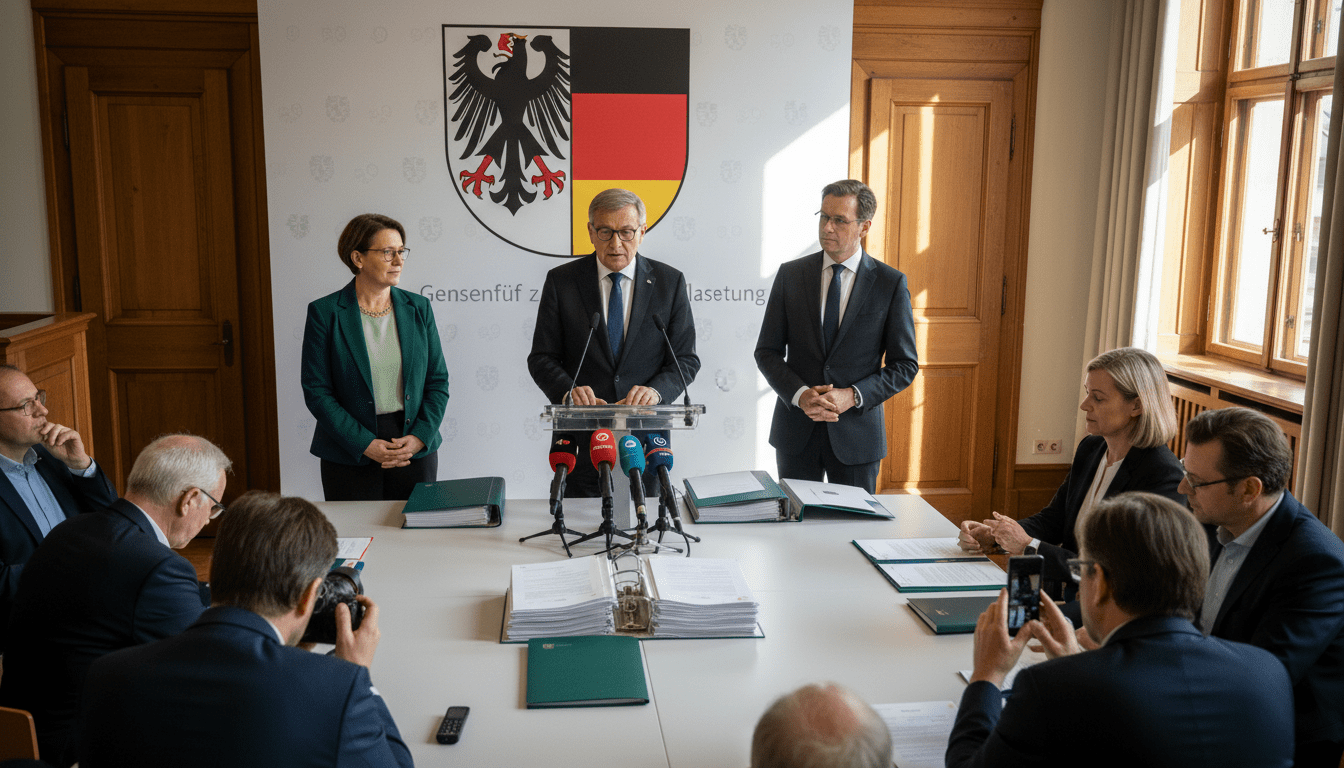
Baden-Württemberg coalition proposes sweeping ‘efficiency law’ to cut bureaucracy
Baden-Württemberg coalition plans an efficiency law to let most reporting, documentation and retention duties lapse by Dec 31, 2027, promising administrative relief and sparking political debate.
Radical efficiency law placed at start of the coalition agenda
The Baden-Württemberg coalition has inserted an efficiency law into its governing contract that would allow existing reporting, documentation and archival obligations to expire on December 31, 2027. The clause requires that any duties meant to remain in force be explicitly re-established by statute, shifting the burden onto legislators to justify ongoing obligations.
The paragraph appears early in the program and was highlighted as a central pledge to businesses and public administrations. The move is being presented as an effort to clear decades of accumulated regulation in areas where the state is responsible.
Cem Özdemir and the political message beyond the state
Greens leader Cem Özdemir, who is expected to assume the minister-president role in Stuttgart, used the proposal in the election campaign to win votes from the economic sector. His elevation carries symbolic weight for the party’s national image as it seeks to be seen as reform-capable beyond the traditional left coalition.
Observers in Berlin view the Baden-Württemberg coalition as a test case for the Greens’ ability to govern with conservative partners while advancing a pro-business reform agenda. The efficiency law is being framed as a practical demonstration of that approach.
Climate policy pushed down the priorities list
The coalition contract, running to 166 pages, notably ranks state modernisation, economy, research and education ahead of climate protection, which appears only in the fifth chapter. That ordering triggered commentary about the Greens’ prioritisation in a coalition with the CDU.
Supporters argue the approach is pragmatic: institutional reform and economic stabilisation can create capacity for effective climate measures later. Critics within and outside the party say the signal risks diluting the Greens’ core identity on environmental urgency.
Health insurance and pension proposals expose internal divisions
At the federal level, Green figures have advanced policy papers that underscore internal divergences within the party. Co-leaders Katharina Dröge and Franziska Brantner advocated adopting more recommendations from the experts’ commission on statutory health insurance, arguing this could allow a two-percentage-point reduction in contributions.
Conversely, other proposals touching pensions—such as suggestions to raise retirement age by eight months for each additional year of life expectancy—have provoked resistance inside the party. These contrasting positions illustrate the tension between reformist pragmatists and members who favour more gradual or redistributive changes.
Labour-market debate references Danish model
Within the party’s debate, Felix Banaszak suggested reconsidering protections against dismissal in certain circumstances, citing Denmark’s flexicurity model as an inspiration. In Denmark, weaker dismissal rules operate alongside generous unemployment benefits and active labour-market policies, a package that proponents say supports both dynamism and social protection.
The proposal stirred discussion about whether Germany should pursue a similar recalibration of labour law, and highlighted how the Baden-Württemberg coalition’s agenda could influence broader party thinking on employment policy.
Tax and social contribution proposals create friction with CDU partners
Fiscal proposals from leading Greens point to potential friction with their CDU partners. Dröge and Brantner have proposed adding a tax bracket above a taxable income of €120,000 at a 45 percent rate, with a top rate of 48 percent, and have floated social insurance levies on capital income.
Those measures aim to broaden revenue sources for social programs but sit uneasily against CDU fiscal priorities. Negotiations over tax and contribution policy will test the partners’ ability to reconcile economic competitiveness with redistributionary aims.
Coalition dynamics shaped by personalities and electoral calculations
Personalities and national ambitions will shape whether Baden-Württemberg’s blueprint becomes a model elsewhere. Some Greens rule out serving as junior partners to figures like Friedrich Merz or Jens Spahn, while others see opportunity in pragmatic alliances with conservative forces. Questions about who could lead a nationwide black-green coalition remain unresolved.
Cem Özdemir’s likely tenure as minister-president is expected to focus on implementing the reform agenda from Stuttgart, rather than a quick return to federal office. His role will be watched closely by party factions assessing the trade-offs of coalition governance.
The coalition’s efficiency law and related policy proposals amount to a deliberate signal: the Greens in government are prepared to pursue structural reforms and market-friendly measures while retaining core social and environmental goals. How many reporting obligations will be reinstated by statute, which fiscal compromises the partners accept, and whether the party’s internal debates settle into a coherent national platform will determine the broader political impact of this Baden-Württemberg experiment.
