
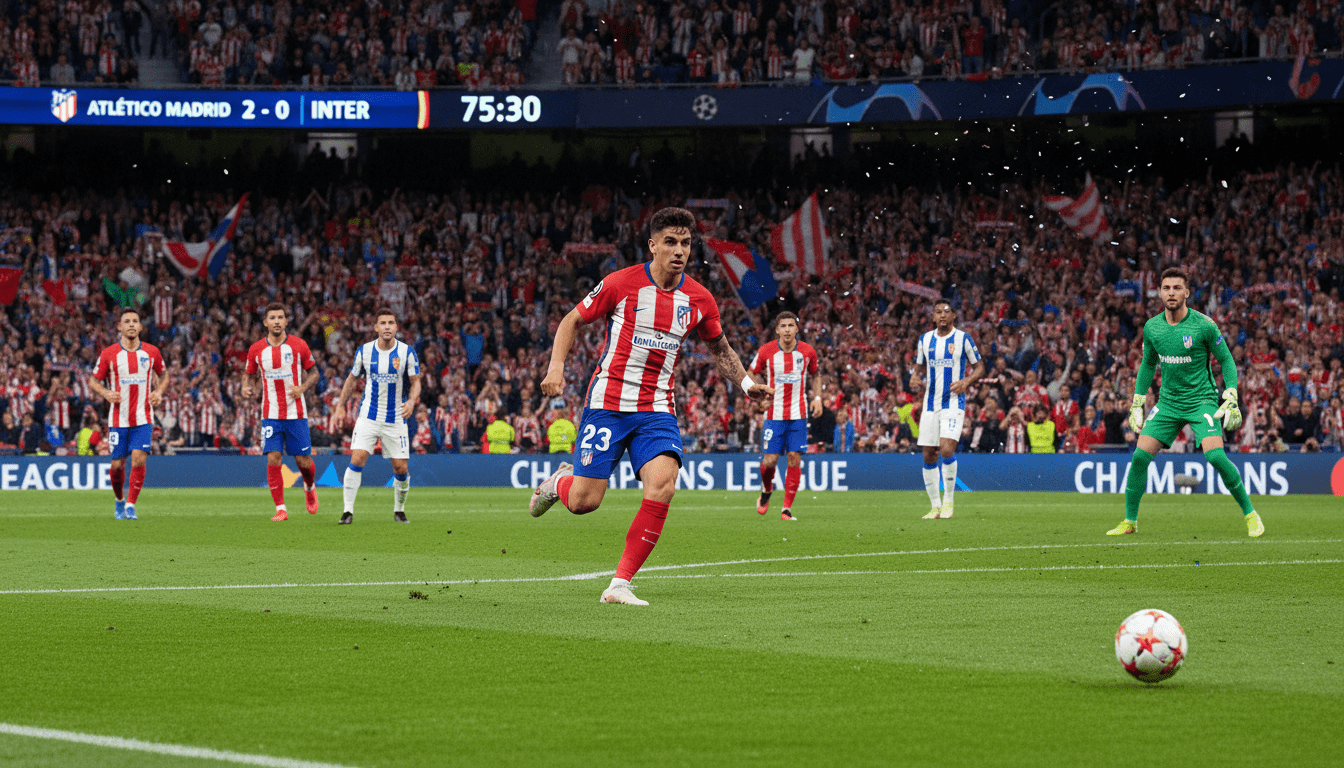
Giuliano Simeone’s rise and Atlético’s quarterfinal test ahead of Barcelona rematch
Giuliano Simeone played a decisive role in Atlético Madrid’s 2-0 first-leg lead, drawing attention ahead of the Champions League quarterfinal return at the Metropolitano.
Atlético Madrid head coach Diego Simeone and his son Giuliano Simeone have become a recurring image at the Metropolitano, where the young forward’s performance helped give the hosts a 2-0 advantage in the Champions League quarterfinal first leg. Giuliano’s movement in attack forced a critical free kick that produced the opener and contributed to a red card for Barcelona, leaving Atlético with a cushion but not a certainty ahead of the return match. The episode has sharpened focus on the 22-year-old’s development, his route from River Plate youth ranks to Atlético’s first team, and how the club manages the father–son dynamic in front of a partisan home crowd.
Giuliano Simeone’s decisive involvement in the first leg
Giuliano Simeone’s run into the box precipitated the sequence that became Atlético’s first goal and shifted momentum late in the first half. The attacker’s intelligent movement drew a foul that led to a set-piece finished into the corner, and moments earlier Barcelona had been reduced to ten men after a challenged defender received a second caution. Those interventions combined to make Atlético’s 2-0 victory more than a narrow lead; they framed Giuliano as both a tactical nuisance and a finishing threat for the remainder of the tie.
Atlético’s second goal, scored later by Alexander Sörloth, allowed the hosts to play the remainder of the match with more control and less urgency. Still, rivals and pundits have noted that even a two-goal lead against Barcelona is far from decisive, prompting players and staff to treat the second leg as a test of discipline and game management.
Metropolitano atmosphere and the Simeone ritual
At the Metropolitano, a recurring ritual has emerged: Diego Simeone and his son perform near the dugout and along the touchline, their gestures and celebrations amplified by an expectant crowd. The father’s animated appeals and the son’s reactive motions have acquired a symbolic cadence, turning match moments into communal sparks that ignite the stands. Fans respond in kind, and the stadium’s intensity frequently becomes a variable in Atlético’s home advantage.
Club sources describe the exchanges as part theatre, part psychological tactic, with Diego Simeone using emotion to shape the match landscape. For opponents the sound and spectacle are meant to be disorienting; for Atlético the performance reinforces identity and unity on home turf.
From Buenos Aires youth prospect to Madrid first-team player
Giuliano’s pathway to the first team was neither linear nor preordained. Raised in Argentina and developed initially at River Plate, he remained in Buenos Aires while his father resumed managerial duties in Madrid, later joining Atlético’s youth ranks at age 16. The forward stood out for his speed and finishing at reserve level, registering a season with roughly 25 goals for Atlético’s B side that helped propel his profile within the club.
Those early years combined domestic schooling in Argentina with intermittent visits to Madrid, where the young player absorbed the club’s culture and the tactical demands of his father’s squads. The transition from youth prospect to senior contributor accelerated during loan spells and a subsequent return to Atlético, where he has become a regular selection.
Loan spells, return and evolving role
The club placed Giuliano on temporary moves to build experience at senior level, with a season at Real Zaragoza followed by time at Deportivo Alavés. Those spells provided consistent minutes against seasoned opposition and a platform to polish decision-making in the penalty area. Atlético recalled him in 2024 and integrated him into rotation, a step that has seen his appearances increase across competitions.
This season he has emerged as a reliable option in the forward line, contributing goals and assists while competing for minutes with more established team members. Coaches and analysts point to his work rate and physical resilience as assets that complement Atlético’s pragmatic approach in knockout football.
Diego Simeone’s public restraint on nepotism
Diego Simeone has been careful to temper commentary about his son, publicly emphasizing objective appraisal over sentiment. The manager has highlighted Giuliano’s physical attributes and capacity for repeated effort, while noting there remain tactical and technical areas to refine. Club insiders say Diego maintains professional distance in team settings, avoiding perceptions of favouritism by separating family presence from selection and match-day routines.
Observers note that the coach’s deliberate, sometimes clipped praise serves both as protection for the player and as reassurance to the dressing room that standards apply uniformly. The balance between paternal pride and managerial scrutiny has become a recurring subtext in coverage of Atlético’s season.
Giuliano Simeone’s international profile has grown in parallel with his club form, and he now counts multiple senior caps for his national side. That step up has added a new dimension to debates about expectations and projection, particularly with major tournaments on the calendar.
Atlético face a demanding second leg at the Metropolitano, where the club must defend its 2-0 advantage while managing pressure from an experienced Barcelona side. Giuliano Simeone’s role in the tie has already reshaped narratives around the team, and his continued development will be measured in minutes, moments and the club’s ability to navigate the thin line between emotion and tactical discipline.
The coming fixture will reveal whether Atlético’s home momentum and Giuliano’s emerging influence are sufficient to close a long-awaited route to the semifinals, and whether father and son can add a new chapter to both club history and the modern football landscape.
