
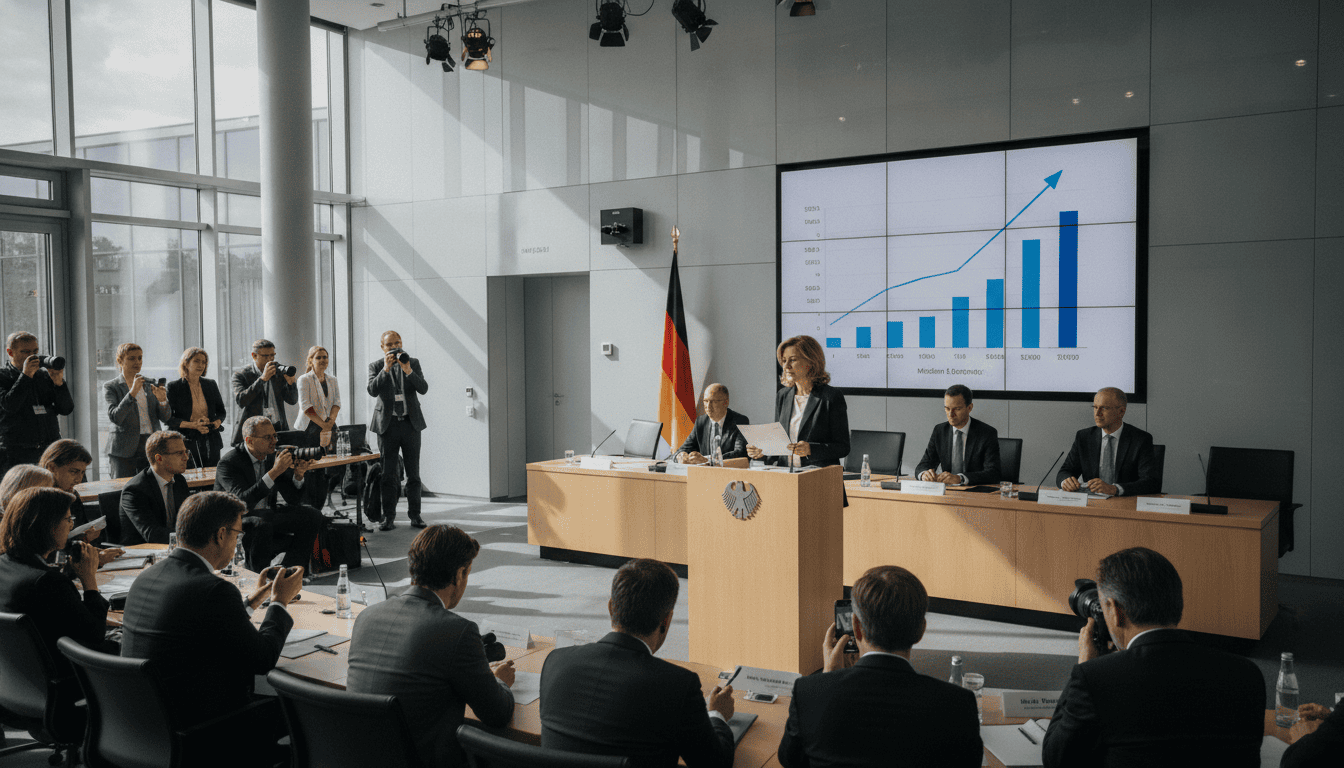
Median wage in Germany rises 5.1% in 2025 to €4,217, Bundesagentur reports
Median wage in Germany rose 5.1% in 2025 to €4,217 gross monthly, outpacing inflation; regional gaps and education drive pay differences, says Bundesagentur.
Germany’s median wage rose noticeably in 2025, with the Bundesagentur für Arbeit reporting a 5.1% increase that lifted the median gross monthly pay for full‑time workers to €4,217. This growth outpaced the year’s average inflation rate of 2.2%, delivering modest real wage gains for many employees. The report highlights stark regional and educational differences that continue to shape pay across the country. Policy makers and employers now face renewed pressure to address unequal distribution of the wage gains.
Federal Agency Reports 5.1% Increase
The Bundesagentur für Arbeit said the median wage for full‑time workers climbed by €203 from the prior year to €4,217 gross per month. Because the median measures the midpoint of the wage distribution, it is less affected by extreme top incomes and therefore offers a clearer picture of typical earnings. The agency contrasted this rise with the 2.2% inflation average for 2025, noting that the increase translated into positive but modest real income growth. Analysts say the result reflects a mix of sectoral wage settlements, labor shortages in some skilled trades, and continuing recovery in higher‑paid services.
Highest medians in Hamburg, Baden‑Württemberg and Hesse
Regional data in the agency’s release show that metropolitan and industrial states continue to lead on pay. Hamburg recorded the highest median at €4,768 per month, followed by Baden‑Württemberg at €4,546 and Hesse at €4,530. These states house dense urban labor markets, financial and high‑technology sectors, and stronger corporate headquarters that tend to anchor higher salary levels. Observers note that urban concentration of high‑paid jobs and commuting patterns contribute to these persistent top ranks.
Lowest medians in Mecklenburg‑Vorpommern, Thuringia and Saxony‑Anhalt
At the opposite end of the spectrum, eastern and rural states remain below the national median. Mecklenburg‑Vorpommern reported the lowest median wage at €3,497, with Thuringia at €3,508 and Saxony‑Anhalt at €3,563. The gap between the highest and lowest state medians amounts to more than €1,200 monthly, underlining entrenched regional inequality. Structural factors such as industry mix, population density and long‑term investment differences continue to limit wage growth in these areas.
Gender pay gap narrows slightly to €309
The report also finds a modest reduction in the gender pay gap for full‑time workers, which fell by €37 year‑on‑year to a difference of €309 in 2025. The Bundesagentur attributed the remaining gap mainly to differences in occupational profiles and career interruptions linked to family responsibilities. While the shrinkage is small, advocates say the trend underscores the impact of policy measures such as parental leave reform and targeted re‑entry support. Campaigners and analysts nonetheless urged more structural changes to achieve sustained parity.
Education and qualifications strongly affect earnings
Educational attainment remains one of the strongest predictors of pay, according to the agency’s breakdown. Full‑time workers without a vocational qualification had a median wage of €3,133, while those with a recognized vocational qualification reached €4,069. Academics — defined as workers with tertiary qualifications — recorded a median of €6,146, far above other groups. These disparities reflect Germany’s labor market premium for formal qualifications and the wage returns to higher education, reinforcing calls for lifelong learning and vocational upskilling programs.
Implications for households and regional policy
For households, the combination of faster wage growth and sub‑3% inflation in 2025 meant a modest improvement in purchasing power for many, though outcomes vary by state and sector. Economists caution that headline gains may mask pressures on lower‑paid workers and those in precarious employment who are not represented by the median full‑time statistic. The data renew debate over targeted regional investment, expansion of childcare and training, and incentives to boost skilled employment in lagging areas. Employer groups emphasized the role of targeted wage negotiations and recruitment strategies to sustain momentum.
The Bundesagentur für Arbeit’s figures give a snapshot of a labour market that is generating real wage increases but remains fragmented by region, qualification and gender. As Germany moves beyond 2025, policy choices on training, family support and regional development will shape whether the median wage in Germany converges across states or continues to reflect long‑standing divides.
